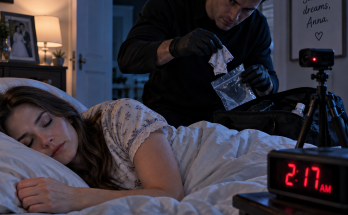
I showed the message to the first officer before he finished introducing himself.
Officer Ramirez was perhaps forty, compact and calm, with the measured voice of someone accustomed to entering rooms after fear had already filled them. His partner, Officer Bell, stood slightly behind him, watching the street through Mr. Peterson’s front window.
Ramirez read the text twice.
“He knows you’re here?”
“Yes.”
“How?”
“I don’t know.”
“Did you tell anyone you were coming over?”
“No.”
“Share your location with him?”
My stomach dropped.
“Our phones.”
“What about them?”
“We share location.”
I had forgotten completely.
Dererick and I had enabled it years ago after I got stranded with a flat tire on a rural road.
Back then it had felt practical.
Intimate, even.
A tiny modern convenience that said we belonged to the same life.
Ramirez nodded.
“Turn it off.”
My thumb hovered over the settings.
Then I stopped.
“If I turn it off, he’ll know I know.”
“He already knows something changed.”
That was difficult to argue with.
I disabled location sharing.
Within seconds, another text arrived.
Why did you turn location off?
Officer Ramirez’s expression hardened.
“Don’t respond yet.”
He asked me to tell the story from the beginning.
Not the beginning of the marriage.
The beginning of tonight.
I described the tea.
Pouring it out.
Pretending to sleep.
The gloves.
The camera.
The samples.
The notebook.
The laptop.
When I reached the folders bearing other women’s names, Bell turned from the window.
“How many?”
“At least three besides me.”
“Names?”
“Jennifer. Patricia. Michelle. I don’t know last names.”
“Photographs?”
“Yes.”
“Sexual?”
I hesitated.
“Some were invasive. Most looked… staged.”
Ramirez kept his face neutral.
“And you copied files?”
I removed the flash drive from my pocket.
“This.”
He did not touch it.
“Keep it for now.”
“I also photographed the notebook.”
I handed him my phone.
He scrolled through several pages.
When he reached the note about preventing unsupervised departure, he looked at his partner.
That small exchange frightened me more than either man reacting openly would have.
“Where is the notebook?” Ramirez asked.
“At my house. In Dererick’s sock drawer.”
“And the laptop?”
“In a briefcase under the bed.”
“Did your husband take the camera?”
“Yes.”
“The black bag?”
“I think so.”
“Do you know what substance he used?”
“No.”
“You should be medically evaluated.”
“I will.”
He asked if I felt dizzy.
No.
Nauseated?
Only from fear.
Any injuries I could identify?
Nothing new.
Ramirez wrote everything down.
Then Mr. Peterson produced his calendar.
The officer’s pen stopped.
“What’s this plate number?”
“Partial,” Mr. Peterson said. “I couldn’t see one character.”
“You witnessed this personally?”
“Yes.”
“Date accurate?”
“Should be within a day. I wrote it that morning.”
Bell photographed the page.
Ramirez asked Mr. Peterson to recount exactly what he had observed.
The white van.
The two men.
The unannounced entrance.
The large duffel.
The bright bedroom light.
By the time he finished, the kitchen felt less like a neighbor’s home and more like an interview room.
Ramirez stepped into the hall to make a call.
Bell remained with us.
My phone rang again.
Dererick.
No one moved.
It rang until voicemail.
Then another message.
You’re scaring me. Please answer.
I felt a bitter laugh rise in my throat.
He was scaring me.
That wording sounded almost elegant in its cruelty.
Bell saw my expression.
“What?”
I handed him the phone.
He read it.
“Do you normally ignore each other’s calls?”
“No.”
“Will that be unusual to him?”
“Yes.”
“Then he knows something is wrong.”
“I know.”
Bell looked toward Ramirez in the hallway.
A minute later, Ramirez returned.
“We need to preserve the house.”
“What does that mean?”
“Based on what you’ve described, we don’t want anyone disturbing potential evidence.”
“Can you search it?”
“Not the whole place just because you asked.”
“It’s my house.”
“It’s also his residence. We can enter under certain circumstances, but a full evidentiary search may require authorization beyond your consent depending on areas exclusively used by him.”
My frustration flashed.
“The laptop is under my bed.”
“That helps.”
“The notebook is in our dresser.”
“That helps too.”
He kept his tone even.
“What we don’t want is to go charging through the house and create a problem with evidence later.”
I understood that intellectually.
Emotionally, I wanted every floorboard ripped open before Dererick could return.
Ramirez asked me for Dererick’s full name, date of birth and employer.
I gave them.
Then Bell said, “Was he actually scheduled to fly to Chicago?”
“I don’t know.”
“You said he told you that.”
“Yes.”
“Do you know whether he packed a suitcase?”
I thought back.
Dererick had taken his standard rolling case from the closet earlier that evening.
“I saw it downstairs.”
“Did he carry it out when he left?”
I closed my eyes.
“I didn’t see him leave. I heard the door and the car.”
Bell looked at Ramirez.
“So Chicago may be cover.”
“Could be.”
My phone buzzed.
This message contained no gentle concern.
Go home, Anna.
I showed it to the officers.
Ramirez immediately photographed the screen.
Then another message arrived.
We can talk before this gets worse.
The room went very still.
Mr. Peterson muttered something under his breath.
Ramirez said, “Do not reply.”
“He knows.”
“Yes.”
“Knows what?”
“That you discovered something.”
My legs felt weak.
“What if he comes back?”
“That’s why you are not going home alone.”
Ramirez made another call.
This time he stayed in the kitchen and spoke quietly but clearly enough for me to hear fragments.
Possible poisoning.
Covert recording.
Multiple potential victims.
Preserve digital evidence.
His language converted my private terror into categories.
Each category made it more real.
Within twenty minutes, an unmarked sedan arrived.
Two detectives came inside.
Detective Lena Shaw introduced herself first. She was tall, dark-haired, perhaps in her late forties, dressed in a charcoal coat over plain clothes.
Her partner, Detective Owen Price, carried a slim folder and spoke little.
Shaw asked to hear the story again.
I wanted to scream that I had already said it.
Instead I told her.
She interrupted more often than the patrol officers had.
“What kind of gloves?”
“Latex or nitrile. Light colored.”
“What side of the bed?”
“Mine.”
“What kind of camera?”
“Compact digital. Black.”
“Tripod?”
“Yes.”
“How high?”
“Maybe eight inches.”
“Did he touch your mouth?”
“No.”
“Eyes?”
“No.”
“Genitals?”
My throat closed.
“I don’t know on other nights.”
She waited.
I forced myself to continue.
“I was unconscious.”
Shaw’s face remained still.
“Understood.”
She asked about the other women.
I described the deterioration visible in their photographs.
“Did any appear deceased?”
“No.”
“Injured?”
“Not obviously.”
“Restrained?”
“I don’t remember restraints.”
“Any file suggesting where they lived?”
“I didn’t look.”
Shaw nodded.
“You did the right thing by copying what you could without staying longer.”
The sentence nearly broke me.
Not because it comforted me.
Because it was the first time anyone had acknowledged that I had been in danger inside my own bedroom.
Price asked for the flash drive.
This time they took it.
He placed it into an evidence envelope while I watched.
Shaw turned to Ramirez.
“Let’s do a protective sweep first, then freeze the residence.”
I looked at her.
“Can I come?”
“No.”
“I know where everything is.”
“You can tell us.”
“I need clothes.”
“We’ll arrange that later.”
The certainty in her voice ended the argument.
They crossed the street together.
I watched from behind Mr. Peterson’s curtain.
Two patrol officers took the front.
Ramirez and Bell went around the side.
Shaw and Price remained near the porch.
One officer knocked.
“Police!”
Nothing.
Again.
“Police!”
Still nothing.
My house looked empty.
But I had spent the night learning how unreliable appearances could be.
After several minutes, the officers entered.
I could not see how.
Mr. Peterson stood beside me.
Neither of us spoke.
The minutes became unbearable.
Five.
Seven.
Ten.
Then one of the officers emerged and spoke to Shaw.
She immediately entered the house.
Something had happened.
“What is it?” I said.
Mr. Peterson had no answer.
My phone buzzed again.
I looked down.
Dererick had sent a photograph.
At first I could not understand what I was seeing.
Then I recognized the room.
Mr. Peterson’s kitchen.
The image showed me standing by the window.
It had been taken from across the street.
My blood turned cold.
The timestamp was less than one minute old.
I dropped the phone onto the table.
“He’s here.”
Bell, who had remained behind now that the detectives were inside, crossed the kitchen in two strides.
“What?”
I pointed at the screen.
He looked.
His hand went immediately to his radio.
Within seconds officers were moving outside.
Lights came on around the block.
A patrol car accelerated toward the corner.
Mr. Peterson backed away from the window.
I could not move.
If the image had been taken from my house, the officers would have seen whoever was there.
Unless it came from a camera.
A hidden one.
Bell seemed to reach the same conclusion.
“Stay away from windows.”
We moved into the hall.
Two minutes later Shaw called Bell.
He listened.
His expression changed.
“What?” I demanded when the call ended.
He hesitated.
“They found a camera.”
“Where?”
“Inside your house.”
“Pointed here?”
“Yes.”
I felt sick.
Dererick had installed surveillance aimed through our front window toward Mr. Peterson’s property.
He had not needed to be nearby.
He had been watching remotely.
“Is that all they found?”
Bell did not answer immediately.
My stomach tightened.
“What else?”
He glanced toward the front door.
“Detective Shaw will explain.”
“Tell me.”
His jaw set.
“They found a concealed compartment in your bedroom.”
I stared at him.
“What compartment?”
“Behind the baseboard inside the closet.”
“I didn’t know there was one.”
“I figured.”
“What was inside?”
Bell looked uncomfortable.
Then he said, “Medication.”
My breathing stopped.
“How much?”
“A lot.”
“What kind?”
“They’re identifying it.”
“Anything else?”
He looked at me for a long moment.
“Yes.”
“What?”
“Several identification cards.”
“Whose?”
“They’re not yours.”
The hallway blurred slightly.
“Jennifer?”
“I don’t know.”
“Patricia?”
“Anna—”
“Michelle?”
“They’re checking.”
I grabbed the wall.
The names in the folders were no longer simply labels on photographs.
Their identification had been hidden inside my house.
And whatever Dererick had done to them had ended with pieces of their lives concealed less than twenty feet from where I slept.
Click here to continue reading: PART 7: The Women in Dererick’s Files Were Real, and One Identification Card Connected Him to a Disappearance Nobody Had Solved
The Night I Poured Out My Husband’s Tea and Waited to Learn What He Expected Me Never to See
Part 6 of 24