Mr. Peterson opened his front door before I reached the second step.
He stood behind the storm door in a red flannel robe with a ceramic mug in one hand, gray hair flattened on one side as if he had only recently gotten out of bed. His eyes moved over my jeans, sweater, bare face, and the purse clutched against my ribs.
“Anna?”
I glanced over my shoulder at our house.
No headlights.
No movement behind the curtains.
“Can I come in?”
Whatever he saw in my expression made him put the mug down without asking another question.
He unlocked the storm door.
“Of course.”
Warm air and the smell of burnt coffee met me in the entryway.
Mr. Peterson closed the door behind us, then turned the dead bolt.
I noticed that.
He had known me for four years. We had exchanged packages, borrowed tools, argued pleasantly about where the property line disappeared beneath the hedge, and waved at one another hundreds of times.
I had never seen him lock the door during daylight.
“It’s a little early for social visiting,” he said quietly. “So I’m guessing this isn’t that.”
“No.”
He led me into his kitchen.
The room looked exactly as I expected it to: yellow overhead light, newspapers stacked beside the refrigerator, a radio turned low near the sink. A half-completed crossword lay beside his coffee.
He pulled out a chair.
“Sit down.”
I remained standing.
“If Dererick comes home, can you see our driveway from here?”
Mr. Peterson’s face changed.
Not confusion.
Recognition.
“Yes.”
“How well?”
“Very.”
My stomach tightened.
“You watch it?”
“I watch the street.”
He said it defensively, then seemed to decide defense was unnecessary.
“I don’t sleep much. You know that.”
I did.
After his wife, Marlene, died, Mr. Peterson’s routines had shifted into strange hours. Porch lights at three in the morning. Snow shoveled before sunrise. Garbage bins brought in before the collection truck reached the next block.
I sat down.
He lowered himself into the chair opposite me.
“What happened?”
I tried to begin with something reasonable.
I failed.
“I think Dererick has been drugging me.”
Mr. Peterson did not move.
I continued before courage disappeared.
“I know how that sounds.”
“It sounds like something you wouldn’t say unless you had a reason.”
“He puts something in my tea. I pretended to drink it tonight.”
Mr. Peterson’s hand flattened on the table.
“What happened after?”
I looked at the newspaper instead of him.
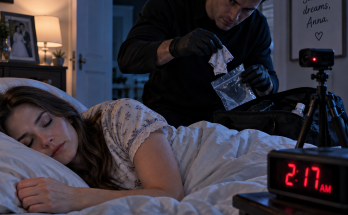
“He waited until he thought I was unconscious. He wore gloves. He took pictures of me.”
A long silence followed.
“Pictures?”
“And samples.”
“What kind of samples?”
“I don’t know. Swabs. A piece of my clothes.”
His jaw tightened.
“He had a camera?”
“Yes.”
“And you were awake?”
“Yes.”
“Did he hurt you?”
“I don’t know.”
The answer surprised both of us.
I looked down at my hands.
“I mean, not tonight. I don’t think. But I found records.”
Mr. Peterson leaned forward.
“What records?”
I told him about the laptop.
Not everything.
I could not yet make myself describe all the photographs or the notes about dosage. But I told him there were folders with women’s names, messages from customers, and entries that suggested Dererick had been doing this for months.
Mr. Peterson sat back slowly.
“Jesus.”
“There was a notebook.”
“Where?”
“At home.”
“You left it there?”
“I photographed it.”
“Good.”
He said that immediately, decisively.
It steadied me.
I pulled out my phone.
Mr. Peterson looked through the first several photographs in silence.
The light from the screen sharpened the lines around his mouth.
When he reached the page that read Do not allow unsupervised departure, he stopped.
“This was written about you?”
“Yes.”
He enlarged the image.
“And this ‘accelerate timeline’ business?”
“I don’t know what it means.”
“That’s not an answer you need to find out alone.”
His voice had changed.
He no longer sounded like my slightly nosy neighbor.
He sounded like a man who had made a decision.
“We’re calling the police.”
“I was going to.”
“Good.”
“But I need to ask you something first.”
He looked at me.
“About Dererick.”
Mr. Peterson set my phone down carefully.
“What about him?”
“You’re awake at night.”
“Usually.”
“Have you seen him leave our house late?”
His eyes went toward the window.
That tiny movement told me the answer before he spoke.
“Yes.”
My skin went cold.
“How often?”
“I don’t know exactly.”
“Guess.”
Mr. Peterson rubbed one thumb against the rim of his mug.
“Once or twice a week. Sometimes more.”
My breath stalled.
“For how long?”
He frowned as he thought.
“Months.”
“How many?”
“Anna, I couldn’t swear to dates.”
“I’m not asking you to swear. Just tell me.”
He glanced at the ceiling.
“Maybe nine months. Ten.”
My mind returned to the oldest photographs in my folder.
Eight months.
Dererick had been leaving late before he began documenting me.
“Where did he go?”
“I have no idea.”
“Did he always take his car?”
“No.”
That word made me look up sharply.
“What?”
“Sometimes someone picked him up.”
I gripped the edge of the table.
“What kind of car?”
“Different ones.”
“Different people?”
“I couldn’t see who was driving.”
“Men? Women?”
“Mostly couldn’t tell.”
He paused.
“One person was a woman.”
My thoughts scattered.
“How do you know?”
“She got out once.”
“When?”
“Couple months ago.”
“Can you describe her?”
Mr. Peterson closed his eyes briefly.
“Forties, maybe. Dark coat. Shoulder-length hair. She stood by the curb and smoked while she waited.”
“Did Dererick know her?”
“He came out and hugged her.”
Not a romantic hug, he clarified.
Brief.
Familiar.
Then they both got into the car.
“What color?”
“Car?”
“Yes.”
“Silver. Maybe gray.”
“Make?”
“I’m sorry. Cars aren’t my thing.”
I pressed my fingers against my temple.
Someone else.
A woman.
A participant?
A customer?
One of the women from the folders?
“What else?”
Mr. Peterson looked uncomfortable.
“There’s more.”
My stomach tightened.
“Tell me.”
“Sometimes he carried things.”
“The black bag?”
“What black bag?”
I described it.
He shook his head.
“No. Bigger.”
“How big?”
He spread his hands.
“Duffel. Dark color. Long.”
“What was in it?”
“No idea.”
“Was it heavy?”
“Looked like it.”
I swallowed.
“How heavy?”
“Anna.”
“Please.”
He thought.
“He carried it with both hands a couple times.”
Every ugly possibility arrived at once.
I forced them away.
“Did he ever bring it back?”
“Sometimes.”
“Sometimes?”
“One night he left with one and came back without it.”
The kitchen seemed to contract around me.
“When?”
Mr. Peterson stood and walked toward a wall calendar near the refrigerator.
Most of the squares contained little handwritten notes.
Dental appointment.
Garbage pickup.
Call Jim.
He flipped backward two months.
Then three.
“I might have written it down.”
“Why?”
“Because there were people outside.”
“What people?”
“Two men.”
He continued flipping.
“I thought something was wrong.”
My heart began pounding.
“What did you see?”
“Dererick came out around one-thirty. Maybe two. There was a van.”
“What kind?”
“White cargo van.”
“Did you get the plate?”
“Part of it.”
I stared at him.
“You wrote it down?”
“I told you, I thought something was wrong.”
He ran a finger over a calendar page.
“Here.”
He lifted the calendar from its hook and placed it in front of me.
In one square, beneath a note about a plumber, he had written:
White van. 3KJ? 718. D + 2 men. 1:48 a.m.
My pulse jumped.
“Can I take a picture?”
“Take the calendar.”
“I don’t want to—”
“Take it.”
I photographed the page anyway.
“What happened?”
Mr. Peterson sat down again.
“The van parked without lights.”
“Across from our house?”
“Two houses down.”
“Then?”
“One man went to your door.”
“Front door?”
“Yes.”
“Did he knock?”
“No.”
The room fell silent.
“How did he get in?”
“I assumed Dererick let him in.”
“You saw that?”
“No. I saw the man go to the porch. A minute later he wasn’t there.”
My skin prickled.
“Then Dererick came out?”
“Maybe twenty minutes later.”
“With the duffel?”
“Yes.”
“And the two men?”
“One walked with him. The other was already near the van.”
“What happened to the bag?”
“They loaded it.”
“Into the van.”
“Yes.”
I could barely hear my next question.
“Was I home?”
Mr. Peterson’s face tightened.
“I believe so.”
A wave of nausea rolled through me.
“Why?”
“Your car was there.”
“That doesn’t prove anything.”
“No.”
“Did you see me?”
“No.”
I stood and paced to the sink.
For months, I had thought the danger came after tea.
Now I could not stop imagining strangers entering my house while I lay unconscious upstairs.
Maybe customers had not merely received photographs.
Maybe permanent access was not a future plan.
Maybe it had already happened in some form.
I braced both hands against the counter.
Mr. Peterson gave me space.
After a moment he said, “There’s something else.”
I laughed once without humor.
“Of course there is.”
He ignored the remark.
“The night with the van, your bedroom light came on.”
I turned.
“What?”
“Not the regular lamp. Brighter.”
“The camera?”
“I don’t know. Your curtains glowed.”
“For how long?”
“Twenty minutes. Maybe half an hour.”
“And you didn’t call anyone?”
Regret crossed his face.
“I thought you were awake.”
The anger came fast and unfair.
“You saw strange men enter my house at two in the morning.”
“I saw one man go to your porch and Dererick later carrying a bag. I had no reason then to think—”
He stopped.
“I’m sorry.”
The anger vanished as quickly as it arrived.
He had been a neighbor looking across a quiet suburban street.
I had been the wife sleeping inside that house.
Neither of us had understood what we were seeing.
I sat again.
Mr. Peterson pushed his phone toward me.
“Call.”
I dialed 911.
The dispatcher answered almost immediately.
I gave my name.
My address.
Then I heard myself say, “My husband has been drugging me, and I have evidence he may be doing it to other women.”
The sentence changed everything.
It made the night official.
The dispatcher asked whether Dererick was present.
“No.”
Whether I was injured.
“I don’t know.”
Whether I was safe where I was.
I looked at Mr. Peterson.
“For the moment.”
She told me officers were being sent.
Then came a question I had not expected.
“Do you know where your husband is now?”
“He said he was going to Chicago.”
“Do you know his flight information?”
“No.”
“Vehicle?”
I gave the make, model, color and plate.
The dispatcher asked me to remain inside.
I agreed.
After the call ended, Mr. Peterson locked the back door too.
We waited.
Five minutes passed.
Then ten.
Every vehicle sound made my shoulders tighten.
At 4:11, headlights entered the street.
I moved away from the window.
Mr. Peterson approached carefully.
“Police.”
Two patrol cars stopped in front of his house without sirens.
Relief hit me hard enough to make my knees weak.
Then my phone vibrated.
Dererick again.
This time it was not a message.
He was calling.
I stared at his name on the screen.
Mr. Peterson looked at me.
“Don’t answer.”
The phone stopped.
Three seconds later, it rang again.
My skin went cold.
Police officers were walking toward the front door.
The call stopped.
A text appeared.
Anna, why are you at Peterson’s?
I looked across the street.
Our house was dark.
No one stood outside.
No car was parked nearby.
Dererick was supposed to be miles away.
Yet somehow, at that exact moment, he knew precisely where I was.
Click here to continue reading: PART 6: Dererick’s Message Proved He Was Watching Me Remotely, but the Police Found Something Worse Hidden Inside Our House
The Night I Poured Out My Husband’s Tea and Waited to Learn What He Expected Me Never to See
Part 5 of 24