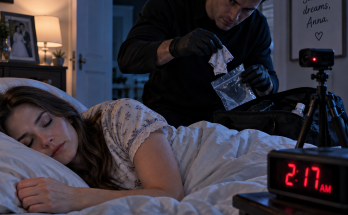
I copied the message containing my name before I read anything else.
The flash drive suddenly felt absurdly small for the weight I was asking it to carry.
I saved the client communications.
Then the dosage files.
Then the photographs that showed Dererick’s gloved hands.
I copied samples of Jennifer’s, Patricia’s and Michelle’s folders too, choosing files with dates and notes attached.
Every few seconds I looked toward the doorway.
The house remained silent.
Dererick had said Chicago.
Three days.
I repeated that to myself.
Three days.
Yet nothing he had told me felt reliable anymore.
He could have been sitting in his car two streets away.
He could have been watching the house through a camera I did not know existed.
I disconnected the laptop from Wi-Fi.
Only after doing it did I realize how instinctive the choice had been.
If the computer synchronized activity somewhere, perhaps he could see that it had been opened.
I had no idea.
I was a designer, not a forensic investigator.
So I stopped exploring anything that was not essential.
Documents first.
Evidence.
Then get out.
The flash drive filled rapidly.
I found a second one inside the briefcase and hesitated before using it.
If Dererick noticed it missing, he would know someone had opened the case.
I left it where it was.
Instead, I copied additional files to cloud storage through my phone, taking photographs of the screen when transfers were too large.
It was clumsy.
But I needed the evidence to exist somewhere he could not destroy simply by taking my computer.
The more I documented, the uglier the structure became.
Dererick had categories.
Dates.
Payments.
Customer aliases.
Women’s names.
Observations about how long substances seemed to affect them.
My own entries began months before the symptoms I had noticed.
Early notes described small amounts.
Later ones recorded changes.
The quantities had increased gradually.
That explained why I had not realized immediately.
He had not begun by knocking me unconscious.
He had taught my body—and my expectations—to accept increasingly unnatural nights as normal.
A memory surfaced.
Six months earlier, I had awakened on a Saturday morning and joked that I had slept like the dead.
Dererick had laughed.
“Guess my tea works.”
I pressed both hands over my face.
How many warnings had sounded harmless because I loved the person saying them?
I returned to the search results for my name.
Near the bottom was a directory titled CURRENT.
Inside it were several notes created within the last two weeks.
The first contained measurements.
Weight.
Sleep duration.
Reaction time.
Physical observations.
My husband had been studying me.
One line mentioned confusion episodes.
Another noted increasing suspicion.
I leaned closer.
Increasing suspicion.
He knew.
Maybe not that I had discovered the truth, but he had noticed the questions.
My refusals of tea.
The evening I went to bed early.
Changes in my routine.
Dererick had been monitoring me while I monitored him.
The next entry made my chest tighten.
Subject becoming inconsistent with ingestion.
I read it again.
He had realized I was sometimes avoiding the tea.
Below that:
May need accelerated schedule.
A date appeared beside the note.
Yesterday.
I stood so abruptly that the laptop nearly slid from my knees.
Accelerated.
The client message had said final phase.
Whatever Dererick intended was not weeks or months away.
He had already decided to move faster because I was suspicious.
I checked the front windows.
The street outside was empty.
Mr. Peterson’s porch across the road was dark.
A delivery van sat three houses down where someone had left it overnight.
Nothing moved.
I locked the front door.
Then the back.
Then I returned upstairs.
The briefcase remained open on the carpet.
I considered taking everything.
Laptop.
External hard drive.
Papers.
But that would announce what I had done.
If Dererick came home before police acted, he would immediately know.
The thought forced me to confront the question I had been avoiding.
Why was I still here?
I had proof now.
Enough to take to someone.
I should leave.
Clare’s apartment was twenty minutes away.
A police station was closer.
I could put the laptop back, take my flash drive, walk to the car and never enter this house alone again.
I closed the computer.
Then stopped.
The notebook.
Dererick had taken it with him.
Or so I had assumed.
I pictured him packing the black bag.
Camera.
Samples.
Notebook.
I remembered him carrying the bag downstairs.
But later, when his car left, had I actually seen the bag?
No.
Only the headlights.
If he had gone directly to the airport or a client, he would probably have taken everything.
Still, a line from the bedroom scene kept returning to me.
He had written in the notebook after the session.
Then he had closed it and placed it near the bag.
I could not remember seeing it go inside.
Maybe fear had blurred the detail.
Maybe not.
I searched his bedside table.
Nothing.
Dresser drawers.
Nothing.
Bathroom cabinet.
Nothing.
Then I opened the sock drawer.
The notebook was underneath a row of neatly folded black dress socks.
I froze.
He had left it.
Perhaps deliberately.
Perhaps he maintained several notebooks.
This one was dark blue, about the size of my palm.
I recognized a faint scratch on the cover from the bedroom.
Same one.
My fingers trembled as I opened it.
The first pages contained dates and initials.
Numbers filled the margins.
Later pages were clearer.
My name appeared repeatedly.
Tea.
Time.
Amount.
Response.
The clinical neatness of the entries made my skin crawl.
He had recorded how quickly I became drowsy.
How long I remained unresponsive.
Whether I remembered events the next morning.
One note mentioned the call to Clare.
He knew about it.
He had apparently seen me use my phone while impaired.
Another note recorded bruising.
Minor visible marking. Explain as nocturnal movement.
I stopped breathing for a moment.
He had not merely suggested sleepwalking because it occurred to him later.
He had written the explanation in advance.
My husband had created symptoms and prepared stories to explain them.
I photographed the page.
Then another.
And another.
Farther into the notebook, names matched the laptop folders.
Jennifer.
Patricia.
Michelle.
Codes appeared beside each one.
Some were crossed out.
I did not know what the marks meant.
The later pages focused increasingly on me.
One entry said customers were asking about extended availability.
Another mentioned permanent arrangements.
A third used the phrase Graduation candidate.
I felt my stomach turn.
There was no definition.
No explicit description of what happened at graduation.
But I had seen Jennifer’s final photographs.
I had seen how ill she looked.
And then her folder simply stopped.
The final note about me had been written before tonight.
Suspicion increasing. Accelerate timeline if necessary.
Beneath it Dererick had added another sentence.
Do not allow unsupervised departure.
I stared at those words until they blurred.
Unsupervised departure.
He was considering the possibility that I might leave.
And apparently he intended to prevent it.
My phone was still beside me.
I picked it up.
For a moment I thought about calling Clare.
Then I remembered her schedule.
She was working overnight at the hospital.
That meant she might not answer immediately.
Police.
I should call the police.
But before I could dial, something outside caught my attention.
A light.
I went to the bedroom window and moved one curtain aside by less than an inch.
Across the street, Mr. Peterson’s kitchen was illuminated.
He was awake.
Our elderly neighbor kept strange hours. Since his wife died, he sometimes sat on the porch before dawn drinking coffee no matter the weather.
And he watched everything.
Dererick used to joke about it.
“If a squirrel sneezes on this block, Peterson files a report.”
Suddenly the joke seemed useful.
If Dererick had been leaving our house at two or three in the morning for months, Mr. Peterson might have seen him.
He might have noticed cars.
Visitors.
Anything.
I photographed every remaining page that mentioned me or the other women.
Then I carefully returned the notebook beneath the socks.
I shut the drawer.
The laptop went back into the briefcase exactly as I had found it.
I wiped the outside with the hem of an old shirt, though I had no idea whether fingerprints mattered when I lived in the same house.
The combination locks clicked shut.
I pushed the case back beneath the bed until it disappeared into shadow.
My flash drive went into the waistband pocket of my pajama pants.
I changed my top because the missing piece at the hem suddenly felt like a flag announcing that I knew.
Jeans.
Sweater.
Shoes.
Phone.
Keys.
I stood at the top of the stairs listening.
Nothing.
Downstairs, the tea mug still sat near the sink.
I looked at it.
A few hours ago, that cup had represented my suspicion.
Now it looked like evidence.
I put it inside a clean food-storage bag without washing it again and placed it in my purse.
Then I stopped myself.
Taking the mug would be noticeable.
I returned it to the counter.
Photographed it instead.
My thoughts were finally becoming clearer.
Leave the house looking normal.
Take what could not be replaced: copies, photographs, the truth.
I unlocked the front door.
Cool predawn air touched my face.
The street was quiet enough that I could hear a sprinkler running somewhere behind the neighboring houses.
Mr. Peterson’s kitchen light remained on.
I stepped outside.
Then my phone vibrated.
I nearly screamed.
A message appeared on the screen.
Dererick.
Hope you’re sleeping well. Flight got moved around. Plans may change. I’ll call you soon.
I read it twice.
Plans may change.
Three days in Chicago suddenly meant nothing.
I looked toward the empty street, then back at our house.
If Dererick returned unexpectedly and found me gone, I did not know what he would do.
But after reading the notebook, I knew what would happen if I stayed alone.
I crossed the street toward Mr. Peterson’s house.
For the first time that night, I was going to tell another person what my husband had done.
And I was going to find out whether Dererick’s secret life had been visible from outside our home all along.
Click here to continue reading: PART 5: Mr. Peterson Had Been Watching Our Street for Months, and What He Saw Made Dererick’s Late-Night Trips Far More Dangerous
The Night I Poured Out My Husband’s Tea and Waited to Learn What He Expected Me Never to See
Part 4 of 24