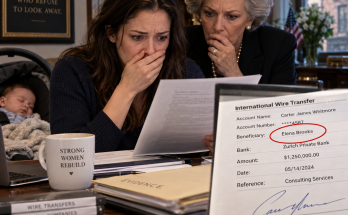
The photograph from Lakeview Federal showed Dad with his head tilted toward one shoulder.
Even in a grainy image, I could tell he wasn’t alert.
Mom stood behind the wheelchair.
Amanda stood at the counter.
I couldn’t look at it for long.
“What was his medical condition that day?” Hale asked.
“Unconscious.”
“Continuously?”
“As far as I remember.”
Dad suffered the stroke on Tuesday evening.
By Wednesday morning, doctors told us brain damage was extensive.
He never meaningfully regained consciousness.
He died Thursday night.
The credit union photograph was timestamped Wednesday afternoon.
“How did they get him out of the hospital?”
That question became the center of everything.
I called Ruth.
She remembered Mom saying doctors had taken Dad for additional imaging that afternoon.
I had been in Raleigh recovering from Lily’s birth.
Amanda had supposedly stayed at the hospital.
Nobody questioned either of them.
Hale obtained Dad’s hospital records with authorization from the estate.
There was no imaging appointment.
There was, however, a four-hour discharge against medical advice.
Signed by Patricia Bennett.
I felt sick.
Mom had removed a critically ill man from the hospital, driven him to a bank, emptied his account, then returned him.
“Could that have harmed him?”
I asked the question reluctantly.
Hale refused to speculate.
“We need physicians to review the records.”
I appreciated the answer.
I did not want anger turning uncertainty into accusation.
Detective Ortiz was equally careful.
“The financial evidence is substantial. What effect the trip had medically is a separate question.”
She asked whether I wanted to view the full security footage.
“Yes.”
“You don’t have to.”
“I know.”
Hale’s office arranged a secure viewing.
I watched alone.
Mom pushed Dad through the credit union doors.
Amanda walked beside them carrying a document folder.
Dad’s head moved with the wheelchair.
Not voluntarily.
At the counter, an employee leaned toward him and appeared to ask something.
Mom answered.
The employee looked uncertain.
Amanda handed over paperwork.
Then another employee approached.
There was a discussion.
Mom became animated.
Amanda pointed repeatedly toward Dad.
Eventually a manager arrived.
He examined the power of attorney.
The transaction proceeded.
Dad never lifted his head.
I paused the video.
For years, Mom told everyone she had never left Dad’s bedside during his final days.
Technically, perhaps that was true.
She had taken the bedside with her.
The account contained $164,220.
But the closing cashier’s check was only $139,220.
Twenty-five thousand dollars was missing.
Hale noticed immediately.
“Where did it go?”
The credit union records showed a transfer executed that morning, several hours before Mom and Amanda arrived.
Destination:
North Valley Trust.
Dad’s trust for me.
Someone had moved $25,000 out before they could take it.
“Dad couldn’t have done it that morning.”
“No.”
“Who had authority?”
Hale checked.
Three people had limited access.
Dad.
His attorney Samuel Pike.
And Ruth.
I stared at him.
“Ruth?”
I called her.
She answered on the first ring.
“I wondered when you’d find that.”
“You moved twenty-five thousand dollars.”
“Yes.”
“Why didn’t you tell me?”
“Because I failed to save the rest.”
I closed my eyes.
“Ruth.”
“Thomas called me Tuesday afternoon before the stroke.”
Dad had learned Mom was searching for the Lakeview account.
He asked Ruth to move as much as possible if anything happened to him.
The credit union imposed a daily transfer limit.
Twenty-five thousand.
Ruth initiated it Wednesday morning.
She intended another transfer Thursday.
By then the account was gone.
“I thought I’d protected it,” she said. “Then North Valley was emptied too.”
“Why stay quiet?”
“Because Elaine told me you had voluntarily changed the trust beneficiary.”
“You believed her?”
“For a while.”
The shame in her voice was real.
Then Ruth began suspecting the documents.
But Dad was dead.
Mom controlled his records.
Amanda insisted I had willingly helped her.
And I never mentioned missing money because I didn’t know any existed.
“It was a perfect lie,” Ruth said. “Everyone who knew one piece thought someone else knew the rest.”
That sentence explained the architecture of the deception.
Compartmentalization.
Elaine knew the forged paperwork but not every family conversation.
Ruth knew about Dad’s concerns but believed I had made later choices.
Hale saw certified documents and assumed family consent.
I knew almost nothing.
Mom and Amanda stood at the center, controlling what each person believed.
“Where did the twenty-five thousand go after North Valley?”
Hale traced it.
When the trust was emptied, the entire balance—including Ruth’s transfer—went to the account Mom opened in my name.
Then it vanished through the same thirty-one withdrawals.
Nothing had escaped.
Not then.
By Tuesday afternoon, investigators had enough records that the financial timeline stretched across more than a decade.
Hale warned me that recovering money would be complicated.
Some claims might face limitation issues.
Some assets could be traced.
Some might not.
I wasn’t thinking about recovery yet.
I was thinking about how many deliberate acts had been required.
This wasn’t one terrible decision.
It was hundreds.
Forms completed.
Signatures copied.
Phone calls made.
Stories rehearsed.
Documents hidden.
Every step gave someone an opportunity to stop.
They continued.
At three, Ortiz called.
Mom had been located.
She was sitting in a bus station thirty miles away with a suitcase.
“Was she leaving?”
“She purchased a ticket to Chicago.”
“Why Chicago?”
“She won’t say.”
“Is she under arrest?”
Ortiz paused.
“Yes.”
The word didn’t give me satisfaction.
Mostly, I felt tired.
“What about Amanda?”
“Also in custody pending charging decisions.”
I looked toward the yard where Noah and Lily were building a crooked snowman with Ruth.
“Do the kids need to know?”
“That’s your decision.”
I told them simply that Grandma and Aunt Amanda were staying somewhere else while adults sorted out serious problems.
Noah understood more.
Lily asked whether Grandma had a bed.
“Yes.”
“Is it warm?”
I swallowed.
“Yes.”
She nodded.
“Good.”
Five-year-olds could offer mercy without surrendering truth.
That evening, Elaine’s attorney contacted Hale.
Elaine wanted to provide additional documents.
Among them was a notebook she had kept privately.
It contained dates, transaction amounts and instructions Mom gave her.
“Why keep evidence of your own crimes?” I asked.
“Insurance,” Hale said.
The same reason Amanda kept Dad’s file.
Everyone in that circle trusted everyone else so little that they preserved evidence against one another.
Elaine’s notebook confirmed the college-fund transfer.
The false power of attorney.
The estate waiver.
The fake account.
The North Valley distribution.
But one entry surprised us.
Three years earlier:
Patricia asks about Claire house deed. Refused.
My house.
I called Elaine with attorneys present.
“What does that mean?”
Mom had asked whether Elaine could help prepare documents allowing her to borrow against my house.
“She wanted a loan?”
“Against your equity.”
“How much?”
“One hundred thousand.”
“Why?”
“Amanda wanted to start a business.”
I laughed once in disbelief.
“What business?”
“A boutique.”
Amanda had talked about opening a boutique.
I remembered Mom telling me to be more supportive.
“Why did you refuse?”
“Because by then I was scared.”
“Not because it was wrong?”
Elaine didn’t answer.
At least she didn’t pretend.
Mom had apparently obtained a copy of my deed but never succeeded in borrowing against the property.
I added a property fraud alert through the county.
Then I checked everything else I could think of.
Titles.
Insurance.
Tax records.
Nothing obvious.
That should have reassured me.
It didn’t.
The next morning, Hale called before breakfast.
“We found where some of the Lakeview money went.”
After closing Dad’s account, Mom deposited $139,220 into a brokerage account.
Within two months, $75,000 went toward Amanda’s house.
That overlapped with the life-insurance funds.
“Wait.”
I sat upright.
“You told me the down payment was seventy-five thousand from the insurance.”
“That’s what the initial bank records suggested.”
“So there were two seventy-five-thousand-dollar transfers?”
“Yes.”
“What happened to the second?”
“That’s the question.”
The house had cost $146,000.
Amanda purchased it without a mortgage.
The entire property had effectively been bought with money connected to Dad.
One transfer from the life insurance.
One from the Lakeview account.
My father had tried to leave those funds to me.
Instead, they bought my sister a house.
The deed remained in Amanda’s name.
Hale explained that tracing those funds could matter in civil proceedings.
I looked around the rental.
Temporary furniture.
Temporary beds.
My sister had slept for years inside an asset purchased from money stolen from me while telling my children they didn’t deserve her family’s guest room.
The symmetry was almost too ugly to contemplate.
Later that morning, Aunt Ruth handed me another folder.
“I found these at home.”
They were letters Dad wrote but never mailed.
Most were addressed to me.
One concerned Amanda’s house.
Dad had discovered plans to use his life insurance and hidden account.
He wrote:
If they use what I intended for Claire to buy Amanda another rescue, I want the house traced.
He had anticipated it.
“Why didn’t he stop them?”
Ruth looked at me.
“He was trying.”
That answer no longer comforted me.
Trying mattered.
So did failing.
I could love Dad and still recognize that earlier truth would have protected me better than secret repairs.
Another letter contained something different.
A list of assets.
Dad had identified a small cabin near Lake Erie.
I knew it.
We had visited twice when I was young.
Mom told us it belonged to a family friend.
According to Dad, it belonged to him.
More precisely, it belonged jointly to Dad and me.
I stared at the page.
“I’ve never owned a cabin.”
Ruth looked confused.
“Thomas put your name on it when you were eighteen.”
“Why?”
“It was supposed to be yours eventually.”
Hale searched county property records.
The cabin existed.
The deed once listed Thomas Bennett and Claire Bennett.
Then, twelve years earlier, my name disappeared.
A quitclaim deed transferred my interest to Patricia Bennett.
My signature appeared at the bottom.
I had never signed it.
The notary was not Elaine.
For the first time, another name entered the story.
Marjorie Reynolds.
Amanda’s former mother-in-law.
Mark’s mother.
I called Ortiz.
She went quiet when I read the name.
“Mark mentioned his mother yesterday.”
“In connection with what?”
“He said Amanda learned how to imitate your signature from Patricia, but Patricia learned how to move property from Marjorie.”
The fraud network had begun earlier than Elaine admitted.
And the cabin was still owned by Mom.
Current estimated value:
$318,000.
I stared at the number.
Mom had been preparing to flee with more than a suitcase.
Between Heritage Atlantic and the cabin, she controlled over six hundred thousand dollars in assets.
She had never needed my money.
Then Hale found the sale listing.
The cabin had been placed on the market nine days earlier.
Before Thanksgiving.
Before the sleeping bags.
Before I canceled Pine Ridge.
Mom had already accepted an offer.
Closing was scheduled for Friday.
I looked at the date.
Three days away.
Mom hadn’t begun preparing for consequences after I left her house.
She had begun moving assets before I ever arrived.
Which meant something had frightened her before Friday night.
Something had told her that after five years of silence, Dad’s secrets might finally surface.
Click here to continue reading: PART 11: The Cabin Sale Proved Patricia Expected Trouble Before Thanksgiving, and a Forgotten Package Explained Why She Needed Claire Distracted That Weekend
Two Sleeping Bags on a Frozen Den Floor Forced Claire to Decide What Her Children Would Learn About Family
Part 10 of 24