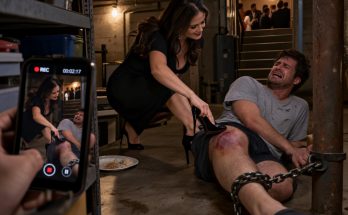
By six that evening, my house smelled like roast beef, onions, coffee, and the pie June Benson insisted on bringing even after I told her dessert was handled.
“It wasn’t handled correctly,” she said.
I did not argue with a woman who had survived Irving Palmer as an in-law.
Harold carried the pie.
June carried opinions.
Both seemed healthier than they had during the trial.
Frank and Laura arrived together.
That alone would have seemed impossible a year earlier.
They were still repairing what eleven years of separation had damaged.
Laura lived in St. Louis now.
Frank complained that it was too far away.
She reminded him he had once gone eleven years without knowing her address.
He stopped complaining for almost four minutes.
Denise came next.
Marcus brought enough food for twenty people.
Dr. Patel arrived late because hospitals do not care about dinner plans.
Emily came quietly.
She had flown in that afternoon.
Her presence changed the room for a moment.
She resembled Sabrina around the eyes.
Wyatt noticed too.
Neither mentioned it.
Emily hugged June and Harold.
Then she shook my hand.
“Thank you for inviting me.”
“Wyatt invited you.”
She looked toward him.
“I know.”
There was history in the room that did not belong to all of us equally.
We respected that.
Nobody invited reporters.
Nobody posted photographs.
Nobody called the evening an anniversary party.
At midnight there would be fireworks outside.
That was unavoidable.
But inside, we intended something quieter.
Dinner.
Stories.
Ordinary conversation.
The kind of evening Irving had used as cover while Wyatt sat beneath his own house in chains.
I wondered whether that memory would ruin New Year’s Eve forever.
Wyatt seemed determined not to let it.
He argued with Marcus about football.
Asked Laura whether Frank had always been impossible.
She said yes.
Frank objected.
Nobody supported him.
Dr. Patel asked Wyatt about his exercises.
He tried changing the subject.
She did not allow it.
For a while, I stood in the kitchen doorway and watched.
A year earlier, every person in that room existed separately.
Frank and Denise were names from different chapters of my life.
Marcus was a trusted mechanic and friend.
Laura was a missing daughter I did not know was connected to Eleanor.
Emily was supposedly dead.
Harold and June were grieving grandparents.
Dr. Patel had not yet entered our lives.
Wyatt was beneath a house.
I was driving toward him.
Families are not always built by blood.
Sometimes they form around the people who show up when leaving would be easier.
At dinner, nobody made speeches.
That was my rule.
Marcus violated it first.
He lifted his glass.
“I’m not making a speech.”
“That’s how speeches start,” I said.
He ignored me.
“To Wyatt.”
Wyatt groaned.
“Marcus.”
“To walking.”
That silenced him.
Marcus continued.
“And to stubborn old men who know secret doors.”
Frank raised his glass.
“I’ll drink to that.”
Everyone did.
Wyatt looked at me.
“His ego was already bad.”
“Correct.”
We ate.
Later, Emily asked whether she could see Eleanor’s training-center photograph.
Wyatt showed her on his phone.
“She looks kind,” Emily said.
“She was.”
“You miss her?”
“Every day.”
Emily nodded.
“I miss my mother differently.”
Nobody needed her to explain.
Margaret had loved both daughters from inside a life controlled by fear.
She had made mistakes.
Kept secrets.
Staged one daughter’s death to save her.
Failed to save the other from Irving’s influence.
Then left evidence behind.
Her love had not been clean.
But it had kept moving.
Around ten, Harold and June left.
Emily went with them.
Dr. Patel left soon afterward.
Denise and Marcus followed.
Laura hugged me at the door.
“Eleanor would have liked tonight.”
“She would have criticized the roast.”
“Probably.”
Frank remained another half hour before Laura ordered him home.
Then it was only Wyatt and me.
The house became quiet.
Dishes filled the sink.
I started washing.
Wyatt dried.
It was something we had done when he was a boy.
He still stacked plates badly.
Some injuries cannot be rehabilitated.
At 11:20, he said, “Do you still have the text?”
I knew which one.
“Yes.”
“Why?”
“I don’t delete much.”
“That’s not true.”
“Fine.”
I dried my hands.
“I kept it.”
“Can I see?”
I opened my phone.
The message remained.
Dad, don’t come.
Four words.
I had read them hundreds of times afterward.
Police copied them.
Prosecutors displayed them.
Reporters quoted them.
But the text still belonged to Wyatt and me before it belonged to the case.
I handed him the phone.
He stared.
“I barely remember sending it.”
“You told me that.”
“I remember thinking about it.”
“What were you thinking?”
He leaned against the counter.
“Irving had gone upstairs.”
“Sabrina?”
“Still downstairs.”
I listened.
“She left her phone on the table.”
That detail had never mattered to the criminal case.
“She went into the storage room for something. I could reach the table if I pulled the chain as far as it would go.”
I pictured him.
Injured knee.
Drugged.
Dragging himself toward a phone.
“I got it.”
“How long?”
“Maybe thirty seconds.”
“What did you want to write?”
He laughed once.
“A lot.”
“What?”
“Call police. Sabrina did this. Irving broke my knee. I’m downstairs.”
“Why didn’t you?”
“Because if they saw the message, they’d know I told you.”
“So you warned me away.”
“Yes.”
He stared at the screen.
“I thought if I wrote something strange enough, you’d know.”
“I did.”
“I didn’t know if you would.”
“That’s insulting.”
“I was drugged.”
“Accepted.”
He smiled.
Then his face became serious.
“I wanted you not to come.”
“I know.”
“But I wanted you to understand.”
“I know.”
“No.”
He looked at me.
“I don’t think I ever said it right.”
I waited.
“I wanted you to stay safe.”
His voice lowered.
“And I wanted you to come anyway.”
There it was.
The contradiction I had understood without language.
A son warning his father away because danger was real.
A son hoping his father knew him well enough to hear what the words could not say.
“I was ashamed of that for a while.”
“Why?”
“Because I put you in danger.”
“You didn’t.”
“I sent the message.”
“You told me not to come.”
“You knew I meant something else.”
“Yes.”
“So I did bring you.”
I shook my head.
“No.”
He frowned.
“I came because I’m your father.”
“That doesn’t mean you had to.”
“Yes, it does.”
He looked toward the dark window.
“That sounds unhealthy.”
“Probably.”
That made him laugh.
Then I said, “You know what I heard when I read it?”
“What?”
“Not the words.”
“What then?”
“You.”
He became quiet.
“You never wrote like that.”
“No.”
“You would have said you were busy. Or sick. Or Sabrina changed plans.”
“Probably.”
“Four words with a period.”
“I was under pressure.”
“You hate periods in texts.”
He smiled.
“Mom used to complain.”
“She said your messages looked like ransom notes.”
“That’s unfortunate in retrospect.”
I laughed harder than I expected.
So did he.
For a few seconds, the basement lost its authority over the memory.
Then Wyatt said, “When you found me, I thought I was hallucinating.”
“You looked at me like you didn’t recognize me.”
“I did recognize you.”
“Then what?”
“I couldn’t believe you were actually there.”
I remembered reaching through the darkness.
His face bruised.
His leg ruined.
The chain between us.
“I thought they’d kill you.”
“I thought so too.”
“You never said that.”
“You never asked.”
“Were you scared?”
“Terrified.”
“You didn’t look terrified.”
“I was busy.”
That answer seemed to satisfy him.
At 11:45, we moved to the living room.
No television.
No countdown show.
The old clock on the mantel kept time.
Wyatt sat carefully.
His knee still disliked low chairs.
“You know what I hate most?” he asked.
“What?”
“People telling me it made me stronger.”
I nodded.
“It didn’t.”
He looked surprised.
“You agree?”
“You were strong before.”
He rubbed his knee.
“It damaged you.”
“Yes.”
“You survived it.”
“Yes.”
“Those aren’t the same thing.”
He stared at me for a long moment.
“Patel says that.”
“She’s smart.”
“Don’t tell her.”
“I intend to.”
He threw a cushion at me.
Missed.
“Your aim hasn’t recovered.”
“My knee was injured.”
“Excuses.”
Outside, early fireworks began.
Wyatt flinched at the first loud crack.
Small movement.
Almost invisible.
I noticed.
He noticed me noticing.
“I’m okay.”
“I didn’t say anything.”
“You made a face.”
“This is my face.”
Another firework exploded.
This time he breathed through it.
Trauma did not end because a jury returned guilty verdicts.
It did not obey anniversaries.
It did not care that the story was supposed to be finished.
But it changed.
The basement was no longer happening now.
That distinction had taken Wyatt months to feel.
At 11:53, my phone buzzed.
For one terrible fraction of a second, both of us looked at it.
Then Wyatt laughed.
“Still gets you.”
“Yes.”
It was Frank.
Happy New Year, old man. Don’t do anything stupid.
I showed Wyatt.
“He knows you badly.”
“Very.”
I replied.
Same to you.
Wyatt said, “Period?”
“Of course.”
“Mom would be proud.”
The clock moved toward midnight.
We did not count down.
At twelve, fireworks spread across the sky.
White.
Gold.
Red.
The sound rolled through the neighborhood.
A year earlier, fireworks had exploded while police surrounded Wyatt’s house.
Upstairs, guests had been cheering.
Downstairs, we were fighting to keep him alive.
Now there were no chains.
No signatures.
No syringes.
No men waiting with drills.
Just my living room.
Two glasses of coffee.
A sink full of dishes.
My son sitting beside me.
Peace is unimpressive until you have lived without it.
Wyatt watched the window.
Then said, “Thank you.”
“For dinner?”
“For ignoring my text.”
I looked at him.
“I didn’t ignore it.”
He smiled slightly.
“You definitely came.”
“I understood it.”
His expression changed.
I continued.
“A son who tells his father not to come because he’s in danger isn’t asking to be abandoned.”
Wyatt looked down.
“He’s hoping?”
“He’s hoping his father comes anyway.”
His eyes filled.
Mine probably did too.
Neither of us mentioned it.
Wyatt stood.
Slowly.
No cane.
I stood with him.
He hugged me.
Not carefully.
Not the cautious hospital embrace where everyone feared touching his injuries.
A real one.
I held my son.
Outside, another year began.
Inside, the worst one finally ended.
Heartland would continue.
Or someday it would change.
Wyatt might remain president.
Or eventually leave.
Jefferson would remain property, not destiny.
Money would return to being a tool instead of a measure of who mattered.
Margaret’s evidence had survived.
Emily had survived.
Laura had come home.
Frank had his daughter again.
Harold and June had answers.
Sabrina would live with the consequences of what she chose.
Irving and Randall would live with theirs.
And Wyatt would carry scars that no verdict could remove.
But scars were not chains.
That difference mattered.
A few minutes after midnight, Wyatt stepped onto the porch.
Cold air entered behind him.
I followed.
He stood at the top of the steps watching fireworks fade over the neighborhood.
“You cold?”
“Yes.”
“Then go inside.”
“In a minute.”
I stood beside him.
His weight rested slightly more on one leg.
Probably always would.
He noticed me looking.
“Don’t.”
“I didn’t say anything.”
“You were about to.”
“No.”
“You were going to ask if my knee hurt.”
“Does it?”
“Yes.”
“Then I was right.”
He shook his head.
We stayed outside until the final fireworks became distant.
Then Wyatt walked down the steps.
One.
Two.
Three.
He reached the driveway.
Turned.
For an instant, I saw every version of him at once.
The eight-year-old lost at the county fair.
The young man learning Heartland.
The husband who wanted to believe his marriage was safe.
The prisoner dragging a chain toward a stolen phone.
The patient learning to stand.
The witness walking toward a courtroom with a cane.
The man standing before me now.
“You coming?” he asked.
That almost made me laugh.
A year ago, he had told me not to.
This time there was only one possible answer.
“Right behind you.”
He waited anyway.
Then we walked back toward the house together.
The End
Read more original stories on Feel Every Story.
My Son’s Four-Word Warning Arrived Before Midnight, and Everything About It Told Me He Was Already in Trouble
Part 20 of 20