The trial began nine months later.
By then, Wyatt could walk with a cane.
Not far.
Not quickly.
But he walked.
Dr. Patel had performed two additional procedures after the hospital attack. Physical therapy followed. Then more therapy. Then the maddening work of teaching damaged muscles to trust weight again.
The first time he crossed his apartment without assistance, he called me.
He did not say hello.
“Twenty-one steps.”
I knew exactly what he meant.
“That all?”
He cursed at me.
Then laughed.
The laugh mattered more than the steps.
The criminal cases had been separated in places and consolidated in others.
Gerald Pike pleaded guilty to conspiracy, obstruction, evidence tampering, and fraud-related charges after federal investigators confronted him with Randall’s archive.
Marissa Vale accepted a cooperation agreement.
Evan Pike pleaded to multiple offenses.
Daniel Reeves admitted bribery and conspiracy.
Judge Voss resigned before federal charges were announced.
Peter Lang and several others became subjects of a broader corruption prosecution.
Stephen Randall negotiated nothing resembling the immunity he originally wanted.
Margaret Palmer’s murder became its own case.
But the prosecution of Irving and Sabrina for what happened to Wyatt remained the center.
Sabrina eventually pleaded guilty to several charges.
Not all.
Her cooperation reduced what prosecutors sought, but it did not erase the kidnapping, drugs, restraint, fraud, or her participation in the plan to stage Wyatt’s death.
Irving refused every offer.
He wanted a jury.
Maybe he still believed he could explain everything.
Men who spend decades controlling stories sometimes mistake that ability for control over truth.
Wyatt attended opening statements.
I sat behind prosecutors.
Irving entered wearing a dark suit.
He looked smaller without his house, his employees, his files, and frightened people surrounding him.
Then he saw Wyatt.
His expression changed.
Only for a second.
Wyatt noticed.
“He thought I’d look worse,” he whispered later.
“You disappointed him.”
“Good.”
The prosecutor began simply.
“This case is about a signature.”
Then she showed the jury Wyatt’s forged documents.
“A signature the defendant believed was worth more than a human life.”
No theatrical shouting.
No exaggeration.
The evidence did not need decoration.
Caleb testified first among the major witnesses.
He admitted his theft from Heartland before the defense could expose it.
He admitted gambling.
Blackmail.
Giving Irving confidential information.
Signing the Meridian transfer without seeing Wyatt.
The defense attacked his credibility.
“You are a thief.”
“Yes.”
“A liar.”
“Yes.”
“You betrayed your employer.”
“Yes.”
“And now you want this jury to trust you.”
Caleb looked toward me.
Then Wyatt.
“No.”
The attorney frowned.
“No?”
“I want them to verify me.”
That was exactly what investigators had done.
Records confirmed his account.
Messages.
Payments.
Access logs.
The 911 call he abandoned.
Irving’s threat.
Caleb did not ask the jury to believe his character.
He asked them to compare his testimony with evidence.
That made him stronger.
Victor testified next.
The defense attacked his omissions.
His old work with Irving.
His private investigation.
His failure to contact police quickly enough.
Victor accepted every failure.
Then prosecutors played the recording where Irving asked what happened if I died.
Victor’s answer was audible.
He left.
Later recordings showed him warning lenders and refusing fraudulent valuation work.
He had made mistakes.
He had not designed the kidnapping.
That distinction mattered.
Denise testified about the basement.
Her body camera footage was played.
The jury saw the red emergency lighting.
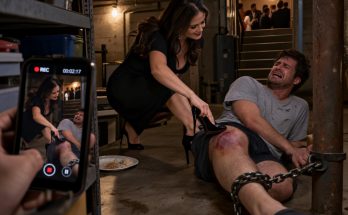
Wyatt chained to the support column.
His swollen leg.
Sabrina.
Irving.
The hired men.
Frank and Marcus entering.
Nobody in the courtroom moved while it played.
I had lived the scene.
Watching it from outside myself was different.
I saw how old I looked.
How frightened Wyatt looked.
How calm Irving remained.
The defense objected repeatedly to portions.
Most objections failed.
Marcus testified about cutting Wyatt free.
He described the condition of the ankle restraint and Wyatt collapsing when he tried to stand.
Then Dr. Patel and Dr. Randall testified about the knee.
The original injury had been deliberate.
Multiple fractures.
Ligament destruction.
Crushed joint surfaces.
Not a fall.
Not an accident.
Not self-inflicted.
The defense suggested the injury occurred during an argument.
Dr. Randall answered with clinical precision.
“This was repeated blunt-force trauma.”
“How can you know?”
“Because bones preserve mechanics.”
That sentence stayed with the jury.
Then came the drugs.
Pharmacy records connected Sabrina to purchases.
Recovered syringes contained sedatives.
Wyatt’s blood samples matched.
The defense tried to suggest Wyatt had substance problems.
The prosecution showed medical concentrations inconsistent with voluntary recreational use.
Then they showed the basement chain.
Actual metal.
Heavy.
Cold.
Bagged as evidence.
The prosecutor did not lift it dramatically.
She simply placed it where the jury could see.
A thing does not need symbolism when it has already been used on a person.
On the fourth week, Sabrina testified.
Her plea agreement required truthfulness.
Irving refused to look at her.
She described the years of manipulation.
Emily.
Margaret.
Jefferson.
The documents.
Then she described Wyatt’s kidnapping.
Her attorney had prepared her.
Still, her voice shook.
“I told him my father had documents downstairs.”
“Did you know Irving was waiting?”
“Yes.”
“Did you know he intended to force Wyatt to sign?”
“Yes.”
“Did you know violence might be used?”
She paused.
“Yes.”
Wyatt stared straight ahead.
The prosecutor continued.
“What happened when Wyatt entered the basement?”
“My father hit him.”
“With what?”
“A sledgehammer.”
“Where?”
“Knee.”
Sabrina cried.
The judge gave her time.
Then she continued.
Wyatt did not look away.
“What did you do?”
“I froze.”
“Afterward?”
“I helped restrain him.”
“Why?”
“I was afraid.”
“Did fear continue for six days?”
Sabrina closed her eyes.
“No.”
That answer mattered.
“When did your conduct become a choice?”
“Before that.”
“Explain.”
“I could have called police.”
“Did you?”
“No.”
“Could you have opened the restraint?”
“Yes.”
“Did you?”
“No.”
“Could you have warned Abraham?”
“Yes.”
“Instead?”
“I sent messages from Wyatt’s phone.”
“To make people believe he was sick?”
“Yes.”
The prosecutor asked the hardest question.
“Did you know your father intended Wyatt to die?”
Sabrina whispered, “Yes.”
“When?”
“Before New Year’s Eve.”
No defense theory could survive that answer intact.
Irving’s lawyer attacked her.
“You want a lighter sentence.”
“Yes.”
“You blame your father.”
“I blame myself too.”
“You were terrified of him.”
“Yes.”
“So your actions were coerced.”
“Some were.”
“Some?”
Sabrina looked directly at Irving for the first time.
“Not enough.”
He stared back.
“You loved your husband?”
“I did.”
“Yet you helped torture him?”
“Yes.”
“Those things cannot both be true.”
Sabrina’s face tightened.
“They were.”
The courtroom became quiet.
Human beings dislike contradictions.
Real life contains them anyway.
Then the prosecutor called me.
I told the jury about Wyatt’s text.
Dad, don’t come.
I described the rejected calls.
The maintenance entrance.
The hidden passage.
The first moment I saw my son chained in his basement.
I did not embellish.
I did not need to.
Then prosecutors played my phone recording.
Irving’s voice filled the courtroom.
Threatening Wyatt’s knee.
Talking about staging an overdose.
Talking about what would happen after midnight.
The defense objected to context.
The judge overruled.
The recording continued.
Irving sat completely still.
For months, his lawyers had described the audio as fragmented.
Ambiguous.
Emotionally charged.
In the courtroom, it sounded like what it was.
A confession spoken before he realized anyone was recording.
The prosecutor asked, “Mr. Yates, why did you enter the basement instead of leaving and calling from a safe location?”
I thought about that.
“Because my son was there.”
“Were you afraid?”
“Yes.”
“Then why continue?”
I looked at Wyatt.
“Fear wasn’t the only thing in the room.”
The prosecutor nodded.
“No further questions.”
The defense tried to make Heartland the motive for my testimony.
“You stand to preserve control of a valuable company if Mr. Palmer is convicted.”
“I controlled it before he was arrested.”
“You dislike him.”
“Yes.”
“You hate him.”
I thought.
“I hate what he did.”
“That wasn’t my question.”
“No.”
The attorney seemed surprised.
“You don’t hate Irving Palmer?”
“I don’t know him well enough anymore to spend that much of myself on him.”
Irving finally looked at me.
I meant it.
Hatred would have kept him inside my life after prison.
I had no intention of giving him that property too.
Then Wyatt testified.
He walked to the witness stand with his cane.
Slowly.
The jury watched every step.
The judge offered additional time.
Wyatt declined.
He described his suspicions.
Victor.
Sabrina’s questions.
The archive access.
The day Sabrina asked him to look at documents downstairs.
Then the hammer.
His voice changed when he reached that moment.
“My knee made a sound before I felt the pain.”
The courtroom was completely silent.
He described waking chained.
The injections.
Thirst.
Confusion.
Sabrina bringing papers.
Irving demanding signatures.
Trying to count time by noises upstairs.
Wondering whether anyone knew he was missing.
Then the prosecutor asked about New Year’s Eve.
“Why did you text your father not to come?”
Wyatt looked at me.
“Because I thought they would kill him.”
“Did you want him to stay away?”
“Yes.”
“Did any part of you hope he would understand something was wrong?”
Wyatt was quiet for several seconds.
“Yes.”
“What did you hope he would do?”
“I didn’t know.”
He swallowed.
“I just didn’t want to be alone down there.”
That sentence hurt more than anything else in the trial.
The prosecutor let the silence remain.
Then asked, “Did your father come?”
Wyatt smiled faintly.
“Yes.”
Irving’s lawyer cross-examined aggressively.
He suggested Wyatt exaggerated.
Suggested marital conflict.
Suggested Sabrina acted under Irving’s domination.
Suggested Wyatt’s memory was unreliable because of drugs.
Wyatt agreed with one thing.
“My memory was unreliable.”
The attorney seized it.
“So you cannot confidently describe every event.”
“No.”
“Then how can this jury rely on your testimony?”
Wyatt looked at him.
“They don’t have to rely only on me.”
He pointed toward the evidence.
“You recorded it.”
That ended the moment.
Closing arguments lasted most of a day.
The defense argued Irving’s words were taken out of context.
That Randall had become the real violent actor.
That Sabrina had reasons to shift blame.
That Wyatt’s drugged memory was imperfect.
That the financial conspiracy had been confused with the basement events.
The prosecution answered with chronology.
Chain.
Hammer.
Sedatives.
Documents.
Messages.
Recordings.
Witnesses.
Whiteboard.
Cleanup plan.
No single piece carried the case.
Together they formed something difficult to escape.
The jury deliberated four hours and forty-three minutes.
We waited in a side room.
Wyatt sat beside me.
“You nervous?”
“Yes.”
“You?”
“Yes.”
“Good talk.”
Frank paced.
Denise read the same page of a magazine for forty minutes.
Marcus drank three coffees.
Then the clerk entered.
“Verdict.”
We returned.
Irving stood.
The foreperson stood.
Guilty.
Kidnapping.
Guilty.
Conspiracy.
Guilty.
Attempted murder.
Guilty.
Fraud.
Guilty.
Coercion.
Guilty.
Count after count.
Unanimous.
Irving’s face changed only once.
When the clerk read the attempted-murder verdict.
He looked toward Sabrina.
She did not look back.
Then he looked toward Wyatt.
Wyatt met his eyes.
No triumph.
No smile.
Just recognition.
The man who expected him to die in a basement was watching him stand in a courtroom.
That was enough.
Outside, reporters crowded the steps.
Wyatt declined to speak.
So did I.
We went to the car.
Before getting in, he stopped.
“What?”
He handed me his cane.
Then walked six steps without it.
Unsteady.
Careful.
Painful.
But upright.
“Show-off,” I said.
He took the cane back.
“Absolutely.”
The verdict did not repair his knee.
It did not return Margaret.
It did not restore Sabrina’s marriage or Emily’s childhood.
It did not erase the basement.
Justice was not restoration.
It was acknowledgment followed by consequence.
For the first time, the law had said publicly what Wyatt already knew.
What happened to him was real.
The people who did it were responsible.
And he had survived long enough to hear the verdict himself.
Click here to continue reading: PART 19: A Year After the Basement, Wyatt Walked Toward My Old Pickup Alone and Decided What Heartland Would Become After Us
My Son’s Four-Word Warning Arrived Before Midnight, and Everything About It Told Me He Was Already in Trouble
Part 18 of 20