At 8:17 on New Year’s Eve, my only son sent me four words that made me put down my coffee and read the message three times.
Dad, don’t come tonight.
Wyatt had never been a dramatic man. He was forty-two, president of Heartland Freight Systems, and had spent most of his adult life solving problems before anyone else realized they existed. When business was bad, he worked. When his marriage became tense, he worked harder. Even after his mother died, he had been the one standing beside me at the funeral asking whether I had eaten. A man like that did not send warnings without a reason.
I typed back, What happened?
The message showed as delivered.
No answer came.
My name is Abraham Yates. I was sixty-eight that winter, though retirement had never fit me particularly well. Forty years around freight terminals and highways had left me with a permanent habit of checking exits, weather reports, mirrors, fuel gauges, and people's faces. My late wife, Eleanor, used to tease me about it. She said I could walk into a restaurant and identify the fire door before noticing the menu.
That evening, the habit stopped feeling foolish.
Wyatt and his wife, Sabrina, were hosting a New Year’s Eve gathering at their home outside Springfield. Fifteen or twenty people were expected: business acquaintances, neighbors, Sabrina’s friends, and several members of her family. I had been invited weeks earlier. Sabrina had even called twice to make certain I planned to attend.
Now Wyatt wanted me nowhere near the place.
I called him.
The phone rang five times before going to voicemail.
“Wyatt, call me.”
I waited thirty seconds and tried again.
Voicemail.
The third time, somebody rejected the call after the second ring.
That changed everything.
A missed call could mean anything. A dead battery could mean anything. Even Wyatt deciding he wanted an evening without his father could have been explained. But somebody had deliberately touched his phone.
I stood, carried my coffee to the sink, and left it there untouched.
Outside, snow from the previous night still covered the fields around my house. The temperature had dropped sharply after sunset, hardening the tire tracks in my driveway into frozen ridges. Fireworks were already appearing above Springfield in scattered bursts of red and white.
I pulled on my winter coat.
Before leaving, I opened the bottom drawer of the desk in my study.
Inside were several things I had not used in years: an old flashlight, spare truck keys, a compact first-aid pouch, and a black pager from another era. Heartland Freight had once maintained a private emergency network after three of our drivers were nearly killed during a cargo hijacking. Most of that system had been retired.
Not all of it.
I slipped the pager into my coat.
Then I hesitated.
There was another reason Wyatt’s message bothered me.
Three months earlier, he had come to my house alone.
He had sat at the kitchen table turning his wedding ring around his finger while pretending we were discussing quarterly fuel costs. After twenty minutes, I had finally asked what was really wrong.
“Sabrina keeps asking about the ownership structure.”
I remembered looking at him over my glasses.
“What ownership structure?”
“Heartland.”
That had caught my attention.
Wyatt had been running the company for years. Most people assumed he owned it outright. I had encouraged that assumption because there was no advantage in explaining private family arrangements to outsiders.
“What exactly does she want to know?”
“She asked whether I can sell without board approval.”
“And?”
“I told her I wasn’t planning to sell.”
“That wasn’t my question.”
Wyatt had smiled faintly.
“No. I didn’t tell her anything else.”
He had then mentioned Sabrina’s father, Irving Palmer. Irving had recently begun discussing investment groups interested in Heartland Freight. Wyatt had dismissed the conversations. Irving had not.
I had warned my son to be careful.
Wyatt had laughed.
“Dad, Sabrina is my wife.”
“I know.”
“You think she’s plotting something?”
“I think people behave differently when they believe enough money is within reach.”
He had disliked that answer.
So had I.
Nothing more came of the conversation, at least nothing Wyatt told me.
Until New Year’s Eve.
I climbed into my old pickup and started toward Springfield.
Halfway there, Wyatt finally called.
I answered before the second ring.
“Wyatt?”
For several seconds, there was only breathing.
Not ordinary breathing.
Labored breathing.
“Son?”
“Dad.”
His voice was barely recognizable.
“What happened?”
“Where are you?”
“Driving.”
“Turn around.”
“Tell me what happened.”
“Please.”
A sound came through the phone.
Metal scraping concrete.
Then Wyatt inhaled sharply as though suppressing pain.
My grip tightened around the steering wheel.
“Are you hurt?”
“No.”
He answered too quickly.
“Wyatt.”
“Dad, listen to me. Don’t come to the house.”
“Is Sabrina there?”
Silence.
“Is Irving there?”
More silence.
Then, very quietly, Wyatt said, “They’re watching.”
The line went dead.
I pulled onto the shoulder.
For several seconds I stared through the windshield while snow blew across the road in thin silver ribbons.
Calling the police immediately would have been the obvious choice.
I nearly did.
Then I remembered Wyatt’s words.
They’re watching.
If someone had control of his phone, they might also be watching the driveway, the security system, or the road approaching the property. A marked police car could turn whatever was happening inside that house into something irreversible before officers reached the door.
I needed information.
And there was one advantage Sabrina and Irving did not know I had.
I knew that house better than either of them.
Twenty-two years earlier, Heartland Freight had quietly purchased the property through one of our holding companies. At the time, I had considered using it as temporary housing for executives and visiting security personnel. I supervised much of the renovation myself.
Later, when Wyatt married Sabrina, arrangements were made for them to live there.
Sabrina believed she knew every room.
She didn't.
I left the highway several miles before their neighborhood and took an old service road running behind a wooded strip bordering the property. I parked near an abandoned equipment shed, switched off the headlights, and walked the remaining distance.
Music reached me before I saw the house.
The party was already underway.
Through the trees, the property looked perfectly normal. Warm light glowed through tall windows. Cars lined the circular drive. People moved behind curtains holding glasses. Someone had strung white lights along the rear terrace.
Nothing about it suggested danger.
That bothered me more.
I stayed near the trees and studied the windows.
At 9:03, Sabrina appeared briefly near the kitchen.
She wore a silver dress.
She was laughing.
A man handed her a champagne flute.
She looked like a woman hosting the happiest party of the year.
Wyatt was nowhere in sight.
I moved toward the western side of the property where an old retaining wall disappeared beneath snow and ivy.
Behind it was a steel maintenance door.
During the original renovation, that passage had allowed technicians to reach the boiler room without crossing the main residence. It had been sealed cosmetically years ago, but the door itself remained.
I brushed snow from the lock.
My old key still fit.
That surprised me.
The hinges resisted at first. I opened the door only wide enough to slip inside, then eased it shut behind me.
Darkness swallowed me.
The air smelled of dust, cold metal, and old concrete.
I switched on my flashlight but kept its beam low.
The narrow passage led toward the mechanical room. Somewhere above me, bass from the party vibrated through the floor.
Then I heard another sound.
A groan.
I froze.
It came again.
Faint.
Human.
I switched off the flashlight.
My eyes adjusted slowly.
The mechanical-room door stood slightly open.
Beyond it was the basement.
I moved closer.
A woman's voice drifted through the gap.
Sabrina.
“You’re making this harder than necessary.”
I stopped breathing.
Another voice answered.
Wyatt.
“I’m not signing anything.”
My hand went automatically toward my phone.
I opened the recorder.
Sabrina spoke again.
“You’ve had almost a week to reconsider.”
A week.
The words hit me with a force I had not expected.
I had spoken to Wyatt five days earlier. Or thought I had. We had exchanged text messages about a freight contract.
Had those messages even been from him?
Something struck concrete.
Wyatt cried out.
I nearly opened the door.
Years on highways had taught me one rule that had kept me alive more than once: do not rush blindly into a situation you do not understand.
So I waited.
Through the narrow opening, I could see part of the basement.
Then Sabrina stepped aside.
And I saw my son.
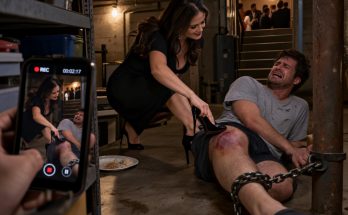
Wyatt was sitting on the floor beside a concrete support pillar.
A heavy chain ran around his waist.
Another restraint held his ankle.
His shirt was stained.
One side of his face was swollen.
And his right knee—
I had to look twice before my mind accepted what I was seeing.
The joint was grotesquely enlarged beneath torn fabric. Purple bruising extended down his leg. A bloodstained towel lay nearby.
Sabrina crouched in front of him.
“You know what happens tonight.”
Wyatt raised his head.
His eyes were unfocused.
“You won’t get away with this.”
“That depends entirely on you.”
She placed a folder on the floor.
Documents.
“Sign.”
“No.”
“Transfer authority over Heartland.”
“No.”
“Then authorize the sale.”
“I can’t.”
Sabrina smiled.
It was not the smile I had seen through the kitchen window.
“You mean you won’t.”
Wyatt shook his head.
“You don’t understand the company.”
“I understand what it’s worth.”
There it was.
Not marriage.
Not love.
Money.
Footsteps sounded on the stairs.
Irving Palmer descended into view.
He carried a syringe.
My stomach turned cold.
“Still resisting?” he asked.
Sabrina stood.
“He thinks his father will save him.”
Irving laughed.
Wyatt looked toward the floor.
“No.”
His voice was almost inaudible.
“I told Dad not to come.”
Irving stepped closer.
“Good.”
He tapped the syringe with one finger.
“Because by morning, Abraham Yates is going to believe his son suffered a tragic overdose after a very public mental breakdown.”
Sabrina glanced toward the ceiling where their guests danced above us.
“The witnesses are already here.”
That was when I understood the party.
It was not a celebration.
It was an alibi being built in real time.
Irving knelt beside my son and pushed the needle into his arm.
Wyatt jerked against the chain.
I tightened my hand around the phone until my knuckles hurt.
Then Irving said something that changed my fear into something colder.
“After midnight, we finish the knee.”
Sabrina looked at Wyatt.
“And if you still won’t cooperate…”
She closed the folder.
“…we finish everything else.”
I had come because my son told me not to.
Now I knew why.
He had not been trying to keep me away from an argument.
He had been trying to keep me away from his murder.
And standing in that dark passage, listening to the people upstairs count the hours toward midnight, I made my decision.
I was not leaving that house without Wyatt.
Click here to continue reading: PART 2: I Reached My Son Through a Hidden Passage, but What He Whispered Revealed Their Plan Had Started Months Earlier
My Son’s Four-Word Warning Arrived Before Midnight, and Everything About It Told Me He Was Already in Trouble
Part 1 of 20