My mother began dividing my father’s belongings before the smell of funeral lilies had faded from the house.
I realized what was happening when I stepped into the dining room and saw three neat piles of documents arranged beside a dented metal box. My brother sat at one end of the table with coffee in my father’s favorite mug. My sister was turning one of our grandmother’s gold bracelets around her wrist, studying how it caught the morning light.
Nobody had called to ask whether I was ready.
“Margaret,” my mother said when she noticed me. “Good. Sit down. We’re nearly finished.”
I stayed beside the doorway with my coat still buttoned. “Nearly finished with what?”
My brother glanced at my sister. It was the briefest exchange, but I caught it. They already knew. Whatever decisions had been made in that room had begun before I arrived.
Mom pushed a chair out with her foot. “Your father’s things. We can’t leave everything unsettled forever.”
Dad had been dead twelve days.
I looked toward the empty chair at the head of the table. His reading glasses were no longer beside the newspaper rack. His slippers had disappeared from beneath the radiator. Even the little wooden bowl where he dropped his keys every evening had been removed.
Someone had already begun erasing him.
“Was there a will?” I asked.
My mother’s mouth tightened. “Your father and I discussed what he wanted.”
That wasn’t an answer.
My brother leaned back. “Do we really need to turn this into a legal proceeding?”
“I asked one question.”
“And Mom answered it.”
“No,” I said. “She didn’t.”
My sister exhaled dramatically. “Margaret, please. We buried Dad less than two weeks ago. Nobody wants an argument.”
That was how things worked in our family. If my brother demanded something, he was being practical. If my sister complained, she was expressing herself. If I asked a question that made anyone uncomfortable, I was starting an argument.
I finally took off my coat and sat.
Mom placed her fingertips on the first folder. “The house will go to your brother.”
I looked across the table.
My brother avoided my eyes.
The house was the largest thing my parents owned—or at least the largest thing I believed they owned. Dad had spent years repairing it himself. He replaced the porch boards one summer, rewired half the upstairs another, and refused to hire anyone to restore the stone fireplace because, as he put it, nobody else would care enough to do the mortar properly.
“You’re giving him the house?” I asked.
“He has a family.”
My brother had a wife and two children. I understood the reasoning before Mom explained it. I had heard variations of it all my life.
He needs more space.
He has responsibilities.
Things are harder for him.
I nodded once. “All right.”
My brother looked surprised by how easily I said it.
Mom moved to the second folder. “Your sister will have the SUV. She needs a dependable vehicle for work.”
My sister smiled faintly.
The SUV was less than two years old.
I remembered Dad bringing it home and joking that he had finally purchased a vehicle with more buttons than he knew how to operate. For months he accidentally turned on the heated steering wheel every time he tried to adjust the radio.
Mom continued. “There are also several savings accounts. Your brother and sister will divide those.”
This time I said nothing.
The silence lasted long enough for my sister to stop touching the bracelet.
Mom looked at me. “Margaret?”
“I’m listening.”
“You understand why, don’t you?”
There it was.
Not whether I agreed.
Whether I understood.
Understanding had been my assigned role since childhood.
When my brother crashed Dad’s car at nineteen, I was expected to understand that he was going through a difficult period.
When my sister needed help with rent after spending her paycheck on a vacation, I was expected to understand.
When I worked weekends through college because my parents said money was tight, I understood that too.
Apparently I had become so good at understanding everyone else that nobody had noticed what it cost me.
“What about Grandma’s jewelry?” I asked.
My sister’s fingers stopped moving.
Mom glanced at the metal box.
“She wanted me to have the bracelets,” my sister said quickly.
“Grandma told you that?”
“She always said I appreciated beautiful things.”
I remembered something different.
Our grandmother had once let me try those bracelets on when I was fifteen. They had slid halfway down my forearms because I was so thin. She had laughed, pushed them back toward my wrists, and told me I would grow into them.
Perhaps that memory meant nothing.
Perhaps I only wanted it to mean something because everything else on the table was moving away from me.
Mom opened the box. Inside lay several pieces of jewelry wrapped in tissue paper.
“The jewelry goes to your sister,” she said.
My brother rubbed his jaw. “There’s Dad’s watch.”
Mom took it out.
I recognized the scratched silver band immediately.
Dad had worn that watch for almost thirty years.
My chest tightened for the first time that morning.
“I’d like that.”
My brother reached for it before Mom could answer.
“I thought I was getting it.”
I stared at him. “You’re getting the house.”
“So?”
“So I asked for one watch.”
His face hardened. “Why are you keeping score?”
I almost laughed.
The man receiving a house was accusing me of keeping score because I had asked for a watch.
Mom intervened. “Your father would want your brother to have it.”
“How do you know?”
Her expression changed.
Not much.
Just enough.
“I knew your father.”
“So did I.”
“Margaret.”
There was a warning in the way she said my name.
I knew that warning too.
Stop.
Make this easy.
Don’t embarrass us.
My brother picked up the watch and fastened it around his wrist.
It hung slightly loose.
I looked away.
For the next half hour, my father’s life disappeared piece by piece.
His tools went to my brother.
His fishing equipment went to my uncle.
My sister claimed a set of antique lamps.
Mom kept the bedroom furniture, dishes, photographs, and most of the personal items.
Nobody asked what I wanted again.
Eventually my mother closed the metal box.
“That should settle everything important.”
Everything important.
I stared at the empty section of table in front of me.
My sister must have noticed because she shifted uncomfortably.
“What does Margaret get?”
Mom looked toward the hallway.
For the first time that morning, she seemed uncertain.
“There is something.”
My brother raised his eyebrows.
Mom stood. “Come with me.”
We followed her through the kitchen, down the narrow back hallway, and into Dad’s old workroom.
The room had barely changed since his death.
Dust lay over the workbench. A coffee can filled with screws stood beside his vise. His faded work jacket still hung from a nail.
For a moment I forgot about the inheritance.
I could almost see him there, bending over some stubborn hinge while an old radio muttered baseball scores in the background.
Then Mom pointed toward the corner.
“There.”
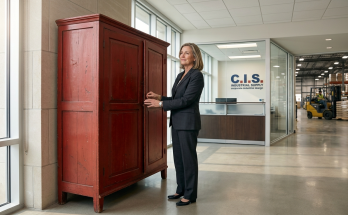
Behind several cardboard boxes stood an old red wardrobe.
I stared at it.
The thing was enormous, heavy, scarred, and probably older than any of us.
Most of the red paint had peeled away. One door sagged. A lower leg had cracked years earlier and Dad had supported it with a brick.
My brother laughed.
“You’re kidding.”
Mom didn’t answer.
My sister stepped around me to get a better look. “That thing?”
“It belonged to your father,” Mom said.
“So did the house,” I replied.
My brother coughed into his hand, trying to hide another laugh.
Mom looked irritated. “You said you didn’t want to argue.”
“I’m not arguing.”
“Then what are you doing?”
I looked at the wardrobe.
“Trying to understand.”
My sister folded her arms. “There’s that word again.”
I turned toward her.
She smiled as though she had made a harmless joke.
Something inside me became very still.
Dad had once told me that anger was expensive. “Before you spend it,” he said, “make sure you’re buying something worthwhile.”
So I didn’t spend mine.
I walked toward the wardrobe instead.
My fingertips brushed the remaining red paint.
A memory surfaced.
I was eight or nine, sitting cross-legged on the workroom floor while Dad repaired one of the doors. He had refused to throw the wardrobe away even after Mom complained that it took up too much room.
“Why keep something this ugly?” I had asked.
Dad had looked offended.
“Ugly?”
“It’s broken.”
“Broken isn’t the same as useless.”
At the time, I had giggled.
Now the memory landed differently.
I opened one door.
The hinges complained.
Inside hung several old shirts and a winter coat I remembered Dad wearing when I was young.
His smell was almost gone.
Almost.
I pressed my fingers against one sleeve.
Behind me, my brother said, “Well, Margaret always liked sentimental stuff.”
My sister added, “At least nobody can accuse Mom of giving her nothing.”
They laughed.
I closed the wardrobe door carefully.
“How am I supposed to move it?”
My mother answered too quickly. “Your uncle can help.”
I turned.
She was watching me strangely.
Not with sympathy.
Not embarrassment.
Something closer to worry.
“Mom?”
“What?”
“You really want me to take this?”
Her eyes moved from me to the wardrobe.
“Yes.”
“Why?”
“Because it was your father’s.”
“So was everything you just divided.”
Her jaw tightened.
“Take it or leave it, Margaret.”
My brother stepped between us. “Come on. Don’t make Mom feel guilty.”
I looked at him.
The expensive watch on his wrist caught the light.
“I wouldn’t dream of it.”
He frowned, unsure whether I meant what I said.
I pulled my phone from my pocket and called my uncle.
While I waited for him, I wandered through Dad’s workroom.
On the wall above the bench were pale rectangles where tools had already been removed. A row of nails remained, useless and empty.
That was when I noticed something unusual.
The floor around the wardrobe had been swept recently.
Everywhere else, dust had collected along the walls.
Not there.
I crouched.
Fresh scrape marks ran across the concrete beneath one side, as though somebody had moved the wardrobe and pushed it back.
“Did someone search this room?” I asked.
My mother appeared in the doorway.
“No.”
“You’re sure?”
“Why would anyone search it?”
I touched one of the scrape marks.
“I don’t know.”
Her eyes followed my hand.
Then she looked away.
My uncle arrived twenty minutes later with moving straps and the resigned expression of a man who had been recruited for a job nobody else wanted.
He examined the wardrobe.
“This old monster?”
“You remember it?”
He gave me a strange look. “Of course.”
“Dad ever tell you why he kept it?”
My uncle opened his mouth.
Mom interrupted from behind us.
“It was his father’s. That’s all.”
My uncle glanced at her.
Another look.
Another small silence.
By then I had noticed too many of them.
My brother’s certainty about the house.
My sister already wearing Grandma’s bracelet.
Mom’s refusal to answer whether there was a will.
The freshly moved wardrobe.
My uncle suddenly deciding not to speak.
Maybe grief was making me suspicious.
Or maybe I had spent my whole life being told not to notice things.
My uncle and I tipped the wardrobe carefully onto a furniture dolly.
Something shifted inside.
A dull knock came from near the bottom.
I stopped.
“What was that?”
“Probably junk,” my brother said.
I bent toward the lowest drawer.
It had no visible handle, only a small brass keyhole darkened with age.
I tried pulling it with my fingertips.
Locked.
Behind me, a cup struck the floor.
It shattered.
We all turned.
My mother stood in the doorway staring directly at my hand.
And for the first time since my father died, she looked frightened.