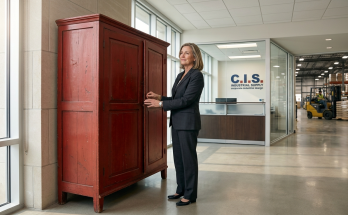
The wardrobe arrived at Collins Industrial Supply eleven months after I took it from Mom’s house.
The restoration specialist had argued with me twice.
“You understand the red paint will still look worn?”
“Yes.”
“There are sections where the wood shows through.”
“I know.”
“We could match the original color.”
“No.”
“The surface won’t look new.”
“That’s the point.”
He finally stopped trying to save me from my own taste.
The damaged leg was repaired.
The loose hinge moved smoothly.
The false bottom remained intact.
The hidden compartment behind the mirror remained too.
I kept nothing valuable inside either one.
Dad had taught me enough about hidden records.
The wardrobe went into the entrance hall outside my office.
Not behind glass.
Not on a pedestal.
Against a wall where people passed every day.
Some employees thought it was beautiful.
Others thought it was strange.
One new manager asked why the owner of a multimillion-dollar company had a battered red wardrobe outside her office.
I said, “Long story.”
That was an understatement.
Collins Industrial Supply had survived the year.
Not unchanged.
We replaced several Northbridge contracts.
Strengthened financial controls.
Disabled every ancient credential that should have vanished decades earlier.
No single executive could alter certain payment records without secondary approval.
Priya insisted.
I agreed.
Dad’s habit had been trust first, controls later.
Mine would be trust and controls at the same time.
Bennett’s problems continued without my daily attention.
That was important.
His firm had separated from him after its internal investigation.
Civil claims proceeded.
Authorities received relevant records through the appropriate channels.
Northbridge’s structure unraveled under scrutiny.
Eric cooperated more extensively than I expected.
David did too.
I stopped measuring my life by whether any of them suffered enough.
That would have kept me tied to them.
Dad had asked for truth.
We had provided it.
What followed belonged to courts, lawyers, regulators, contracts, and consequences.
My job was the company.
My family.
Myself.
Samuel came by once a week at first.
Then every two weeks.
Eventually he started complaining that I called him too rarely.
“I thought lawyers charged for phone calls.”
“We do.”
“Then you should be pleased.”
“I’m offended professionally.”
He still kept Dad’s photograph in his office.
I still sometimes forgot Dad was dead until I saw it.
Grief had become quieter.
Not smaller.
Just less demanding.
Mom remained in the house.
Her Sunday calls continued.
Sometimes we talked for forty minutes.
Sometimes four.
She no longer began conversations by asking whether Thomas or Sarah needed something.
That small change took months for me to notice.
When I finally did, I cried afterward.
Thomas visited the company on a rainy Thursday.
He did not call first.
My assistant appeared at the door.
“Your brother is here.”
“Does he look dangerous?”
She blinked.
“I’m joking.”
“Oh.”
“I need to work on that.”
Thomas walked in carrying a black notebook.
He looked healthier.
Not richer.
Healthier.
His sales job had become permanent.
He had been promoted once.
He still complained about his manager.
Apparently adulthood did not eliminate everything.
He stopped when he saw the wardrobe.
For a long moment he simply stared.
“You put it here.”
“Yes.”
“Why?”
“Where would you put it?”
“Garbage collection.”
I gave him a look.
He smiled.
“Kidding.”
“Mostly.”
“Mostly.”
He walked over and touched the repaired leg.
“They fixed it.”
“Yes.”
“But left the paint.”
“I asked them to.”
He ran his fingers across a scar in the wood.
“I remember making this.”
“What?”
He pointed.
A narrow gouge near the bottom.
“I hit it with my bike when I was ten.”
“You never told Dad?”
“No.”
“Coward.”
“Absolutely.”
He laughed.
Then his expression softened.
“Dad knew.”
“What?”
“He saw me do it.”
“How do you know?”
“He made me sand the splinter so nobody got cut.”
That sounded like Dad.
“He didn’t punish you?”
“He said the scratch would remind me not to ride a bike in the house.”
“Effective?”
“No.”
We laughed.
Thomas opened his black notebook.
“I brought something.”
“What?”
He handed it to me.
Inside were dates and amounts.
Repayments.
Every one.
Some to the estate.
Some to the trust.
One toward losses associated with the company information he had provided.
The amounts varied.
Some small.
Some larger after good commission months.
“You don’t have to show me this.”
“I know.”
“Then why?”
“Because I wanted someone to know I’m doing it.”
I looked at him.
“Someone or me?”
He thought.
“You.”
“Why?”
He looked toward the wardrobe.
“Because you were the one I expected to give everything up.”
My chest tightened.
“I didn’t realize it at the time.”
“I know.”
“When Mom said the house was mine, part of me knew something was wrong.”
I said nothing.
“I knew Dad wouldn’t do that without paperwork.”
“But you accepted it.”
“Yes.”
“Why?”
“Because I wanted it.”
The answer was simple.
Human.
Ugly.
True.
“I thought you’d get something later.”
“The wardrobe.”
“No.”
He shook his head.
“I knew about the shares.”
“Some of them.”
“Yes.”
“And you decided that made the house fair.”
“Yes.”
I appreciated that he did not hide behind Mom.
“I was angry that Dad trusted you.”
“Why?”
“Because you didn’t even want what I had spent my whole life trying to get.”
“His company?”
“His approval.”
That stopped me.
Thomas sat.
“I kept thinking if I had the right business, made enough money, owned the right house, Dad would look at me the way he looked at you.”
“How did he look at me?”
“Like he didn’t have to worry what you’d do when he turned his back.”
I looked away.
“That doesn’t mean he loved me more.”
“I know that now.”
“Did you know then?”
“No.”
He smiled sadly.
“I thought trust was favoritism.”
“And I thought rescue was favoritism.”
Thomas stared.
Then laughed.
“We were both idiots.”
“Speak for yourself.”
He laughed harder.
I joined him.
When it passed, he looked at the wardrobe again.
“I really thought this was worthless.”
“I know.”
“We all did.”
“Dad didn’t.”
“You didn’t either.”
“I didn’t know what it was worth.”
“You took it anyway.”
That was true.
Why?
Because it was Dad’s.
Because he had touched it.
Because everyone else had already claimed the shiny things.
Because somewhere inside me, the child who watched Dad repair broken furniture still believed old things deserved to be carried home.
Thomas walked to the wardrobe and opened the door.
Empty.
“Nothing inside?”
“Not anymore.”
“No secret company?”
“I already have one.”
“No gold?”
“Sarah would be furious.”
He smiled.
“No hidden property deed?”
“Please don’t give Dad ideas retroactively.”
Thomas closed the door.
“I brought something else.”
He reached into his pocket.
Dad’s silver watch.
I stared.
“You took it from Mom?”
“No. I left it there after the first meeting.”
“I noticed.”
“I couldn’t wear it.”
“Why?”
“It felt stolen.”
The word hung between us.
“Dad didn’t specify the watch in the will,” I said.
“I know.”
“Samuel says personal items can be distributed by agreement.”
“I know.”
Thomas placed it on my desk.
“I want you to have it.”
Old Margaret would have refused instantly.
No, you keep it.
You’re his son.
It means more to you.
I almost heard the words.
Instead I picked up the watch.
The leather band was worn.
Dad had scratched the crystal years ago.
I remembered seeing his wrist resting on the steering wheel.
His hand pointing toward tools.
His fingers tapping impatiently during family dinners.
“I want it.”
Thomas nodded.
“I know.”
That sentence felt different now.
Not accusation.
Permission.
I put the watch beside my computer.
“Thank you.”
He sat again.
“You know what’s weird?”
“What?”
“I’m happier in my rental than I was in Mom’s house.”
“Why?”
“Because when the rent gets paid, I paid it.”
I smiled.
“That sounds expensive.”
“It’s terrible.”
“Welcome.”
He laughed.
Before leaving, Thomas stopped at the doorway.
“Margaret.”
“Yes?”
“I’m sorry.”
“For what specifically?”
“All of it.”
“That’s broad.”
“I have a broad history.”
I smiled.
He continued.
“I’m sorry I let you be the easy one.”
My throat tightened.
“I’m sorry I thought you didn’t need anything because you didn’t ask.”
That sounded like Mom.
Dad.
Everyone.
“I’m learning to ask.”
“Good.”
He nodded toward the wardrobe.
“Dad knew what he was doing.”
“Sometimes.”
“You think he got things wrong?”
“Of course.”
Thomas seemed surprised.
“He watched this family pattern for years before stopping it.”
“That’s true.”
“He hid things instead of talking.”
“Also true.”
“He protected us so much we didn’t know what we needed protection from.”
Thomas nodded.
“And he still left you all this.”
I looked around the office.
“He left me responsibility.”
“That sounds like something you’d say to avoid admitting you’re rich.”
I laughed.
“Probably.”
Thomas opened the door.
Then looked back at the wardrobe.
“You know the house is worth a lot less than that thing now.”
“The wardrobe?”
“Yes.”
“Financially, it’s worth almost nothing.”
“That’s not what I mean.”
“I know.”
He left.
That evening, after everyone else went home, I sat alone outside my office.
The warehouse was quiet.
The wardrobe stood beneath the soft hallway lights.
I opened the bottom drawer.
The brass key still worked.
Inside I had placed one thing.
Dad’s black notebook.
Not the evidence copy.
The original.
I opened to the page where he had written about me.
Margaret works without asking.
For years I might have read that as praise.
Now I understood the warning inside it.
I closed the notebook.
Tomorrow I would call Mom if I needed her.
I would ask Sarah for help with the family dinner.
I would let my team solve problems without taking them back.
I would tell Samuel when I was overwhelmed.
I would not turn strength into another locked drawer.
I slid the notebook inside.
Closed it.
Turned the key.
Then I went home.