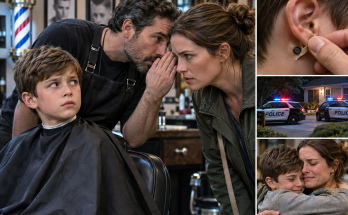
The morning I went to court, Wesley asked whether I was going somewhere important.
I was standing in the kitchen wearing a dark jacket.
Rachel had arrived early to take him to school.
“Yes.”
“Is it about the man?”
“It is.”
He looked at my shoes.
“Will you be home for dinner?”
“I expect so.”
He nodded.
Then he picked up his backpack.
I hugged him before he left.
Rachel waited until he was outside before speaking.
“You ready?”
“As ready as I'm going to be.”
She squeezed my hand.
I watched them leave.
Then I picked up my purse and drove to the courthouse.
Several months had passed since the haircut.
The weather had changed.
Wesley's hair had grown over his ears again and been trimmed more than once.
Our lives had gradually returned to their familiar shape.
But the legal proceedings had continued in the background.
There had been meetings.
Documents.
Telephone calls.
Dates that changed.
Questions that needed answering.
Eventually, both Martin and Gregory entered guilty pleas to charges arising from the investigations.
The precise legal arrangements differed according to their respective roles.
The prosecutor had explained everything to me beforehand.
There would be no lengthy trial requiring Wesley to describe his encounter in front of a courtroom.
I was grateful for that.
What remained was sentencing.
I arrived early.
Detective Morris was waiting near the courtroom entrance.
She greeted me warmly.
“How's Wesley?”
“Doing better.”
“I'm glad.”
She introduced me to a member of the victim support team.
The woman explained where I would sit and when I might be invited to speak.
I thanked her.
Then I entered the courtroom.
Martin was already there.
I recognized him immediately.
He looked older than I remembered.
His shoulders seemed narrower.
His hair had thinned.
For a moment, I saw the man who had stood beside Daniel's grave.
Then I remembered his voicemail.
The suggestion that Daniel's illness had made him unreliable.
I sat down without acknowledging him.
Gregory was seated separately.
I had seen photographs of him during the investigation.
Seeing him in person was different.
This was the man Wesley had trusted because he claimed to know his father.
This was the man who had approached my child near school.
I looked away.
I didn't want my attention fixed on either of them.
The proceedings began.
The prosecutor described the financial arrangements that Daniel had first questioned years earlier.
There were payments supported by misleading invoices.
Services that hadn't been properly verified.
Business relationships that had concealed where money was going.
The evidence showed that Martin and Gregory had benefited from fraudulent transactions.
Daniel had identified irregularities while carrying out his ordinary responsibilities.
He had asked for explanations.
When those explanations proved inadequate, he had retained copies of relevant documents.
His illness had interrupted his efforts to report the matter more fully.
But the information had survived.
I listened as the prosecutor referred to the notebook and the electronic records.
I remembered the damaged corner of the black cover.
I remembered Daniel's handwriting on the envelope.
For safekeeping.
Those two words had become part of my understanding of everything that happened.
The prosecutor then explained how the recent review of contractor payments had caused Martin and Gregory to become concerned about Daniel's surviving records.
They had discussed obtaining his personal computer and any additional documents.
Martin had remembered asking me for the laptop after Daniel's funeral.
I hadn't given it to him.
Gregory had subsequently undertaken efforts to discover where the material was kept.
Those efforts had included approaching Wesley.
The prosecutor described the electronic device recovered from behind his ear and the monitoring device found near our entrance.
She explained how investigators had connected the equipment, recovered communications, financial records, and other evidence to the defendants.
I kept my hands folded in my lap.
Hearing everything described in a formal setting was difficult.
There was something strange about listening to strangers discuss the worst morning of my life in careful legal language.
They referred to locations.
Evidence.
Dates.
Actions.
I remembered a little boy asking whether his haircut looked wrong.
I remembered my keys hitting the kitchen counter.
I remembered the fear in his voice when he mentioned Daniel.
Both accounts were true.
But only one contained the experience of being his mother.
When it was my turn to speak, I carried my written statement forward.
My hands were shaking.
I had practiced reading it at home.
Rachel had listened.
I had managed to finish without crying.
Standing in the courtroom was different.
I looked down at the paper.
Then I began.
I explained that Wesley had been six when his father died.
That he had spent three years learning to live without someone he loved.
I described how Gregory had used that loss to gain his trust.
I told the court that my son had believed he was speaking to someone who could tell him something about his father.
He hadn't understood that the man wanted information about our home.
He hadn't understood the purpose of the object placed behind his ear.
He had simply trusted an adult.
I paused.
The courtroom remained quiet.
I continued reading.
I described our temporary move to Rachel's house.
Wesley's difficulty sleeping.
His questions about whether Daniel would be disappointed in him.
I explained that the physical irritation behind his ear had disappeared quickly.
The fear had taken much longer.
Then I read the sentence I had written at the end.
“My son deserved to remember his father without being afraid of anyone who mentioned his name.”
My voice broke.
I took a breath and finished.
When I returned to my seat, Detective Morris handed me a tissue.
I thanked her.
Martin's lawyer spoke about his circumstances.
Gregory's lawyer addressed his client's involvement.
Both men had opportunities to speak.
Gregory expressed regret for the harm he had caused.
He acknowledged that Wesley should never have been involved.
Martin apologized for his conduct and the consequences for our family.
I listened.
I didn't interrupt.
I couldn't determine how much of what they said came from genuine remorse.
Perhaps some of it did.
Perhaps they finally understood the seriousness of what they had done.
I wasn't responsible for deciding what was inside their hearts.
The court was responsible for addressing their actions.
The judge spoke about the financial offenses and the deliberate invasion of our family's privacy.
He addressed the seriousness of involving a child in an effort to obtain information.
He also recognized the significance of Daniel's records and the evidence investigators had recovered.
Both men received prison sentences.
The court imposed additional legal consequences, including restrictions intended to protect our family from further unwanted contact.
Financial recovery proceedings would continue separately.
I listened until everything was finished.
Then I remained seated for a moment.
People began gathering their belongings.
The defendants were escorted away.
I watched Martin disappear through a doorway.
I thought I might feel satisfaction.
Instead, I felt a quiet sense of finality.
There was no punishment that could return the months Wesley had spent worrying.
There was no sentence that could bring Daniel back.
But the truth had been established.
The men responsible had been held accountable.
And my husband was no longer someone whose concerns could be dismissed as the confusion of a sick man.
Outside the courtroom, Investigator Bennett approached me.
He shook my hand.
“Daniel's work made a significant difference.”
I thanked him.
He explained that the financial recovery process was ongoing.
The company had also introduced stronger oversight procedures following the investigation.
Some of the people responsible for failing to investigate Daniel's original concerns had faced professional consequences.
I asked whether the company had formally acknowledged his contribution.
“Yes.”
A few days later, I received a letter confirming that acknowledgment.
It recognized Daniel's diligence and the importance of the records he had preserved.
I read it at the kitchen table.
Then I placed it beside his photograph.
I wished it had arrived while he was alive.
I wished someone had listened when he first raised his concerns.
But I was glad the acknowledgment existed.
Wesley came home from school that afternoon.
He dropped his backpack beside the door.
“Did you go to court?”
“Yes.”
“What happened?”
I sat beside him.
“The men who did those things have been punished.”
“Are they going to come here?”
“No. They're in prison, and there are rules preventing them from contacting us.”
He considered that.
“Did Dad help?”
“Yes.”
“How?”
“He kept important information that helped the police understand what those men had done.”
Wesley smiled.
“So Dad was a police helper too?”
“In a way.”
He looked pleased.
Then he asked what we were having for dinner.
I laughed.
He didn't need the financial details.
He didn't need to understand every decision the court had made.
He needed to know that the adults responsible had been held accountable and that his father had done something good.
That was enough.
The following Saturday, we returned to the barbershop.
Wesley had asked specifically for Tobias.
When we arrived, Tobias was finishing another customer's haircut.
He waved.
“Be with you in a minute.”
Wesley sat beside me.
His legs swung beneath the waiting chair.
He was discussing a soccer match he hoped to play the following weekend.
I listened.
When Tobias called him over, Wesley climbed into the chair without hesitation.
Tobias fastened the cape around his shoulders.
“Same haircut?”
“Short around the ears.”
“Got it.”
I watched from my usual seat.
The clippers began humming.
Wesley started talking about school.
Then soccer.
Then video games.
I smiled.
It was almost exactly the conversation I remembered from that first Saturday.
Except this time, I didn't feel the same fear.
When Tobias moved behind Wesley's left ear, I noticed my son's shoulders remain relaxed.
He kept talking.
The skin behind his ear was clear.
There was no patch.
No hidden object.
Nothing that didn't belong there.
Tobias finished the haircut and brushed away the loose hair.
Wesley climbed down.
“Looks good.”
“You think so?”
“Definitely.”
He hurried toward the candy machine.
I approached Tobias.
“The court proceedings are finished.”
He looked at me.
“Everything worked out?”
“The men responsible were convicted.”
He nodded slowly.
“I'm glad.”
I wanted to explain again how much his decision had meant to us.
But I had already thanked him several times.
So I simply shook his hand.
“You made a difference.”
He smiled.
“Take care of that boy.”
“I will.”
I paid for the haircut.
Then I gave Wesley money for the candy machine.
He selected something bright red.
We walked outside together.
On the way home, he asked whether Tobias would always be his barber.
“If you want.”
“I do.”
“Then we'll keep going.”
He unwrapped his candy.
I drove past his school, the grocery store, and the familiar streets leading toward our house.
For months, those places had carried memories of fear.
Now they were gradually becoming ordinary again.
When we arrived home, Wesley ran into the kitchen.
I followed him.
I placed my keys on the counter.
That small sound no longer made my chest tighten.
Wesley opened the refrigerator.
“Can I have juice?”
“Yes.”
He poured himself a glass.
Some of it spilled.
He grabbed a paper towel before I could say anything.
I stood watching him clean the counter.
He was growing.
He was learning.
He was becoming more independent.
Daniel would have enjoyed seeing that.
Later that afternoon, we visited the cemetery.
Wesley brought flowers.
I brought a copy of the company's letter acknowledging Daniel's work.
I knew Daniel couldn't read it.
But I wanted to bring it anyway.
We stood beside his grave.
Wesley placed the flowers carefully.
Then he told Daniel that the men had been punished.
He explained that Tobias was still cutting his hair.
He talked about soccer.
I waited until he finished.
Then I spoke quietly.
“They finally listened to you.”
My eyes filled with tears.
“I wish you could have known.”
Wesley slipped his hand into mine.
We stood together for several minutes.
I thought about Daniel's black notebook.
His unfinished report.
The envelope he had placed among our household files.
He had believed that doing the right thing mattered, even when nobody seemed interested in listening.
Tobias had made a similar decision.
He had noticed something unusual and chosen to speak.
Neither man had known exactly what would happen afterward.
Both had acted because remaining silent felt wrong.
I hoped Wesley would carry that lesson with him.
Not the fear.
Not the memory of police officers standing in our kitchen.
The courage to pay attention.
The courage to ask questions.
The courage to tell someone when something didn't feel right.
That evening, we returned home and made dinner together.
Wesley helped set the table.
I poured coffee into Daniel's chipped mug.
After dinner, we watched television.
Wesley fell asleep against my shoulder.
I carried him to his bedroom and tucked him beneath the blanket.
His soccer ball rested beside the dresser.
His certificate stood near Daniel's photograph.
Everything was where he wanted it.
As I turned toward the doorway, he opened his eyes.
“Mom?”
“Yes?”
“You can turn the hallway light off tonight.”
I looked at him.
“Are you sure?”
He nodded.
“I'm okay.”
I kissed his forehead.
Then I stepped into the hallway and switched off the light.
For a moment, I stood in the darkness.
I listened to the quiet house.
There was no need to check the windows again.
No need to stand beside the front door wondering whether someone was outside.
I went into the kitchen and washed Daniel's mug.
Then I placed it beside mine.
I looked at the photograph on the shelf.
For a long time, I had thought protecting Wesley meant knowing everything that happened around him.
I understood now that I couldn't know everything.
I could listen.
I could pay attention.
I could make sure he knew that he could tell me anything without being afraid.
And I could teach him that trusting someone who lied to him was nothing to be ashamed of.
The responsibility belonged to the person who chose to deceive him.
Before going to bed, I checked on Wesley once more.
He was sleeping peacefully.
His freshly cut hair rested against the pillow.
His left ear was visible.
I didn't need to examine it.
I didn't need to touch it.
I simply pulled the blanket over his shoulder and kissed his forehead.
Then I closed his bedroom door halfway and went to my own room.
Our house was quiet.
My son was safe.
Daniel's name had been cleared of the doubts Martin had tried to place upon it.
The truth had survived.
And tomorrow morning, Wesley and I would make pancakes.
The End
Read more original stories on Feel Every Story.
I Thought Taking My Son for His Saturday Haircut Was the Safest and Most Ordinary Thing We Could Do Together
Part 10 of 10