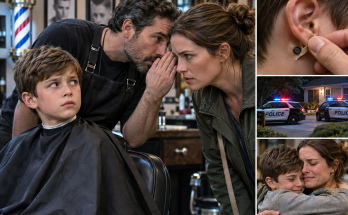
The first night back home, Wesley asked me to leave the hallway light on.
I had already tucked him into bed.
His soccer ball rested beside the dresser, and his school clothes were folded across the chair.
“Just tonight?”
“Maybe tomorrow too.”
“All right.”
I left his bedroom door open.
Then I went into the kitchen and checked the back door.
I checked the front door.
I checked the windows.
When I returned to my bedroom, I realized I couldn't remember whether I had actually tested the front lock.
So I went back.
The lock was secure.
I stood there feeling foolish.
Nobody was outside.
Nobody had tried to enter.
But my body hadn't caught up with what my mind understood.
Gregory Vance was in custody.
Martin Hale had been arrested.
The police had removed the devices.
We had new locks.
Still, I stood beside the front door listening to the silence.
Eventually, I went to bed.
I woke shortly after midnight when Wesley appeared beside me.
He was holding his pillow.
“Can I sleep here?”
I moved over.
He climbed beneath the blanket.
Within minutes, he was asleep.
I stayed awake much longer.
The following morning, I made pancakes.
Wesley poured too much syrup onto his plate.
I handed him a napkin without complaining.
“Are we staying here now?”
“Yes.”
“For good?”
“This is our home.”
He looked around the kitchen.
Then he returned to his breakfast.
I understood why he needed to ask.
Adults had told him where he would sleep, when he could attend school, and who was allowed to collect him.
For more than a week, almost everything had been decided for him.
I wanted him to feel that some things belonged to him again.
His bedroom.
His toys.
His Saturday mornings.
After breakfast, he asked whether we could rearrange his furniture.
We moved his bed against the opposite wall.
He said he liked being able to see the doorway.
I didn't ask why.
We spent nearly an hour deciding where his dresser should go.
By lunchtime, his bedroom looked different enough to feel new without losing anything familiar.
He seemed pleased.
“Dad would like it.”
“I think so.”
He placed his soccer certificate beside a photograph of Daniel.
Then he stood back to admire his work.
I watched him.
The man who had approached Wesley had tried to turn Daniel's memory into something frightening.
I wasn't going to let that become the only way my son remembered his father.
That afternoon, Detective Morris called.
She explained that the investigation had reached another important stage.
The financial evidence recovered from Daniel's storage device had been compared with independent business records.
Several of his findings had been confirmed.
The suspicious payments weren't simply duplicated entries caused by an accounting error.
Money had been directed toward businesses through transactions that investigators believed were fraudulent.
Martin had been involved in approving many of those transactions.
Gregory had connections to the businesses receiving the payments.
I sat at the kitchen table.
“How much money?”
She explained that the total was still being established.
It involved a substantial amount accumulated over several years.
I looked at Daniel's photograph.
“He was right.”
“Yes. His concerns were well founded.”
I pressed my hand against my forehead.
For three years, Daniel had been unable to defend his judgment.
People had apparently dismissed his warnings.
Martin had even suggested that Daniel's illness had affected his ability to understand the records.
Now the evidence was confirming what Daniel had written.
I wanted him to know.
That was the hardest part.
There was nobody I could call to tell him.
Nobody who could bring him into the kitchen and let me explain that his work had mattered.
I thanked Detective Morris.
Then I asked whether investigators had established why Gregory had approached Wesley.
She said communications between Gregory and Martin had provided important evidence.
Martin had become concerned about a recent review of the company's contractor payments.
He knew Daniel had questioned some of those same transactions.
He also knew Daniel had kept copies of certain records.
Gregory had been asked to determine whether those copies remained in our possession.
I listened carefully.
“Did Martin know Gregory was going to approach my son?”
“The communications indicate that Wesley was discussed as a possible source of information.”
I closed my eyes.
I needed a moment.
Martin had known Wesley was a child.
He had seen photographs of him.
He had visited our house after Daniel died.
There was no misunderstanding about Wesley's age or circumstances.
“What about the thing behind his ear?”
Detective Morris explained that investigators believed Gregory had been responsible for attaching the device.
The purpose appeared to have been monitoring Wesley's movements and gathering information about our family's routines.
The device near our front entrance had been placed for a related purpose.
The recovered evidence supported the conclusion that Gregory was trying to establish when our home was occupied and when it might be accessible.
I looked toward the hallway.
“Were they planning to break in?”
“There is evidence suggesting they were considering unauthorized access to the property.”
I felt sick.
They had wanted Daniel's computer.
His papers.
Anything that could establish what he knew.
And my nine-year-old son had been treated as a means of obtaining those things.
I asked Detective Morris whether I would have to testify.
She said that possibility remained.
The case would proceed through the courts, and prosecutors would determine which witnesses were necessary.
I told her I would cooperate.
I wasn't looking forward to sitting in a courtroom.
But I wasn't going to hide from it either.
After the call, I found Wesley in his bedroom.
He was arranging his video games.
“Want to go outside?”
He looked surprised.
“Now?”
“It's a nice afternoon.”
He grabbed his soccer ball.
We went into the backyard.
He asked me to stand between two flowerpots that he had decided would serve as goalposts.
I agreed.
He scored almost immediately.
“You're supposed to stop it.”
“I'm trying.”
“You're not very good.”
“I know.”
He laughed.
We played until my legs began to ache.
When we went inside, he was hungry.
I made sandwiches.
He ate his without removing the crusts, which was unusual enough that I noticed.
Then he asked whether we could visit Dad's grave that weekend.
I hadn't expected that.
“Of course.”
“Can I bring my certificate?”
“Yes.”
He seemed satisfied.
On Saturday, we bought flowers.
Wesley chose yellow ones because he remembered Daniel liking bright colors.
At the cemetery, he walked ahead of me.
He knew the way.
He placed the flowers beside the headstone and carefully unfolded his school certificate.
“Dad, I got this.”
I turned away for a moment.
Wesley continued talking.
He told Daniel about his reading assignment.
He mentioned soccer.
He explained that we had moved his bed.
Then he became quiet.
I waited beside him.
Finally, he looked up.
“Can I tell him about the man?”
“You can tell him anything.”
Wesley looked at the headstone again.
“A man said he knew you.”
He paused.
“I thought he was nice.”
His voice became smaller.
“I didn't know.”
I knelt beside him.
“You didn't do anything wrong.”
He looked at me.
“But I told him about your closet.”
“You believed someone who told you a lie.”
I took his hand.
“That was his fault, not yours.”
Wesley began crying.
I held him.
For several minutes, we stayed there beside Daniel's grave.
I didn't try to make him stop.
I didn't tell him to be brave.
He had already been brave enough.
When he finally pulled away, he wiped his face with his sleeve.
“Would Dad be mad?”
“No.”
“Really?”
“Your dad would want you to know how much he loved you.”
Wesley looked at the certificate.
Then he folded it carefully.
We stayed a little longer before returning to the car.
On the drive home, he asked whether we could get ice cream.
We did.
He chose chocolate.
I chose vanilla.
We sat outside the shop and watched people walking past.
For the first time in days, I wasn't studying every unfamiliar face.
Over the following weeks, Wesley began meeting with a counselor.
At first, he complained that he didn't know what he was supposed to talk about.
The counselor told him he could talk about anything.
Sometimes they discussed school.
Sometimes soccer.
Sometimes his father.
Gradually, Wesley stopped asking whether unfamiliar cars belonged to Gregory.
He still wanted the hallway light on.
I left it on.
There was no deadline for him to feel comfortable again.
Meanwhile, the criminal investigation continued.
Investigator Bennett occasionally contacted me about Daniel's records.
I answered questions about dates, documents, and the circumstances under which certain belongings had been stored.
Linda also remained involved.
She provided further information about the company's accounting practices.
One afternoon, she called me personally.
“I thought you'd want to know something.”
“What is it?”
“The company has acknowledged that Daniel's original concerns should have been investigated properly.”
I sat down.
“They admitted that?”
“Yes.”
She explained that the company was reviewing its internal procedures and cooperating with authorities.
Several people had been questioned about their handling of Daniel's complaints.
I thanked her for telling me.
After ending the call, I went into the hallway closet.
Daniel's cardboard box was still there.
The investigators had taken the relevant documents, but his ordinary belongings remained.
I lifted out his coffee mug.
There was a small chip near the handle.
I remembered asking him why he didn't replace it.
He had said it still held coffee.
That had been Daniel.
Practical.
Careful.
Uninterested in replacing something simply because it wasn't perfect.
I washed the mug and placed it beside mine.
The next morning, I used it.
It felt good to bring something of his back into our daily life.
Not as evidence.
Not as a clue.
Just as something that had belonged to the man I loved.
A few months later, prosecutors contacted me about the case.
The charges against Martin and Gregory included offenses connected to the fraudulent financial arrangements and the unauthorized monitoring of our family.
Gregory also faced allegations arising from his conduct toward Wesley.
I met with a prosecutor who explained the proceedings.
She told me that the recovered records, communications, financial documents, and physical evidence formed a substantial part of the case.
Wesley's account was important.
But they intended to avoid requiring him to participate more than necessary.
I felt enormous relief.
I didn't want him sitting in a courtroom while adults argued over what had happened behind his ear.
He had given investigators the information he remembered.
He had done enough.
The prosecutor asked whether I wanted to provide a statement describing how the events had affected our family.
I said I did.
At home, I sat at the kitchen table with a notebook.
For several minutes, I couldn't write anything.
Then I began with the hallway light.
I wrote about Wesley asking whether his father would be angry.
I wrote about his fear of returning to school.
I wrote about sleeping at Rachel's house and carrying our belongings in a single bag.
I wrote about checking the front door repeatedly.
I didn't exaggerate anything.
I didn't need to.
The ordinary details were painful enough.
When I finished, I read the statement twice.
Then I added one final sentence.
My son deserved to remember his father without being afraid of anyone who mentioned his name.
I closed the notebook.
Outside, Wesley was practicing soccer.
The ball struck the garden wall.
He called for me to watch.
I went outside.
He stepped backward, took a running start, and kicked the ball between his makeshift goalposts.
“Did you see?”
“I saw.”
He smiled.
For that moment, nothing else mattered.
Click here to continue reading: PART 10: When the Court Finally Heard What Happened to Our Family, I Understood That My Husband Had Left Us Something More Valuable Than Evidence
I Thought Taking My Son for His Saturday Haircut Was the Safest and Most Ordinary Thing We Could Do Together
Part 9 of 10