The day the case ended, Birdie was at school.
I was glad.
She had already given enough of herself to what happened.
She had told her story to trained investigators.
She had attended appointments.
She had answered questions that no six-year-old should have needed to answer.
I didn't want her sitting in a courtroom while adults argued over the afternoon she nearly died.
So I went alone.
Deputy Harris met me outside.
He was carrying the same worn folder I had seen so many times.
I recognized it immediately.
Inside were photographs and reports.
The maintenance gate.
The torn backpack.
The muddy bank.
The small red boot.
The broken butterfly clip.
The things that had become part of our family's life.
Harris greeted me quietly.
"Ready?"
I looked at the courthouse doors.
"No."
He nodded.
Then he held the door open.
I walked inside.
The proceedings had taken months.
There had been interviews.
Evidence reviews.
Court appearances.
Long conversations with the prosecutor.
There had been days when nothing seemed to happen.
And days when the telephone rang and I felt frightened before I even answered it.
I learned more about the legal system than I ever wanted to know.
I learned that a case did not become simple just because I knew my daughter had been hurt.
I learned that investigators had to establish exactly what could be proved.
I learned that statements, photographs, and physical evidence had to be considered carefully.
And I learned that justice moved according to its own schedule.
Not according to the impatience of a mother who wanted her child protected.
By the time the case reached its final resolution, Dennison had admitted more than he had during his first interview.
He acknowledged confronting Birdie near the gate.
He acknowledged grabbing her backpack.
He acknowledged frightening her.
And he acknowledged leaving the area without making sure she was safe.
Those admissions mattered.
They did not erase what happened.
They did not make Birdie's nightmares disappear.
But they removed the possibility that he could continue pretending he had never encountered her.
The court accepted the resolution of the case.
Dennison was held accountable for his conduct.
The consequences included court-ordered restrictions, supervision, and obligations connected to the harm caused.
He was no longer permitted to approach Birdie or our home.
He could no longer treat our family as an extension of his private neighborhood dispute.
And he could no longer dismiss the incident as nothing more than enforcing a rule.
I listened without moving.
I had imagined this moment many times.
In some versions, I felt angry.
In others, I cried.
Sometimes I imagined standing up and telling him exactly what his actions had cost us.
But when the judge finished speaking, I felt strangely quiet.
There was no rush of happiness.
No feeling that everything had been repaired.
Just a sense that one part of the story had finally been placed where it belonged.
In the hands of the law.
Not in Birdie's bedroom.
Not at our kitchen table.
Not between me and my daughter.
The prosecutor had helped me prepare a victim-impact statement.
I had spent several evenings writing it.
At first, I couldn't get past the opening.
I wrote Birdie's name.
Then I stopped.
I looked at the page for a long time.
How could I explain what it felt like to search for my child in the rain?
How could I describe the sound of the canal?
The moment a rescuer found her red boot?
The way her tiny voice came from the drainage tunnel?
I tried to write about those things.
But every sentence seemed too small.
Then I stopped trying to make it sound important.
I wrote the truth.
I wrote about Birdie.
I wrote that she loved drawing rabbits.
That she kept shiny objects in a jar.
That she liked carrots cut into little circles.
That she had once believed every crow in the neighborhood was Edgar until she learned to recognize the white feather.
I wrote that she was six years old.
And that on the afternoon she disappeared, an adult had frightened her so badly that she ran toward dangerous water.
I wrote about the hours when I didn't know whether she was alive.
I wrote about her calling for me.
And I wrote about the night she asked whether she was bad because the man had said so.
That was the hardest part.
I had to stop several times.
I couldn't see the page through my tears.
But I finished.
Now, standing before the court, I read those words aloud.
My voice shook.
I didn't try to hide it.
I was not there to impress anyone.
I was there to tell the truth.
I spoke about the way Birdie had changed after the rescue.
How she checked the windows at night.
How she asked whether the maintenance gate was locked.
How she became frightened when she heard an angry man's voice.
I spoke about therapy.
About patience.
About the nights when I sat beside her until she fell asleep.
Then I told the court what I wanted most.
I wanted my daughter to grow up without believing that a powerful adult could frighten her and walk away without consequences.
I wanted her to know that being small did not make her unimportant.
I wanted her to understand that her voice mattered.
When I finished, I folded the paper.
My hands were trembling.
I returned to my seat.
I didn't look toward Dennison.
I couldn't.
I had said everything I needed to say.
The court completed the proceedings.
The prosecutor spoke with me afterward.
She explained the remaining paperwork.
She told me which restrictions were in place.
She answered my questions about what would happen next.
I thanked her.
Then I stepped outside.
The weather was clear.
A light breeze moved through the trees.
I stood on the courthouse steps.
The same place where I had stood after the earlier hearing.
Only now, I wasn't waiting for another date on the calendar.
The case had reached its resolution.
I took a long breath.
Then I called my sister.
"How did it go?" she asked.
"It's finished."
She was quiet for a moment.
"Are you okay?"
I looked at the sky.
"I think so."
I wasn't certain.
But I felt a little lighter.
Not because the court had made everything right.
Nothing could make that afternoon right.
Birdie had still been frightened.
She had still slipped near the canal.
She had still spent hours in the cold.
But someone had been held responsible.
And I no longer had to spend every day wondering whether the truth would be acknowledged.
I drove home slowly.
I passed the grocery store.
The pharmacy.
The school crossing.
The same ordinary landmarks I had noticed when Birdie came home from the hospital.
I remembered that drive.
Her yellow sweater.
Her stuffed rabbit.
Her excitement when she saw Edgar waiting on the porch.
I smiled.
Then I turned onto our street.
The neighborhood looked familiar.
Children rode bicycles.
A man watered his front garden.
Someone had left a blue recycling bin near the curb.
Life had continued while our family struggled to feel safe again.
I parked in the driveway.
For a moment, I stayed inside the car.
I looked toward our porch.
The railing was empty.
Then a black shape moved through the branches of the nearby tree.
I smiled.
Edgar.
He landed on the fence.
His white wing feather showed clearly in the sunlight.
He looked toward the house.
Then he hopped along the rail.
I stepped out of the car.
"Hello, Edgar."
He tilted his head.
I laughed softly.
I had once been embarrassed to talk to a bird.
Now I didn't care who heard.
"She's at school," I told him.
He gave a short call.
I shook my head.
"You'll see her later."
He flew to the porch railing.
I watched him settle.
Then I went inside.
The house was quiet.
I placed my bag on the kitchen counter.
I set the courthouse papers inside a drawer.
I didn't want them on the table when Birdie came home.
She had spent enough time surrounded by reminders of what happened.
I wanted the kitchen to be a kitchen again.
A place for meals.
Crayons.
Spilled juice.
Arguments about vegetables.
I wanted ordinary problems.
Small ones.
The kind that could be solved with a towel or a patient conversation.
I took out a cutting board.
I began preparing dinner.
I chopped carrots into little circles.
Birdie's favorite.
I placed them in a bowl.
Then I checked the clock.
She would be home soon.
For the first time in months, I wasn't waiting for an investigator to call.
I wasn't wondering whether another hearing would be scheduled.
I wasn't preparing to explain the case to another stranger.
I was simply making dinner.
The school bus arrived a little after three.
I heard the brakes outside.
Then I heard Birdie's footsteps on the walkway.
I opened the door before she reached it.
She was carrying her backpack.
Not the torn pink one.
We had bought a new one.
It was purple.
With small yellow stars.
She had chosen it herself.
She looked up at me.
"Mommy!"
I knelt.
She ran into my arms.
I hugged her.
She smelled like pencil shavings and sunshine.
"How was school?"
"Good."
She pulled back.
"We painted."
I smiled.
"What did you paint?"
"A bird."
I laughed.
"Of course you did."
She looked pleased.
"Not Edgar this time."
I raised my eyebrows.
"Really?"
"A bluebird."
I pretended to be surprised.
"Something new."
She laughed.
Then she looked toward the porch.
"Is Edgar here?"
"He was."
She moved toward the window.
I followed her.
The railing was empty.
She looked disappointed for a moment.
Then she shrugged.
"He'll come back."
I nodded.
"I'm sure he'll visit again."
We went into the kitchen.
She placed her backpack on the chair.
Then she asked for a snack.
I gave her apple slices.
She ate while telling me about her painting.
I listened.
I didn't interrupt.
I didn't think about the courthouse.
I didn't think about Dennison.
I just listened to my daughter explain how she mixed blue and white paint.
It was a small conversation.
But it felt like something precious.
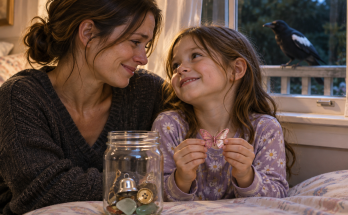
Later, after dinner, Birdie asked whether she could look at Edgar's collection.
I followed her into her bedroom.
The jar was still on the windowsill.
Sunlight had faded the curtain slightly.
The little objects inside caught the remaining light.
Birdie lifted the jar carefully.
She sat on the bed.
Then she unscrewed the lid.
I sat beside her.
She took out the bottle cap.
The brass button.
The silver earring.
The green sea glass.
Then she found the silver bell.
She held it between her fingers.
It made a tiny sound when she moved it.
I smiled.
"Remember when he brought that?"
She nodded.
"The day we came home."
"That's right."
She placed it on the blanket.
Then she reached into the jar again.
She took out the damaged butterfly clip.
I felt my chest tighten.
I hadn't touched it in weeks.
Birdie held it up.
"Can we fix this?"
I looked at the broken wing.
I thought about the matching piece found near the maintenance gate.
I thought about the police photographs.
The evidence.
The courthouse.
Then I looked at her.
"I don't think we can make it exactly the same."
She considered that.
"Could we glue it?"
"Maybe."
She turned it over.
The little butterfly was scratched.
One side was slightly bent.
She stared at it for a while.
Then she shook her head.
"No."
I waited.
She placed it beside the silver bell.
"I like it like this."
I felt my eyes sting.
"Why, sweetheart?"
She looked at the two objects.
"Because Edgar found it."
I nodded.
"Yes, he did."
She moved the bell closer.
Then she looked at me.
"Mommy?"
"Yes?"
"Did the mean man go away?"
I took a breath.
I had known the question might come.
I had thought about how to answer it.
I wanted to tell her everything was over.
I wanted to promise that nothing frightening would ever happen again.
But I had learned not to make promises nobody could keep.
I touched her hand.
"The court made rules to keep him away from us."
She looked at me.
"Can he come to our house?"
"No, sweetheart. He's not allowed to."
She seemed to think about that.
Then she asked whether he could yell at Edgar.
I shook my head.
"He doesn't get to come here and bother us."
Birdie nodded.
She looked toward the window.
Then she asked the question I had been waiting for without knowing it.
"Was I brave?"
I felt my throat tighten.
I looked at her face.
She was serious.
She needed to know.
I thought about the canal.
The muddy slope.
The tunnel.
The little voice singing in the darkness.
I thought about how hard she had tried to reach safety.
How she had stayed alive while the rescue team searched.
How she had remembered enough to help investigators understand what happened.
And how she had continued going to school, drawing pictures, and learning to feel safe again.
I moved closer.
"Yes, Birdie."
She watched me.
"You were very brave."
She looked down.
"Even when I cried?"
I nodded.
"Especially then."
She frowned.
"Why?"
I took her hands.
"Because being brave doesn't mean you aren't scared."
She listened.
"It means you keep trying even when you are."
She thought about that.
Then she smiled.
"Edgar was brave too."
I laughed through my tears.
"Yes."
I looked toward the window.
"I think he was."
She placed the broken butterfly clip beside the silver bell.
Then she returned both objects to the jar.
She arranged them carefully.
She wanted the bell near the front.
And the butterfly beside it.
I watched her close the lid.
She placed the jar back on the windowsill.
Then she stepped away.
For a moment, we stood together.
I looked at the little collection.
Most people would have seen junk.
A bottle cap.
A button.
An earring.
A piece of glass.
A bell.
A broken hair clip.
But I saw thirty-four mornings of feeding a crow.
I saw my daughter's delight.
I saw a frightened search through the rain.
I saw Edgar waiting on fence posts.
I saw Deputy Harris raising his flashlight.
I saw the willow tree.
The muddy bank.
The rescue workers.
And the moment my daughter came out of the tunnel.
I saw how close we had come to losing her.
Then I looked at Birdie.
She was standing beside me.
Alive.
Growing.
Still curious.
Still willing to love something small and unexpected.
I put my arm around her shoulders.
"Want to help me put away the crayons?"
She nodded.
We returned to the kitchen.
She carried her drawing from school.
The bluebird.
Not Edgar.
A new bird.
A new picture.
I smiled at that.
It meant something to me.
Not that she had forgotten Edgar.
She hadn't.
Not that she had forgotten what happened.
She probably never would.
But her world was growing again.
It was no longer only the canal.
The gate.
The frightening man.
There were other birds.
Other colors.
Other things to discover.
That evening, after Birdie was asleep, I stepped onto the porch.
The air was cool.
The neighborhood was quiet.
I placed a few peanuts on the railing.
Then I moved back.
For several minutes, nothing happened.
I looked toward the tree.
No movement.
I smiled to myself.
Edgar didn't owe me another visit.
He had already given us more than I could explain.
I turned toward the door.
Then I heard wings.
A familiar black shape settled on the railing.
One white feather stood out against the darkness.
Edgar looked at me.
I stood still.
He picked up a peanut.
Then another.
He hopped sideways.
I laughed softly.
"You're late."
He tilted his head.
Then he flew away.
I watched until he disappeared into the trees.
I didn't chase him.
I didn't call him back.
I simply stood on the porch for a moment.
I thought about the first time I had seen him.
Just another crow.
A bird looking for food.
Nothing special.
At least, that was what I had believed.
Now I knew how much could change because somebody noticed one small thing.
A white feather.
A familiar bird.
A broken butterfly clip.
I went inside and locked the door.
Then I checked on Birdie.
She was asleep beneath her blanket.
Her stuffed rabbit rested beside her cheek.
The hallway light was on.
She still liked it that way.
I left it.
I brushed a strand of hair from her forehead.
Then I stood beside the bed and listened to her breathing.
I had done that every night since the rescue.
Maybe one day I would stop checking so often.
Maybe one day the memory of the canal would become less painful.
Maybe one day Birdie would walk past the maintenance gate without feeling afraid.
I hoped so.
But I wasn't going to rush either of us.
We had time.
That was the gift I kept returning to.
Time.
More mornings.
More drawings.
More bedtime songs.
More little arguments about carrots.
More chances to hold my daughter's hand.
I looked at the jar on the windowsill.
The silver bell caught the light from the hallway.
Beside it was the broken pink butterfly.
Two small objects.
One brought home before we knew where Birdie was.
One brought home after she was safe.
I stood there for a moment.
Then I turned off the bedroom lamp, leaving the hallway light shining through the doorway.
Before I went to bed, I looked back once more.
Birdie moved slightly beneath the blanket.
Then she settled.
Safe.
Warm.
Home.
I closed my eyes.
And for the first time in a long while, I let myself believe we would be all right.
The End
Read more original stories on Feel Every Story.
I Begged Three Police Officers to Follow a Crow Through the Rain Because He Was Carrying Something That Belonged to My Missing Daughter
Part 10 of 10