The next discovery made me feel as though someone had been watching our house for weeks.
Not looking at it.
Watching it.
There is a difference.
I learned about it while Birdie was resting in the hospital.
The morning had been quiet.
A nurse had helped her walk a few careful steps.
The doctor was pleased with her progress.
Birdie wanted to know when she could wear her yellow sweater again.
I told her it was waiting at home.
She smiled.
For a little while, the world felt ordinary.
Then my phone rang.
Deputy Harris.
I stepped into the hallway.
"Hello?"
"Lynette, we've made some progress."
I looked toward the door.
"Is it about Dennison?"
"Yes."
I moved to an empty chair.
"Tell me."
Harris explained that investigators had obtained authorization to search Mr. Dennison's truck.
I stopped moving.
They had found mud inside.
That alone didn't surprise me.
It had been raining hard.
Half the neighborhood was muddy.
But the location mattered.
The passenger-side floor mat had dirt on it that investigators wanted to compare with the canal area.
Then Harris told me about a small piece of fabric.
Pink fabric.
Torn.
Caught beneath a seat.
I looked through the hospital room window.
Birdie's backpack was sitting near her bed.
The rabbit on the front was still stained.
One strap was damaged.
I could see the torn edge from where I sat.
"What kind of fabric?"
Harris answered carefully.
"It appears consistent with the material from Birdie's backpack."
I felt my stomach tighten.
"Was she in his truck?"
"We haven't established that."
I remembered Birdie's words.
She had said the man didn't put her inside a vehicle.
She had said he took her through the gate.
I told Harris that again.
He said investigators were considering every piece of evidence.
The fabric mattered.
But it didn't prove exactly how it had gotten into the truck.
I knew that.
Still, I couldn't stop picturing the torn strap.
The man pulling at the backpack.
Birdie trying to get away.
I had held that bag against my chest while the rescue workers searched the canal.
Now a piece of similar fabric had been found inside the truck belonging to the man she might have encountered.
It felt like another piece of the afternoon had returned.
Harris continued.
The deputies had also searched Mr. Dennison's garage.
There they found the pellet gun.
I closed my eyes.
I remembered Dennison standing near my yard.
The way he had complained about Edgar.
The way he had spoken about shooting the bird as though it were a simple household chore.
At the time, I had told him to leave Edgar alone.
He had looked annoyed.
Now I remembered that conversation with a different kind of fear.
The gun wasn't proof that he had used it against Birdie.
Harris made that clear.
But it was the same type of weapon he had mentioned during our disputes.
It was another detail that helped investigators understand the hostility.
I rubbed my forehead.
"What else?"
There was a pause.
Then Harris told me about the papers.
Stacks of them.
Complaints.
Notes.
Photographs.
Records of things Mr. Dennison believed violated neighborhood rules.
My name appeared repeatedly.
The crow.
The peanuts.
The porch railing.
The backyard.
I felt embarrassed at first.
Then angry.
I knew he had complained.
I knew he had sent notices.
But I hadn't understood how much time he had spent documenting our home.
Harris said some photographs showed Edgar landing on the porch.
Others showed the area around our backyard.
There were written observations about the times the bird usually arrived.
I looked at the clock.
Every morning.
Almost the same time.
I had never hidden that routine.
Birdie liked to watch Edgar before breakfast.
Sometimes we stood at the kitchen window.
Sometimes we went onto the porch.
We would place a few peanuts down and step away.
I had thought of those mornings as private.
They weren't private in any secret way.
Anyone walking past could see us.
But there was something disturbing about learning that a neighbor had been recording them.
Harris continued.
Some notes mentioned when I left for the grocery store.
Others referred to when Birdie played outside.
I sat very still.
"Birdie?"
"Yes."
I looked at my daughter's room.
She was six years old.
She loved drawing.
She liked rabbits.
She liked looking for shiny objects in the grass.
Why would a grown man keep written records of when she played outside?
I felt something cold settle in my chest.
"What did he write?"
Harris explained that investigators were reviewing the notes carefully.
Some appeared to be routine observations.
Others were more personal.
They wanted to determine why Dennison had kept them.
I looked down at my hands.
"I didn't know he was doing that."
"I understand."
"I knew he complained about the bird."
I swallowed.
"But I didn't know he was keeping track of us."
Harris let me finish.
Then he told me about one particular note.
It had been written three days before Birdie disappeared.
It referred to the ongoing dispute about my household and said Dennison intended to handle the matter directly.
I stared at the wall.
Directly.
That word bothered me.
It sounded small.
Ordinary.
The sort of word people put in letters when they want something to sound official.
But now I knew how Birdie had described the man by the fence.
He had been angry.
He had grabbed her backpack.
He had said he would take her home.
And he had blamed her mother for feeding birds.
I looked up.
"Did Dennison explain the note?"
Harris said he had declined to answer further questions about it.
I felt sick.
Not because silence proved guilt.
It didn't.
But because I had spent weeks dismissing the man's behavior as an unpleasant neighborhood argument.
I thought he wanted to control where people placed garbage bins.
How tall their grass could grow.
Whether children left bicycles on sidewalks.
I had believed that was the size of his anger.
I hadn't imagined that my little girl might become part of it.
Harris told me investigators had also spoken with a maintenance worker.
The worker remembered arguing with Dennison near the gate earlier that week.
The dispute had concerned people using the green space.
Dennison wanted stricter control over the area.
He had complained about children wandering near the fence.
He had asked questions about leaving the maintenance gate open during inspections.
I held the phone closer.
"Was he allowed to do that?"
"The access rules are being reviewed."
I thought about the photograph of the latch.
The video.
The man opening the gate.
Birdie saying she had been taken through it.
The details were beginning to fit together.
But I still didn't know what happened in the minutes after the camera lost sight of the man.
I asked Harris whether they were going to arrest Dennison.
He didn't promise anything.
He said investigators were taking the evidence seriously.
They were comparing the footage.
The statements.
The fabric.
The physical evidence from the canal.
And the information found in his records.
I nodded.
Then I remembered he couldn't see me.
"Thank you."
He told me he would contact me when there was another update.
I ended the call.
For a while, I sat in the hallway without moving.
The hospital smelled faintly of cleaning supplies.
Somebody nearby was laughing quietly.
A nurse walked past carrying a blanket.
Life continued.
I felt as though mine had stopped at the moment Birdie disappeared.
I had been trying to move forward ever since.
Find her.
Get her warm.
Listen when she was ready.
Help the police.
Take her home.
But every new detail pulled me back toward that muddy canal.
I stood and returned to her room.
Birdie was drawing.
The hospital had given her a small box of crayons and some paper.
She had drawn a house.
A tree.
A large black bird.
I sat beside her.
"Is that Edgar?"
She nodded.
"He has his white feather."
I looked at the drawing.
She had made the feather large enough to recognize.
I smiled.
"That's how we always know it's him."
Birdie added a little circle beside the house.
"What's that?"
"His present."
I looked closer.
She had drawn a button.
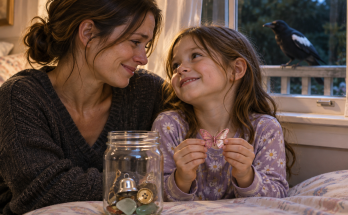
I thought of her jar at home.
All those little objects she loved.
The green glass.
The silver earring.
The brass button.
I wondered whether she would still enjoy looking at them after what happened.
Would Edgar remind her of being found?
Or would he remind her of being trapped beside the water?
I hoped it would be the first.
But I knew I couldn't decide that for her.
She looked at me.
"Mommy, can I draw our house bigger?"
"Of course."
She reached for another sheet.
I watched her begin again.
Her hand moved carefully.
The bandage on her palm made holding the crayon awkward.
She frowned.
I offered to help.
She shook her head.
"I can do it."
So I let her.
I had spent the last day wanting to protect her from everything.
I wanted to stand between her and every road.
Every fence.
Every stranger.
Every body of water.
But I couldn't make her world so small that she stopped living in it.
I knew that.
Even if I wasn't ready to act on it.
Later that afternoon, Harris called again.
The investigators had finished another round of questioning.
Dennison had been taken into custody for further questioning.
I closed my eyes.
I didn't cheer.
I didn't smile.
I didn't feel anything like victory.
I asked whether Birdie was safe.
Harris said the investigation was continuing and that they were taking appropriate steps.
I thanked him.
Then I sat beside my daughter.
She had fallen asleep with her drawing on the table.
I looked at the crow.
The white feather.
The little button.
Then I looked at the torn backpack hanging from the chair.
All of it had begun with a bird Mr. Dennison wanted gone.
A bird he considered a nuisance.
A bird he believed didn't belong near our home.
Yet Edgar had been the one to bring me the first recognizable clue.
He hadn't signed a complaint.
He hadn't threatened a fine.
He hadn't followed us around with a camera.
He had appeared on the porch with a broken butterfly clip.
And when I followed him, he led us toward Birdie.
I put my hand over my mouth.
I was crying again.
Quietly.
I didn't want to wake her.
I had imagined feeling satisfied if the police took Dennison into custody.
But all I felt was tired.
And frightened.
And grateful that Birdie was alive.
I wanted the investigators to establish what happened.
I wanted the person responsible held accountable.
But I didn't want Birdie to spend the rest of her childhood thinking about the man who had frightened her.
I wanted her to remember the things she loved.
Her drawings.
Her rabbit.
Her red boots.
The little jar on the windowsill.
I looked at the calendar beside her bed.
The doctor had said she might be able to leave soon.
I had never wanted to go home so badly.
And I had never felt so uncertain about returning there.
That evening, Birdie woke and asked for her yellow sweater again.
I told her it would be waiting when we left.
She smiled.
Then she asked whether Edgar would still come to the porch.
I looked out the window.
"I think he might."
She hugged her rabbit.
"Good."
I reached for her hand.
For the first time since the search, I allowed myself to imagine bringing her through our front door.
I imagined taking off her shoes.
Putting her rabbit beside her pillow.
Making her something warm to eat.
I imagined looking through the kitchen window and seeing a familiar black shape on the railing.
Maybe Edgar would come.
Maybe he wouldn't.
He was a wild bird.
He came when he wanted.
But I knew Birdie would look for him.
And I knew I would, too.
Click here to continue reading: PART 8: Two Days After My Daughter Was Pulled From the Canal, We Returned Home to Find Edgar Waiting With a Small Silver Gift on Our Porch
I Begged Three Police Officers to Follow a Crow Through the Rain Because He Was Carrying Something That Belonged to My Missing Daughter
Part 7 of 10