
The morning after my birthday, I woke in the small guest bedroom.
For a few seconds, I forgot about the restaurant.
Then I saw the nearly empty shelves.
The bare wall.
The space where my photographs used to stand.
And I remembered.
Sarah knew.
Greg knew.
The sale was no longer something I was preparing quietly.
It was something we would all have to face.
I stayed in bed for a moment.
I had expected to feel frightened.
Instead, I felt tired.
But there was something else beneath it.
Relief.
I had finally told the truth.
Not just about selling the house.
About what living there had become.
I got dressed.
Then I opened the bedroom door.
The hallway looked the same.
The pictures on the walls hadn't moved.
The floor was familiar beneath my feet.
For decades, I had walked through that house without thinking about where I belonged.
Now I noticed everything.
The bedroom Sarah and Greg had taken.
The stairs.
The kitchen.
The door leading toward the garage.
All the places where I had gradually surrendered my right to make ordinary decisions.
I went downstairs.
Sarah was sitting at the kitchen table.
There was a cup of coffee in front of her.
She looked as though she hadn't slept well.
I understood.
Neither had I.
She looked up when I entered.
“Morning, Mom.”
“Good morning.”
For a moment, neither of us spoke.
I opened a cupboard.
I reached for my usual cup.
It was still there.
That small thing comforted me more than I expected.
I poured coffee.
Then I sat across from her.
She watched my hands.
Finally, she spoke.
“Are you really going through with it?”
I nodded.
“Yes.”
She looked disappointed.
But she didn't argue immediately.
That was different.
I waited.
She turned her cup slightly on the table.
“I keep thinking about what you said last night.”
I looked at her.
“Which part?”
She swallowed.
“That you haven't felt welcome here.”
I didn't answer right away.
I wanted to believe she was beginning to understand.
But I had learned not to confuse one emotional conversation with lasting change.
“Yes,” I said.
“That's how I've felt.”
She looked around the kitchen.
“I didn't know it was that bad.”
I thought about correcting her.
I wanted to remind her of the baking sheets.
The bedroom.
The garage.
The bills.
The morning she told me to clean the house and remain upstairs while Greg's boss visited.
But I had already explained enough.
I didn't want another argument about whether each individual incident was serious.
Together, they had changed my life.
And that was what mattered.
“I know you didn't understand,” I said.
She looked at me.
“But I was living through it.”
Her eyes filled with tears.
I reached for my coffee.
I didn't rush to comfort her.
I was learning how difficult it could be to let somebody feel responsible for the consequences of their own behavior.
Greg came into the kitchen a few minutes later.
He stopped when he saw us sitting together.
He looked at Sarah.
Then at me.
“Have you called the buyer?”
I shook my head.
“No.”
He frowned.
“You need to tell him we're still living here.”
I looked at him.
“Everyone involved will be informed about the proper arrangements.”
He crossed his arms.
“You make it sound simple.”
“It isn't simple.”
That answer surprised him.
I continued.
“I know moving is difficult. I've been preparing for it for months.”
He looked toward Sarah.
I watched him.
For the first time, I wondered whether he understood how much work I had done while he believed I was merely clearing out my bedroom.
I had packed photographs.
Moved personal belongings.
Reviewed finances.
Spoken with people who understood the sale process.
Considered where I would go.
And tried to accept that I was leaving the home where my husband and I had built our life.
None of it had been easy.
I hadn't made the decision in a moment of anger.
I had made it after years of trying to remain comfortable in a place where I no longer felt at home.
Greg pulled out a chair.
He sat down.
“We can't move overnight.”
“I know.”
“We need time.”
“I understand.”
He seemed uncertain how to respond.
I hadn't dismissed his concerns.
I wasn't interested in creating unnecessary hardship.
But understanding that moving would take time wasn't the same as agreeing to cancel the sale.
I explained that the arrangements needed to follow the proper process.
I wasn't going to throw anyone's belongings outside.
I wasn't going to change locks without authority.
I wasn't going to behave toward Sarah and Greg the way they had behaved toward me.
But I also wasn't going to abandon the decision.
The house would be sold according to the agreement and the required steps.
Sarah looked at Greg.
Then she looked at me.
“Can we at least make this peaceful?”
I nodded.
“I'd like that.”
And I meant it.
I didn't want shouting.
I didn't want threats.
I didn't want to spend the final weeks in that house feeling frightened of another argument.
I wanted us to handle what came next as adults.
That was all.
Over the following days, the practical arrangements moved forward.
There were documents to review.
Questions to answer.
Details that needed professional attention.
I stayed involved.
I read what I was given.
I asked questions whenever something was unclear.
I wanted to understand the transaction from beginning to end.
I had never sold that house before.
I wasn't going to pretend I knew everything.
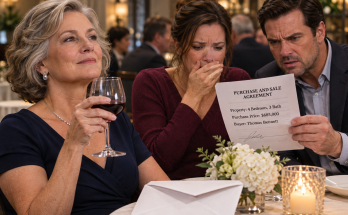
Thomas Bennett remained the buyer named in the agreement.
The purchase price was six hundred and eighty-five thousand dollars.
Those were the figures Sarah and Greg had seen inside the white envelope.
Now they were no longer merely words on a page.
They were part of a process that affected all three of us.
I remembered meeting Thomas at the coffee shop.
How strange that ordinary conversations about a house had helped me imagine a different future.
For years, I had thought of the property only as the place where my husband and I raised Sarah.
It had been more than a building.
It had held most of my adult life.
But Thomas had looked at it as a property.
Four bedrooms.
A garden.
A garage.
Something another person could purchase and use.
At first, that had been painful.
I felt as though selling it meant turning memories into a number.
But eventually, I understood that the memories weren't being sold.
The house was.
The memories belonged to me.
They would remain mine.
I could carry them somewhere else.
That realization helped.
Sarah and Greg began preparing to move.
I could hear them discussing boxes.
Furniture.
The practical difficulties of finding another place.
Sometimes their conversations were tense.
Sometimes they were quiet.
I didn't involve myself unless something concerned my belongings or the property.
That was new for me.
Usually, I would have stepped in.
Offered to solve a problem.
Paid for something.
Made a phone call.
Found a way to make things easier.
But this time, I let them handle their own arrangements.
They were adults.
They had jobs.
They had responsibilities.
And those responsibilities did not automatically become mine because Sarah was my daughter.
I still cared about them.
That hadn't changed.
But I was no longer willing to confuse caring with taking over.
One afternoon, Sarah came into my bedroom.
The closet was almost empty.
My books were gone.
The photographs had already been packed.
She stood near the doorway.
“It's strange seeing this room like this.”
I looked around.
“Yes.”
She touched the edge of the doorframe.
“I remember when this was the guest room.”
I nodded.
“It still is.”
She looked at me.
I could tell she understood the meaning.
I had moved into the guest bedroom in a house that belonged to me.
I had accepted it because I thought making Sarah comfortable was more important than keeping my own space.
Now the room was nearly empty because I was leaving the house altogether.
Sarah looked toward the shelves.
“Where did you put the albums?”
“Somewhere safe.”
She nodded.
Then she said something I hadn't expected.
“I'm glad you kept them.”
I looked at her.
I remembered the baking sheets.
The old metal trays her great-grandmother had used.
Sarah had thrown them away because they took up room she wanted.
I had never been able to get them back.
That loss was small compared with selling a house.
But it stayed with me.
Because the trays had been something I loved.
And my daughter had decided they were disposable.
I looked toward the empty shelves.
“I wish I'd kept more things.”
Sarah lowered her eyes.
“I know.”
We stood quietly.
I didn't demand an apology.
I didn't ask her to explain why she had thrown them away.
The conversation had already happened.
I had explained what the trays meant to me.
She hadn't understood then.
Perhaps she understood better now.
I hoped so.
But I didn't need to force a perfect resolution.
Some losses remained losses.
That was part of being honest about what had happened.
As the sale progressed, I returned to the garden.
I hadn't spent much time there lately.
The house had become so uncomfortable that I sometimes avoided the places I once loved.
But I wanted to see it properly before leaving.
I stood near the plants.
I looked toward the back of the house.
I remembered my husband working outside.
The ordinary sound of him moving around the garden.
The conversations we had while doing small jobs.
I could almost picture him standing there.
For a moment, I cried.
Not because I regretted selling.
Because I missed him.
I had missed him for years.
Sometimes grief became so familiar that I hardly noticed it.
Then something ordinary would bring it back.
A doorway.
A photograph.
A patch of garden.
I stood there until I felt ready to go inside.
I thought about the question Sarah had asked at the restaurant.
Was I really willing to leave the house where her father lived?
I was.
That didn't mean leaving was painless.
It meant I no longer believed suffering inside those walls was a requirement for honoring his memory.
My husband and I had worked hard to own that property.
We had paid the mortgage.
Raised our daughter.
Built a life.
I couldn't imagine he would have wanted those efforts to leave me feeling powerless in my own home.
I had spent too many years holding on to the building because I was afraid of losing the past.
Now I understood that I could leave without losing it.
Eventually, the remaining arrangements for the sale were completed.
The necessary requirements had been handled.
Sarah and Greg had made their own arrangements to leave.
And the house passed out of my ownership.
I remember the final paperwork.
The signatures.
The careful attention I gave each page.
I didn't feel excitement.
I felt the seriousness of what I was doing.
This was the end of a long chapter of my life.
But it was also a decision I had made for myself.
When the transaction was complete, the sale price was no longer merely a figure Sarah and Greg had discovered in an envelope.
It represented the property my husband and I had spent decades paying for.
The financial details were handled through the closing process.
I knew there would be obligations and costs associated with selling.
I had made arrangements with professional advice.
I didn't view the entire purchase price as money I could spend without thought.
I was sixty.
I needed to be careful.
I wanted security.
Not luxury.
Not an expensive celebration.
Not a way to prove my daughter wrong.
I wanted enough independence to live without constantly worrying that someone else would decide what happened to my money.
That was the goal.
And I took it seriously.
My next home was different.
It wasn't the four-bedroom house.
It didn't have the same history.
There were no familiar marks on the doorframes.
No decades of photographs hanging where they had always hung.
No room that reminded me of Sarah's childhood simply because I walked into it.
At first, the difference felt strange.
I would reach for something and remember it belonged in another kitchen.
I would look toward a wall and expect to see a familiar picture.
Then I would remember.
I was somewhere new.
And the choice had been mine.
I arranged my belongings slowly.
The photo albums came out first.
Then the books.
The china.
The things I had saved because they mattered to me.
I placed them where I wanted.
Nobody asked why I needed so much space.
Nobody told me a cupboard had to be cleared for a different appliance.
Nobody suggested my belongings were in the way.
I could hardly believe how peaceful those ordinary decisions felt.
One morning, I made coffee.
Then I sat down.
The room was quiet.
I didn't hear Greg's exercise equipment.
I didn't hear anyone discussing how my bedroom could be used for storage.
I didn't worry that Sarah would ask me to remain out of sight while visitors came.
I simply drank my coffee.
For a long time, I had thought peace would arrive only after every family disagreement was resolved.
Now I understood that sometimes peace began when I stopped allowing the same disagreements to control my daily life.
Sarah and I continued speaking.
Not constantly.
Not in the easy way we once had.
Our relationship had changed.
There were things she regretted.
Things I still found painful.
Conversations we hadn't fully finished.
I didn't pretend everything was repaired because we could speak politely.
Trust takes more than one apology.
It takes changed behavior.
And time.
I was willing to give our relationship the opportunity to become healthier.
But I wasn't willing to return to the arrangement we had before.
Sarah understood that.
At least, she was beginning to.
One day, she asked whether I missed the house.
I thought about my answer.
I missed parts of it.
The garden.
The memories.
The feeling of being a young wife and mother, building a future with the man I loved.
I missed things that no longer existed exactly as I remembered them.
But I didn't miss feeling like a visitor in my own home.
I told her that.
She was quiet for a moment.
Then she said she understood.
I didn't know how completely she understood.
Maybe that would come later.
I was learning not to demand certainty from every conversation.
I could tell the truth.
Then allow other people to decide what to do with it.
That was enough.
Greg and I remained polite when we spoke.
There was distance between us.
I needed it.
He had become accustomed to making decisions about my space and expecting my financial support.
That had damaged our relationship.
I wasn't going to deny it.
But I also wasn't interested in spending the rest of my life being angry with him.
I had more important things to do.
I wanted to enjoy ordinary days.
Make my own decisions.
Spend time with people who valued my company.
And grow older without feeling that my existence was an inconvenience.
I thought about my sixtieth birthday often.
The Italian restaurant.
The wineglass.
The white envelope.
Sarah's expression when she unfolded the agreement.
Greg's anger when he saw the price.
The way he held the document as though he could make the sale disappear by refusing to accept it.
I remembered how calm I had been.
That calm had surprised me.
But I understood it better now.
I hadn't been calm because I didn't care.
I had been calm because I had already grieved the decision.
I had spent months letting go of the house.
Months questioning myself.
Months preparing to do something I once thought impossible.
By the time Sarah opened that envelope, the difficult part had already happened inside me.
I had finally accepted that I was allowed to want a different life.
I no longer needed permission.
That was what the white envelope meant to me.
Not revenge.
Not punishment.
Not a victory over my daughter.
A decision.
Mine.
I thought about the woman I had been three years earlier.
The woman who answered Sarah's phone call and immediately offered her home.
I didn't despise that woman.
She had been kind.
She had wanted to help her daughter through a difficult time.
I still believed that was a good thing.
What I regretted was what happened afterward.
The years of silence.
The way I allowed my boundaries to disappear.
The belief that being a loving mother meant never disappointing Sarah.
I wished I had understood sooner that I could be generous without giving up control of my own life.
I wished I had spoken clearly when she first asked to take the master bedroom.
I wished I had insisted that Greg respect the garage.
I wished I had protected the things that mattered to me.
But I couldn't change those years.
I could only learn from them.
And I had.
One evening, I opened one of the old photo albums.
There was a picture of Sarah as a little girl.
My husband stood beside her.
They were smiling.
I looked at the photograph for a long time.
For years, I had believed the only way to stay close to that life was to remain in the house where it happened.
Now I was holding the same photograph somewhere else.
And the memory was just as real.
I smiled.
Then I closed the album.
The past hadn't disappeared.
My husband hadn't become less important.
Sarah hadn't stopped being my daughter.
I had simply stopped believing that loving them required me to give up myself.
On my sixtieth birthday, my daughter had told me I was becoming a burden.
She had expected me to leave.
But she had also expected to keep the home I owned.
The white envelope changed that conversation.
It showed her that I had already made a choice.
A choice she hadn't expected.
A choice Greg couldn't control.
And a choice I was finally strong enough to carry through.
I had lost the home where I raised my daughter.
I had lost some of the easy trust I once felt toward her.
I had learned that my kindness could be mistaken for permission to take more than I wanted to give.
Those were painful things.
I didn't pretend the ending made them disappear.
But I had gained something I hadn't felt in years.
The right to walk into my own kitchen and feel welcome.
The right to keep the things I loved.
The right to decide how my money would be used.
The right to grow older without apologizing for taking up space.
I put the photo album back on the shelf.
Then I looked around my new home.
Everything was where I had chosen to place it.
The room was quiet.
The evening was mine.
And for the first time in three years, I wasn't waiting for someone else to tell me where I belonged.
I already knew.
The End
Read more original stories on Feel Every Story.
I Watched My Daughter Pull a Paper From the White Envelope, Knowing She Was About to Learn What I Had Already Decided
Part 10 of 10

One Comment on “PART 10 – I Sold the House My Husband and I Had Worked Decades to Own, and Finally Learned That Leaving Was Not the Same as Abandoning My Daughter”