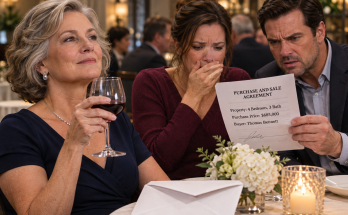
Sarah kept her fingers on the agreement.
She wasn't reading it anymore.
She was looking at me.
I recognized that expression.
I had seen it when she wanted me to change my mind about something.
The master bedroom.
The garage.
Another household expense.
For three years, I had usually given in.
This time, I waited.
“Mom, can't we work something out?”
Her voice was softer now.
I looked at her.
“What would we be working out?”
She glanced at Greg.
He leaned forward immediately.
“The sale. Obviously.”
I looked at the white envelope.
The document was still lying beside it.
The price hadn't changed.
Neither had the buyer's name.
Thomas Bennett.
Six hundred and eighty-five thousand dollars.
I had spent months reaching this decision.
Greg was talking as though ten minutes of arguing should be enough to reverse it.
“We could discuss other arrangements,” Sarah said.
I nodded.
“I tried discussing arrangements with you before.”
She looked uncomfortable.
I remembered standing in the hallway after refusing to pay another household expense.
I remembered her following me.
Her voice had been raised.
She had accused me of not contributing enough.
In my own house.
At the time, I had been so surprised that I hardly knew what to say.
Now I understood what had happened.
She had become accustomed to treating my financial support as an obligation.
And I had become accustomed to defending myself whenever I tried to keep something for my own needs.
I looked at her across the restaurant table.
“I've been trying to tell you something was wrong for a long time.”
She lowered her eyes.
Greg shook his head.
“That doesn't mean you sell the house.”
I looked toward him.
“No. It doesn't.”
He seemed encouraged.
Then I continued.
“But I decided selling was what I wanted.”
His expression tightened.
I wasn't interested in fighting.
I had done enough of that inside my own head.
For months, I had questioned whether I was selfish.
Whether I was abandoning Sarah.
Whether I owed Greg more time.
Whether selling the house meant disrespecting my husband's memory.
I had asked myself those questions repeatedly.
The answer hadn't come quickly.
But it had come.
I wanted to leave.
And I wanted to decide what happened to the home my husband and I had spent years paying for.
Sarah touched the agreement.
“Where are we supposed to go?”
I felt the familiar pull of guilt.
There it was.
The question that had governed so many decisions in our family.
What would Sarah do?
How would Greg manage?
What would happen if I refused to help?
I had been answering those questions with my money and my space for three years.
I didn't want them homeless.
I didn't want them frightened.
But I couldn't continue making their circumstances the only ones that mattered.
“You'll need to find another place,” I said.
Greg stared at me.
“Just like that?”
I looked at him.
“No. Not just like that.”
I reminded him that they had moved in temporarily.
Three years earlier.
After his investments had gone badly and their rent increased.
Sarah had called me crying.
I had opened my home because she needed help.
I hadn't asked them to sign anything that first night.
I hadn't demanded a payment before allowing them inside.
I had trusted her.
And for a while, the arrangement had worked.
They helped with utilities.
Greg maintained the lawn.
Sarah cooked occasionally.
We behaved like people sharing a home.
Then the arrangement changed.
Slowly.
So slowly that I almost failed to notice.
The master bedroom became theirs.
My belongings were moved.
The garage filled with Greg's exercise equipment.
My car stayed outside.
Then my pension began covering more household expenses.
And my daughter started treating ordinary decisions as things she could make without asking me.
I looked at Sarah.
“I didn't agree to give you the house.”
She swallowed.
“I know that.”
I waited.
She looked down.
“At least, I know now.”
Those last words mattered.
They were the first admission I had heard that evening that something about her expectations had been wrong.
Greg didn't seem interested.
He was looking at the price again.
“Six hundred and eighty-five thousand,” he said.
I didn't answer.
He pointed toward the paper.
“That's a lot of money.”
“Yes.”
“And you've already agreed to sell for that?”
“Yes.”
He looked frustrated.
I could almost see him searching for another argument.
I wondered whether he would question the buyer.
The price.
The paperwork.
Anything except the way he and Sarah had treated me.
Finally, he said the house had been in the family for decades.
I nodded.
“It has.”
He said selling it would be a mistake.
I thought about my late husband.
The mortgage payments.
The years when money was tight.
The garden we had cared for.
The garage where our belongings had been stored.
I remembered the pride we felt when the house was finally paid off.
Those memories mattered.
But the house wasn't the only place they could exist.
I looked at Greg.
“Living there has become painful for me.”
He shifted in his chair.
I continued.
“I don't want the rest of my life to feel that way.”
Sarah looked at me quickly.
“Mom, we never wanted you to be unhappy.”
I believed she didn't want to think of herself as someone who made her mother unhappy.
That wasn't the same as noticing what she had done.
I remembered my grandmother's baking sheets.
They were old.
Scratched.
Dark around the edges.
Sarah had thrown them away because she wanted the cupboard for her juicer.
I had told her those baking sheets mattered to me.
She had treated my feelings as an inconvenience.
I remembered Greg standing in my nearly empty bedroom.
Pleased that I was clearing out my belongings.
Thinking about where he could put his golf clubs.
Neither of them had asked why my room was becoming bare.
They had seen space opening up.
And they had imagined how to use it.
I looked at my daughter.
“When did you last ask whether I was happy living with you?”
She opened her mouth.
Then stopped.
I didn't need an answer.
Her silence told me she couldn't remember.
I wasn't trying to shame her.
I wanted her to understand that I had been a person living in that house.
Not merely a source of income.
Not an aging relative occupying a bedroom.
Not somebody whose belongings could be rearranged whenever the household needed more room.
A person.
With memories.
Preferences.
And a life that was still mine.
Sarah looked toward the window.
I watched her for a moment.
When she was little, I had been able to tell when she was upset by the way she held her shoulders.
I could still recognize it.
That was one of the hardest things about being her mother.
I could be angry with her.
I could be hurt.
I could know I needed distance.
And still, part of me wanted to reach across the table and make her feel better.
I had done that for so long.
Sometimes before she even asked.
But comforting Sarah had become a habit that cost me more than I understood.
I couldn't solve this by making another promise.
Greg picked up the agreement again.
He looked at Thomas's signature.
“Does this man understand that people are living in the property?”
“Yes.”
“Does he know we haven't agreed to leave?”
I kept my voice calm.
“I've been getting advice about the proper process.”
He looked at me.
I continued.
“I'm not going to force anyone out improperly. But I'm also not withdrawing the sale because you're upset.”
Sarah reached toward him.
“Greg, please.”
He put the papers down.
For a moment, the only sounds came from the restaurant.
Cutlery.
Quiet conversations.
Someone walking past our table.
I noticed the candle burning beside the wine bottle.
It had been placed there for my birthday dinner.
I had turned sixty.
That was the occasion Sarah had supposedly wanted to celebrate.
Instead, we were arguing about whether I was allowed to make decisions concerning my own house.
I looked at my daughter.
“Do you remember what you said earlier?”
She nodded slowly.
I waited.
She looked at the empty dessert plate.
“You mean about moving?”
“Yes.”
Her face tightened.
I reminded her that she had suggested senior living.
She had talked about needing more space.
Greg wanted a home office.
They had plans for the house.
Plans that didn't include me.
Sarah rubbed her forehead.
“I didn't explain it well.”
I thought about that.
Perhaps she hadn't.
But I had understood what she wanted.
She wanted me somewhere else.
And she wanted to stay where she was.
I didn't think more careful wording would change the meaning.
“You were clear enough,” I said.
She looked at me.
For the first time, I could see how painful it was for her to hear those words returned without an argument.
She had expected me to be frightened about leaving.
She hadn't expected me to have already made arrangements.
Greg glanced toward the restaurant entrance.
“We need time to figure this out.”
I nodded.
“There will be a proper process.”
He looked at me.
“But the sale is going ahead?”
“Yes.”
I didn't say it sharply.
I didn't need to.
The agreement was already on the table.
Sarah asked whether I had somewhere to go.
I told her I had made arrangements for my own next steps.
I didn't give her every detail.
Not because I wanted to punish her.
Because I had learned the value of keeping some decisions under my own control.
For years, every plan I mentioned became a discussion about how it affected Sarah and Greg.
I didn't want my next home chosen that way.
I wanted somewhere I could wake up without worrying about someone moving my belongings.
Somewhere the kitchen cupboards were mine to arrange.
Somewhere I didn't have to explain why I wanted to keep an old photograph.
I had spent enough time feeling unwelcome.
The thought of living differently still felt unfamiliar.
But I wanted to try.
Sarah folded the agreement carefully.
The paper made a soft sound.
I remembered my husband keeping mortgage statements in a drawer.
He had always been careful with documents.
He believed that when something mattered financially, we should understand exactly what we were signing.
I thought he would have wanted the same care now.
That was why I had spoken to professionals.
Why I had asked questions.
Why I had taken my time.
I didn't want an argument to replace a proper transaction.
And I didn't want my daughter to believe I was making decisions out of anger.
The sale wasn't revenge.
It was a way forward.
Sarah finally looked directly at me.
“Do you hate us?”
The question startled me.
I shook my head.
“No.”
Tears gathered in her eyes.
“Then why does it feel like you're leaving us?”
I looked at her for a long time.
I wanted to choose my words carefully.
“Because I've been living with you without feeling welcome for a long time.”
She began crying.
I let her.
Not because I wanted her to suffer.
Because I had spent years trying to prevent every uncomfortable feeling she experienced.
And it hadn't helped either of us.
She was allowed to be upset.
I was allowed to make my decision.
Both things could be true.
Greg leaned toward her.
He told her they should go home.
Then he looked at me.
“We'll discuss this later.”
I nodded.
“We can discuss the practical arrangements.”
He appeared ready to argue again.
I continued.
“But my decision to sell isn't up for a vote.”
He stopped speaking.
I could see that he disliked the answer.
I had no better one to offer.
Sarah reached for her purse.
She looked exhausted.
I felt exhausted too.
I had imagined my sixtieth birthday ending differently.
Perhaps with laughter.
Perhaps with a photograph of the three of us at dinner.
Perhaps with a few kind words about getting older.
Instead, I was watching my daughter try to understand that she could no longer decide where I belonged.
I picked up the white envelope.
The paper inside was no longer a surprise.
It had served its purpose.
Sarah knew about the sale.
Greg knew about the sale.
And I had finally said aloud what I had been afraid to say for years.
I wanted a life of my own.
I stood carefully.
Sarah watched me.
For one brief moment, I could see the little girl I had raised.
That made leaving the table difficult.
But it didn't make the decision wrong.
I looked at her.
“I love you, Sarah.”
She wiped her cheeks.
“I love you too, Mom.”
I wanted to believe we could someday say those words without using them to avoid difficult conversations.
Perhaps we could.
But not tonight.
I took my purse.
The white envelope went inside.
And I walked away from the restaurant table knowing that my daughter finally understood something I had needed to understand myself.
Loving her didn't require me to surrender my home.
Click here to continue reading: PART 10: I Sold the House My Husband and I Had Worked Decades to Own, and Finally Learned That Leaving Was Not the Same as Abandoning My Daughter
I Watched My Daughter Pull a Paper From the White Envelope, Knowing She Was About to Learn What I Had Already Decided
Part 9 of 10