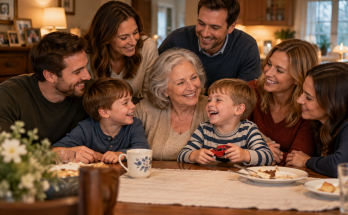
Three months after the celebration at Eleanor’s Table, my brother Gabriel called me on a rainy Thursday morning.
“Emily, are you busy?”
I was standing in my kitchen, washing a coffee mug.
“Not really. Why?”
He was quiet for a moment.
Then he said, “I found something in Mom’s old paperwork. I think you should see it.”
I closed the faucet.
“What kind of paperwork?”
“I’m not sure how to explain it over the phone.”
I felt that familiar tightening in my chest.
For most of my life, I had believed my mother was an ordinary woman with an ordinary past.
Then I discovered she had given birth to Gabriel at seventeen.
I learned that the homeless boy she had fed behind our house was actually my older brother.
I found out that she had spent twenty years keeping us apart because she was afraid of telling the truth.
And somehow, despite everything, Gabriel and I had found our way toward becoming a family.
I thought we had finally uncovered every secret she had left behind.
I was wrong.
“Gabriel,” I said carefully, “please tell me this isn’t another family secret.”
He sighed.
“I hope it isn’t.”
An hour later, I arrived at Mom’s house.
Gabriel’s black SUV was parked in the driveway.
The front door was unlocked.
I stepped inside and found him sitting at the kitchen table.
He was wearing jeans and a gray sweater instead of the expensive business clothes I had first seen him wearing after Mom’s funeral.
In front of him sat a small cardboard box.
Mom’s blue sweater was still hanging over the back of her chair.
Neither of us had been able to move it.
“Hey, little sister,” he said.
I smiled.
“Hey.”
He stood and hugged me.
It was something we did naturally now.
A year earlier, I could barely imagine touching him without remembering the resentment I had carried since childhood.
Now his hugs felt like something I had been missing without knowing it.
I sat down.
“What did you find?”
Gabriel pushed the box toward me.
“I was looking for some of Mom’s old volunteer records.”
I opened it.
Inside were several folders, a worn address book, and a bundle of letters held together with a faded ribbon.
I recognized my mother’s handwriting immediately.
“What are these?”
“Letters she wrote over the years.”
“To whom?”
Gabriel hesitated.
“To me.”
I looked up.
“You already knew about them?”
“Some of them.”
He reached for the bundle.
“But there are letters in here she never gave me.”
I frowned.
“Why not?”
“I think she wrote them before I found her.”
My eyes moved toward the old envelopes.
On the front of one, Mom had written a date.
It was from the year Gabriel turned five.
I picked it up carefully.
The paper was yellow and fragile.
“Can I read it?”
Gabriel nodded.
“I think she would have wanted us both to.”
I unfolded the letter.
My sweet Gabriel,
Today you are five years old.
I don’t know where you are or whether anyone is making you a birthday cake.
I hope someone sings to you.
I hope someone holds your hand when you are frightened.
And I hope that wherever you are, you know you were loved before you ever opened your eyes.
I stopped reading.
My throat burned.
Gabriel stared down at his hands.
“She wrote one every birthday,” he said.
I looked at the bundle.
There were so many.
“She kept all of them?”
He nodded.
“Until I found her.”
I unfolded another letter.
This one was dated thirteen years after his birth.
Dear Gabriel,
You are thirteen today.
I wonder whether you like baseball or music.
I wonder whether you have your father’s eyes.
Sometimes I look at children your age in grocery stores and wonder if you might be among them.
I know that sounds foolish.
But a mother never stops looking for the child she lost.
A tear fell onto my hand.
I wiped it away before it touched the paper.
Gabriel spoke quietly.
“I never knew she did this.”
I looked at him.
“You didn’t?”
He shook his head.
“She told me she thought about me every birthday. But I didn’t know she wrote letters.”
I glanced around the kitchen.
Suddenly I remembered something from my childhood.
Every year, near the beginning of spring, Mom spent one evening alone in her bedroom.
She would close the door and tell me she needed some quiet time.
I used to think she was upset about Dad.
But some of those evenings had happened while Dad was still alive.
I looked back at Gabriel.
“Was your birthday in March?”
He nodded.
“March seventeenth.”
My heart sank.
That was the day.
Every year.
The same day Mom disappeared into her bedroom.
I pressed my fingers against my lips.
“Oh, Gabriel.”
He looked at me.
“What?”
“She used to shut herself away every March seventeenth.”
His expression changed.
I swallowed.
“I remember asking Dad why she was sad.”
Gabriel leaned forward.
“What did he say?”
“He told me some memories take longer to stop hurting.”
For a long moment, neither of us spoke.
Then Gabriel lowered his head.
“I wish I could thank him.”
“Dad?”
He nodded.
“For loving her even with all that sadness.”
I looked toward the window.
Rain slid down the glass.
“Dad loved her more than anything.”
Gabriel smiled faintly.
“I think he must have.”
We spent the next two hours reading Mom’s letters.
Some were only a few sentences.
Others filled several pages.
She wrote about seeing a little boy in a red jacket who reminded her of Gabriel.
She wrote about hearing a child laugh on a crowded bus and wondering whether her son laughed the same way.
She wrote about meeting my father.
About telling him the truth.
About being terrified that he would leave.
And about the moment he took her hand and promised that having loved one child did not make her less worthy of being loved herself.
I had never heard that story.
Mom never spoke much about the early years of her marriage.
I knew Dad had been kind.
Patient.
Quiet.
But I had never understood how much kindness he had shown her before I was born.
Then I found a letter dated the year I arrived.
My hands began trembling as I unfolded it.
Dear Gabriel,
Today you became a big brother.
Her name is Emily.
She has tiny fingers and dark hair, and she makes the funniest little sounds when she sleeps.
I wish I could show her to you.
I wish you could hold her.
I hope one day you will meet her and know that she was never meant to replace you.
I covered my mouth.
Gabriel looked up.
“What does it say?”
I handed him the letter.
He read it slowly.
Then he stopped.
I watched his eyes fill with tears.
“She told me about you,” he whispered.
I nodded.
“From the day I was born.”
He looked at me.
For the first time, I saw something in his expression that reminded me of the frightened teenager who had once stood behind our house.
“I thought she started thinking about us being a family after I found her.”
I shook my head.
“No.”
He looked back at the letter.
“She wanted us together before I even knew you existed.”
I reached across the table.
He took my hand.
We sat there holding on to each other while the rain continued outside.
Eventually, Gabriel wiped his face.
“There’s something else.”
I looked up.
He reached into the bottom of the box.
This time he removed a small photograph album.
Its cover was faded green.
The corners had begun to peel.
I recognized it.
Mom had kept that album in her bedroom closet for as long as I could remember.
Whenever I asked to look inside, she told me it contained old family pictures.
I had assumed they were photographs of grandparents and relatives who had died before I was born.
Gabriel placed it between us.
“Have you seen this before?”
I nodded.
“But she never let me open it.”
He looked surprised.
“Really?”
“Yes.”
I opened the cover.
The first photograph showed Mom at seventeen.
She was standing outside the same hospital where Gabriel had been born.
In her arms was a newborn wrapped in a white blanket.
We had already seen another photograph from that day.
But this one was different.
A woman stood beside Mom.
She appeared to be in her forties.
Her face was stern.
Her hand rested on Mom’s shoulder.
I recognized her immediately.
“Grandma.”
Gabriel leaned closer.
“That’s her?”
I nodded.
My grandmother had died when I was twelve.
I remembered her as a strict woman who believed children should be quiet, obedient, and grateful for everything they received.
She rarely hugged me.
She almost never laughed.
And she never mentioned Gabriel.
I stared at her face in the photograph.
For the first time, I wondered what she had said to my mother on the day that picture was taken.
Whether she had comforted her.
Whether she had allowed her to cry.
Or whether she had simply reminded her that the baby would soon belong to someone else.
Gabriel turned the page.
There were photographs of Mom as a young girl.
School pictures.
A graduation ceremony.
A small wedding.
Dad stood beside her in a dark suit, smiling proudly.
Then came pictures of me.
My first birthday.
My first bicycle.
My first day of school.
I smiled despite the tears still drying on my cheeks.
“Look at my haircut.”
Gabriel laughed.
“Mom did that?”
“Unfortunately.”
He shook his head.
“She really shouldn’t have been allowed near scissors.”
I laughed harder than I had expected.
It felt good.
Then Gabriel turned another page.
The laughter stopped.
There was a photograph of me at eight years old.
I was standing in the backyard beside Mom.
Gabriel was there too.
He was thin and awkward, wearing an old brown jacket.
I remembered that afternoon.
Mom had asked me to stand beside him.
I had refused.
She had finally convinced me to stay still long enough for a photograph.
But I kept my arms folded.
My face was angry.
Gabriel stood a little apart from us.
And Mom smiled as though she were trying desperately to make the moment happy.
I touched the photograph.
“I was so mean to you.”
Gabriel shook his head.
“Emily.”
“I remember that day.”
“So do I.”
I looked at him.
“What did you think when she asked us to take that picture?”
He considered the question.
Then he smiled sadly.
“I thought it was the first family photograph I’d ever taken with my birth mother.”
My heart broke.
For me, it had been a picture with a stranger.
For him, it had been something precious.
I stared at his younger face.
“I wish I could go back.”
Gabriel squeezed my shoulder.
“We can’t.”
“I know.”
“But we can take new pictures.”
I turned toward him.
He smiled.
“And maybe this time you’ll smile.”
I laughed through my tears.
“Only if you promise not to wear that terrible jacket.”
He looked offended.
“That was my best jacket.”
We both began laughing.
And somehow, in the middle of Mom’s quiet kitchen, surrounded by the mistakes and sorrows of our past, it felt as though something inside me finally loosened.
Not all the guilt disappeared.
Not all the years were returned.
But the distance between us grew a little smaller.
That afternoon, Gabriel and I decided to put Mom’s letters into a new album.
We arranged them by year.
We included photographs and little notes explaining what was happening in our lives at the time.
Gabriel brought pictures from his adoptive childhood.
I added photographs from mine.
For the first time, we began building a history that included both of us.
It was not the childhood we should have shared.
But it was ours.
A few weeks later, Gabriel invited me to Eleanor’s Table.
He wanted my help preparing a new family meal program.
I arrived early on a Saturday morning.
The kitchen was already busy.
Volunteers carried boxes of vegetables.
A young man stirred soup in an enormous pot.
Denise stood near the counter checking a clipboard.
She smiled when she saw me.
“Emily! You’re just in time.”
“For what?”
She handed me an apron.
“Your brother volunteered you to help bake.”
I laughed.
“Of course he did.”
Gabriel appeared behind her.
“It’s your specialty.”
I raised an eyebrow.
“You mean because I made six apple pies for your birthday?”
“Exactly.”
He grinned.
“Clearly, you’re qualified.”
I tied the apron around my waist.
“All right. What are we making?”
Denise pointed toward a stack of ingredients.
“Apple pies.”
I stared at Gabriel.
He shrugged.
“People love them.”
I laughed.
And then I began working.
As I peeled apples, I watched the people moving through the dining room.
Some were volunteers.
Some were families who had come for breakfast.
Others were people still struggling to find stable housing.
I thought about Gabriel at eighteen.
Sleeping behind our house.
Hoping that one day he could stop worrying about his next meal.
I looked toward him.
He was helping an elderly man carry a tray.
There was nothing in his manner that suggested he owned a successful transportation company operating across six states.
He simply listened.
Asked questions.
Remembered names.
And treated everyone as though they mattered.
I understood why Mom had been so proud of him.
Later that morning, a little boy approached the kitchen counter.
He couldn’t have been more than nine.
He wore an oversized blue sweatshirt.
His mother stood a few steps behind him.
The boy stared at the pies cooling near the window.
“Excuse me,” he said.
I smiled.
“Yes?”
“Can I have a piece?”
“Of course.”
He glanced toward his mother.
“Can she have one too?”
I nodded.
“Absolutely.”
I placed two slices on separate plates.
The boy took them carefully.
Then he looked up at me.
“Thank you.”
Something about his expression caught me off guard.
He had the same cautious look Gabriel wore in that old backyard photograph.
The look of a child who had learned not to expect too much.
I watched him carry the plates to his mother.
She touched his cheek.
Then she looked toward me and mouthed, “Thank you.”
My eyes filled.
Gabriel stepped beside me.
“You okay?”
I nodded.
But I couldn’t speak immediately.
He followed my gaze toward the little boy.
Then he understood.
“Mom used to say something about moments like that,” he said.
I looked at him.
“What?”
He smiled softly.
“She said you never know which meal someone will remember for the rest of their life.”
I thought about the apple pie I had spent twenty years resenting.
One plate.
One birthday.
One misunderstanding that had shaped so much of my childhood.
Then I looked at the little boy sitting beside his mother.
And I realized how differently I saw that same act of kindness now.
I reached for Gabriel’s hand.
“Do you think we could make this a regular thing?”
He looked at me.
“What?”
“Family baking day. Every month.”
His face brightened.
“You’d really do that?”
I smiled.
“Why not?”
He hugged me.
“Mom would have loved it.”
I nodded.
“She would.”
That evening, after the last meal had been served and the kitchen had been cleaned, Gabriel and I sat at one of the empty tables.
Outside, the sky was turning pink.
He pushed a small envelope toward me.
I looked at it.
“What’s this?”
“A picture.”
I opened it.
Inside was a photograph taken earlier that morning.
Gabriel and I were standing in the kitchen.
He had flour on his sweater.
I was holding a tray of pies.
And we were both laughing.
Not posing.
Not trying to look like a perfect family.
Just laughing.
I stared at the photograph for a long time.
Then I remembered the old picture in Mom’s garden.
The little girl with folded arms.
The lonely teenager standing awkwardly beside her.
The mother smiling through a sadness neither child understood.
I placed the new photograph beside the old one on my phone.
Twenty years separated them.
Twenty years of secrets.
Resentment.
Loneliness.
And regret.
But in the new photograph, Gabriel’s arm was around my shoulders.
My head was tilted toward his.
And for once, neither of us looked as though we were standing in the wrong place.
I smiled.
“This one’s going in the album.”
Gabriel nodded.
“Definitely.”
I looked at him.
“Maybe we should take one every year.”
He grinned.
“Only one?”
I laughed.
“Fine. Every month.”
He leaned back in his chair.
“Deal.”
For a moment, we sat quietly.
Then Gabriel looked toward Mom’s photograph hanging by the entrance.
“I still miss her every day,” he said.
I followed his gaze.
“Me too.”
His voice softened.
“Sometimes I wish she could see us now.”
I took his hand.
“I think she would be happy.”
He nodded.
And when we finally left Eleanor’s Table that evening, I carried the photograph home with me.
I placed it in a frame beside Mom’s picture.
Every morning afterward, when I walked into my living room, I saw them together.
The mother who had loved us imperfectly.
The brother I had nearly lost without ever knowing he was mine.
And the family we were still learning to become.
END PART 3