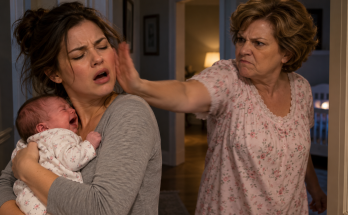
She had always understood that fear could make people careless. She also understood that caution was not the same thing as dishonesty.
Voss folded his arms. “Tessa, I need to know what evidence exists and how it was obtained.”
“You will.”
“That isn’t an answer.”
“No,” I said. “It’s a promise.”
For a moment, nobody spoke.
Outside the hospital room, a cart squeaked down the hallway. A nurse laughed softly at something another nurse had said. The ordinary sounds seemed almost unreal.
My family had told the police I was unstable.
Maybe they expected me to be incoherent. Maybe they thought pain would make me confess to anything just to be left alone.
But I had spent two years preparing for the possibility that nobody would believe me.
I had learned to keep copies.
I had learned to write down dates.
I had learned that a quiet person could be mistaken for a powerless one.
Bridget turned the laptop toward Voss.
“The first folder is labeled Northstar,” she said. “That’s the family business.”
“Northstar Senior Support,” I added.
Voss opened the first spreadsheet.
Northstar was the company my mother had built fifteen years earlier. On paper, it provided in-home assistance to elderly clients who needed help with meals, transportation, medication reminders, and household tasks.
My father handled contracts and insurance.
My mother handled staff.
Emma had recently started working in the office, mostly managing social media and client newsletters.
And I had handled the books.
At least, that was what everyone believed.
I had started as a receptionist when I was nineteen. Within a year, I was processing invoices. By twenty-three, I was reconciling accounts and preparing reports for the accountant.
That was how I first noticed the numbers that didn’t make sense.
Small inconsistencies.
A client billed for three visits on a day when the assigned aide had been out sick.
Mileage reimbursement submitted for routes no employee had driven.
Supplies charged to clients who had never requested them.
At first, I assumed it was sloppy bookkeeping.
Then I found a payment made to a company called Cedar Lane Consulting.
The company had no website, no employees, and no listed office address.
Its registered agent was my father.
I stared at the spreadsheet on the screen.
“It wasn’t one mistake,” I said. “It happened every month.”
Voss scrolled through the records.
“How much?”
“Across four years? Approximately eight hundred thousand dollars.”
He looked at me sharply.
I added, “That’s only what I could trace.”
Bridget placed another document in front of him. “The payment trail is supported by bank statements and tax filings. Tessa also preserved internal emails.”
Voss opened a message.
The sender was my mother.
*Move the client adjustments before the quarterly review. Tessa is asking too many questions.*
The recipient was my father.
His reply was brief.
*I’ll handle it.*
Voss leaned back.
“Why didn’t you report this?”
The question was reasonable.
It still hurt.
“Because I thought I could fix it without destroying everyone,” I said.
Bridget’s expression softened.
I kept looking at the screen.
“My mother had built the company from nothing. Employees depended on it. Some of the clients depended on it. I thought if I gathered enough information, I could make them stop quietly.”
“And did they know you were looking?”
“I don’t think so.”
Voss studied me. “What changed?”
I touched the edge of the blanket.
“Last spring, I found a second set of records. Payments weren’t just being moved through Cedar Lane. They were being used to cover personal debts.”
“Your parents’ debts?”
“Yes.”
“How personal?”
“Credit cards. A renovation loan. A private settlement with a former employee.”
Voss’s face hardened. “What kind of settlement?”
“I don’t know all the details. I found a copy of the agreement, but several pages were missing.”
Bridget reached into the banker’s box and removed a clear evidence sleeve.
Inside was a torn document.
“Those pages were not missing,” she said. “They were shredded. Tessa found fragments in the office recycling bin and reconstructed what she could.”
Voss read the visible lines.
His jaw tightened.
“What happened to the employee?”
“She was fired after reporting false billing. My mother told everyone she had stolen money.”
“Had she?”
“No.”
I said it quietly, but the certainty behind it surprised me.
“Her name was Lorna Bell. She had worked for Northstar for eight years. I found a message she sent Dad. She said she had proof that supervisors were being told to sign visit logs for services they never provided.”
Voss looked back at the screen.
“Where is Lorna now?”
“I don’t know. She moved out of state.”
Bridget glanced at me. “We can locate her.”
“I hope you do.”
The room became quiet again.
I had spent so long carrying those facts alone that seeing them displayed in orderly folders felt almost frightening. Evidence was supposed to make me feel safe.
Instead, it made everything real.
My family had not simply been cruel.
They had built a life around decisions they kept insisting were harmless.
One altered invoice became a habit.
One false accusation became a method.
One frightened employee became an inconvenience.
And whenever anyone questioned them, they called that person difficult, unstable, or ungrateful.
Voss clicked open another folder.
This one was labeled *Personal*.
There were photographs, scanned letters, and audio files.
“Why did you keep personal material with the financial evidence?” he asked.
“Because the two were connected.”
He opened a photograph.
It showed a white envelope on a desk.
The handwriting belonged to my mother.
Voss zoomed in.
“‘Dr. Vale,’” he read.
My chest tightened.
Dr. Miriam Vale was our family physician. She had treated my parents for years. She had also signed the emergency psychiatric commitment request that my family submitted after leaving me.
“I met with her once,” I said. “About six months ago.”
Bridget looked at me.
“You didn’t mention that.”
“I didn’t know if it mattered.”
“What happened?”
“I went in for migraines. She asked whether I was sleeping. I told her I was having trouble because of stress at home.”
“And?”
“She asked if I felt safe.”
Voss watched me carefully.
“What did you say?”
“I said I wasn’t sure.”
The words felt different now that I heard them aloud.
At the time, I had been thinking about the financial records. About my mother’s anger whenever I asked questions. About my father’s habit of locking his office door. About Emma sending me messages from the next room instead of speaking to me directly.
I had not meant that I was in immediate danger.
I had meant that home no longer felt like home.
“But Dr. Vale wrote that I was paranoid,” I continued. “She said I had an unhealthy fixation on my family’s finances.”
Voss opened the report.
There it was.
*Patient exhibits suspicious thought patterns and possible persecutory ideation.*
My face grew warm.
“I never saw this until after I got here.”
Bridget read the report twice.
“Did you tell her about the missing funds?”
“Yes.”
“Did you show her anything?”
“No. I was afraid my mother would find out.”
Voss rubbed a hand over his chin. “This report was used to support the commitment request.”
“I know.”
“Did Dr. Vale know your parents were involved in the company?”
“She was their doctor before she was mine.”
Bridget leaned toward the screen. “There’s a date on this document.”
“Six months ago,” I said.
“No.” She pointed to the bottom. “The report was amended three weeks later.”
Voss enlarged the page.
The original timestamp showed one date.
The metadata showed another.
The report had been edited after my visit.
Bridget’s expression changed.
“Someone added the language about persecutory ideation later.”
Voss looked at me. “Do you have the original?”
“I do.”
He opened a file with the same name.
The first version was shorter.
It described stress, headaches, and difficulty sleeping. It did not mention paranoia. It did not recommend psychiatric intervention.
Voss stared at both versions.
“Why would a doctor alter a medical record?”
“I don’t know,” I said.
But a thought had already formed.
“Maybe she was asked.”
“By whom?”
I looked at the envelope in the photograph.
“My mother.”
Bridget clicked through the remaining files.
A scan of a bank transfer appeared.
The sender was my father.
The recipient was a company connected to Dr. Vale’s husband.
The amount was twelve thousand dollars.
The description read: *Consulting—office systems review.*
Voss sat very still.
“Do you know what this payment was for?”
“No.”
“Did Dr. Vale’s husband provide services to Northstar?”
“Not that I ever saw.”
Bridget opened another document.
A text message from my mother to an unknown number.
*She is starting to remember conversations differently. I need the paperwork clean before she talks to anyone.*
Voss read it once.
Then again.
“Whose number is that?”
“I don’t know.”
“You saved it?”
“No. I took a screenshot.”
“Why?”
“Because I found it on my mother’s tablet.”
“Were you authorized to access the tablet?”
I met his eyes.
“No.”
Bridget answered before he could. “Detective, we are not asking you to ignore how the evidence was obtained. We are asking you to recognize what it may establish. The original devices can be examined through proper legal process.”
Voss nodded, though reluctantly.
He was not my ally because he believed me.
He was my ally because he was beginning to see reasons to investigate.
That distinction mattered.
Too many people wanted rescuers to arrive with certainty. In real life, certainty usually came later, after paperwork, interviews, and long hours of checking what everyone had said against what had actually happened.
Voss closed the file.
“What happened the night your family left you?”
The question settled over the room.
My fingers curled into the blanket.
Bridget did not interrupt.
I told him what I remembered.
Not every detail.
Only the sequence.
My mother shouting.
My sister holding up her phone.
My father standing in the doorway and refusing to look at me.
The drive.
The cold.
The alley.
Voss listened without moving.
When I finished, he said, “Your family claims you attacked your mother.”
“I didn’t.”
“Your mother has photographs of bruising.”
I looked at Bridget.
She nodded grimly. “She submitted them.”
“I never touched her.”
“I believe you,” Voss said.
The words should have comforted me.
Instead, they scared me.
Belief was fragile. It could shift with the next document, the next statement, the next version of events.
“I have something else,” I said.
Bridget turned toward me.
“You didn’t put it on the drive?”
“No.”
“Where is it?”
“Still in my apartment.”
Voss frowned. “Your apartment has been searched.”
“I know.”
“Then it may be gone.”
“No.” I swallowed. “They searched the obvious places.”
“What did you hide?”
I looked at the ceiling.
For months, I had kept a small metal box in the ventilation duct behind the bookcase. It held a backup phone, a handwritten ledger, and a key.
Not a house key.
A storage key.
The storage unit had been rented under my middle name, with payments made through an account my family didn’t know existed.
Inside was the first evidence I had ever collected.
The documents that had started everything.
“I have a storage unit across town,” I said. “The key is in my apartment.”
Voss stood.
“I’ll arrange for an officer to retrieve it.”
“No.”
His expression tightened. “Tessa—”
“I want to go with you.”
“You’re not being discharged yet.”
“Then I want Bridget to go.”
Bridget was already shaking her head. “Not until you’re medically cleared.”
“I need to know what’s there.”
“You know what’s there,” she said. “You put it there.”
“I know what I put there. I don’t know what my family may have found.”
That silenced her.
Voss glanced at the laptop.
“What exactly is in the unit?”
“A paper ledger. Original letters from employees. A duplicate of the Northstar server archive.”
“Why didn’t you tell me sooner?”
“Because I didn’t know if I could trust you.”
He accepted that without offense.
“Fair enough.”
The door opened, and a nurse stepped inside.
“Sorry to interrupt,” she said. “There’s someone here asking to see Tessa.”
My heart stopped.
“Who?”
The nurse checked her clipboard.
“Emma Hart.”
I expected anger.
Instead, a strange emptiness spread through me.
Emma had not visited since the night I was found.
Not once.
Not even after I woke up.
Voss looked at me. “Do you want to see her?”
I didn’t know.
That was the honest answer.
Bridget leaned close. “You don’t have to.”
I stared at the closed door.
The last clear image I had of Emma was her holding up her phone while I begged her to call for help.
But another image existed too.
Emma at eleven, asleep against my shoulder during a thunderstorm.
Emma at fourteen, asking me to help with her college application.
Emma at nineteen, standing in the kitchen and saying, “Mom gets angry when you ask too many questions.”
I had dismissed that moment as frustration.
Now I wondered if it had been fear.
“Let her in,” I said.
Bridget looked as though she wanted to object, but she only moved her chair closer to mine.
Voss stayed by the door.
Emma entered alone.
She looked different without makeup.
Younger.
Not like a child. She was twenty-two. But without the careful expression she wore around our parents, she seemed uncertain and exhausted.
Her eyes were red.
She stopped when she saw the detective.
“I didn’t know he’d be here.”
“He is,” I said.
She looked at me.
For several seconds, neither of us spoke.
Then she whispered, “I’m sorry.”
The words fell into the room and stayed there.
I wanted to accept them.
I wanted to reject them.
Instead, I asked, “For what?”
Emma’s mouth trembled.
“For recording you.”
My stomach tightened.
“Why did you?”
She looked down at her hands.
“Mom told me to.”
Bridget’s gaze sharpened.
Emma continued quickly. “She said you were dangerous. She said you were going to hurt yourself and blame all of us. She told me to document your behavior so nobody could accuse her of doing anything.”
“You laughed.”
Emma closed her eyes.
“I know.”
“You laughed while I was asking you to call someone.”
“I was scared.”
“People who are scared don’t always laugh.”
“I know.”
Her voice broke, but I did not reach for her.
Not yet.
“What happened to the video?” I asked.
“Mom has it.”
“Did you send it to her?”
“Yes.”
“Did you send it to anyone else?”
Emma shook her head.
Then she hesitated.
That hesitation was small.
But I saw it.
“Emma.”
She lifted her eyes.
“There’s another copy.”
“Where?”
“On my old tablet. I forgot it was still connected to the family cloud account.”
Voss stepped forward. “What does the copy show?”
“More than the video I sent Mom.”
Emma’s hands began to shake.
“It starts earlier. Before you came into the room.”
I felt cold move through me.
“What does it show?”
She looked at the detective.
“Dad was talking to Mom.”
“About what?”
“I don’t know. I wasn’t supposed to be listening.”
“But you were.”
Emma nodded.
“He said the doctor had agreed to sign the paperwork if they could prove you were unstable.”
Bridget stood very still.
“What paperwork?” Voss asked.
“The commitment request.”
My breath caught.
Emma looked at me, and tears finally slipped down her face.
“There’s more,” she said. “Dad told Mom the storage unit was the only thing they still had to find.”
Voss’s attention sharpened.
“What did your father say exactly?”
Emma reached into her coat pocket and pulled out her phone.
“I wrote it down after I watched the video again.”
She unlocked the screen and handed it to Voss.
He read silently.
His expression changed.
Then he looked at me.
The words Emma had transcribed were simple.
*If Tessa gets to that unit, everything is over.*
Below them was a second line.
*And if she remembers who opened the account, we’re finished.*
I stared at the phone.
“I opened the account,” I said.
Emma shook her head.
“No.”
Her voice was barely audible.
“Dad did.”
The room seemed to narrow around us.
Voss looked from Emma to me.
“What does that mean?”
Emma pressed her lips together, as if she had been holding the next words inside for too long.
“The storage unit wasn’t rented under your middle name, Tessa.”
She turned the phone toward me.
A photograph filled the screen.
It showed a rental agreement.
The signature at the bottom was unmistakable.
My father’s.
And beside his name was a second line I had never seen before.
Authorized occupant: Tessa Hart.
Emma whispered, “He put the evidence there before you ever knew it existed.”
-END OF PART 2, –PRESS NEX PART IN BOTTOM OF PAGE TO READ NEXT PART