The final court date arrived after weeks of paperwork and discussion.
By then, I knew the routine.
I checked the calendar.
I confirmed the time with my attorney.
I made sure Maya's school arrangements were in place.
Then I put the folder in my bag and left the house.
The legal process had not turned into the dramatic ending I once imagined.
There had been no single document that explained every financial question.
There had been no moment when Julian stood before me and admitted that every concern I had raised was justified.
There had been records to review, questions to answer, and decisions the court had to make.
Some financial issues had been clarified.
Others had remained disputed, and the court had addressed them through the disclosure process and the evidence available.
I had learned to distinguish between what I could establish and what I could only suspect.
That distinction had become important to me.
It had also become a kind of relief.
I no longer had to make every unanswered question carry the weight of my entire marriage.
When I arrived at the courthouse, my attorney was waiting near the entrance.
She asked whether I had the latest copy of the proposed orders.
I handed it to her.
We reviewed the remaining points before going inside.
The parenting schedule had been revised several times.
The latest version included clear arrangements for school days, weekends, and exchanges.
It also required us to communicate directly about changes rather than asking Maya to carry messages.
I read the wording one last time.
There were parts I would have written differently.
There were compromises I had not expected to make.
But the schedule was clear enough to follow.
And it kept Maya's routine at the center of the arrangement.
Inside the courtroom, Julian sat beside his attorney.
He looked tired.
So did I.
For months, I had imagined that seeing him at the end of the case would make me feel something decisive.
I expected anger.
I expected relief.
I expected to know whether I still hated him or whether I had finally moved beyond that feeling.
Instead, I felt quiet.
Judge Thorne entered, and we stood.
Once the hearing began, the attorneys reviewed the remaining issues.
They discussed the final paperwork and confirmed which matters had been resolved.
The financial questions were addressed according to the records and the court's directions.
The judge did not treat every suspicion as a proven fact.
He did not accept every assurance without examining the available evidence.
He considered what had been established and what remained within the limits of the proceeding.
That was what I had wanted, even when I had been too frightened to describe it that way.
I wanted the questions taken seriously.
I wanted the decisions based on evidence.
I wanted to stop feeling that Julian's confidence could make my concerns disappear.
The court then reviewed the parenting arrangements.
Our attorneys confirmed the terms of the proposed schedule.
Judge Thorne asked whether both parents understood their responsibilities.
We did.
He emphasized that Maya's welfare remained the priority and that neither parent should involve her in disputes about money or the divorce.
I listened carefully.
I thought about the day Maya had stood beside the child advocate with her rabbit tucked under one arm.
I remembered how small she had looked when she asked the judge whether she could show him something.
I remembered the silence that followed the video.
I had been so focused on what the recording might prove that I had almost forgotten what it had cost Maya to bring it forward.
She had been worried enough to ask an adult for help.
That was what I needed to remember.
The judge completed the necessary review.
The divorce was settled under the final orders, and the parenting arrangements were put into place.
There was no applause.
No one stood up to congratulate me.
The clerk organized the paperwork, and the attorneys discussed the remaining administrative steps.
The marriage was over.
I sat still for a moment, trying to understand what I felt.
I had wanted the case to end.
I had not understood how strange the quiet afterward would be.
My attorney touched my arm.
“We'll go through the final documents together,” she said.
I nodded.
We left the courtroom and found a quiet place to review the paperwork.
She explained the terms and answered my questions.
I asked about the remaining financial provisions.
She showed me where the final orders addressed them.
I asked about the parenting schedule.
She pointed to the dates and responsibilities we had discussed.
I read everything carefully.
Then I signed where required.
My hand trembled slightly.
Not because I was unsure that the marriage was ending.
Because I understood that signing the papers would not make every feeling disappear.
I would still have days when I remembered the man I had married.
I would still wonder about parts of our life that had never been fully explained.
I would still feel angry about the accusations he had made and frightened by the way money had been used in our dispute.
But I no longer needed those feelings to decide what I did next.
When I left the courthouse, the sun was bright.
People moved along the sidewalk, carrying folders and phones, talking about ordinary things.
I stood beside my car and took a deep breath.
For months, I had measured progress by the size of the folder in my hands.
Now I was holding the final paperwork.
It was thinner than the stack I had carried into the first hearing.
I placed it on the passenger seat.
Then I drove home.
The house looked the same when I opened the front door.
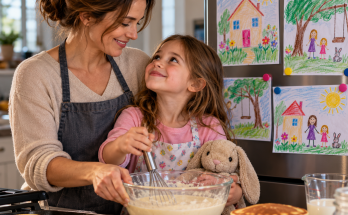
The refrigerator still held Maya's drawings.
The kitchen table still had a small mark near the edge.
The drawer still contained the notebook where I had recorded the financial questions.
I walked to the refrigerator first.
The house with the bright front door was still there.
So was the park picture.
The drawing of the tree and swing was beside them.
I touched the corner of the first picture and pressed it flat.
Then I put the final court papers in the drawer.
I did not place them on the kitchen table.
I did not open the notebook.
I washed a few dishes and wiped the counter.
When I finished, I stood in the quiet kitchen and listened to the refrigerator hum.
The silence felt different now.
It was not the silence of waiting for Julian to come home.
It was not the silence after an argument when I was trying to decide what I should have said.
It was simply a quiet room.
I was allowed to be in it without defending myself.
Maya came home later that afternoon.
She dropped her backpack near the door and ran toward me.
“Can we make pancakes?”
I laughed.
“Is that going to be your question every day?”
“Maybe.”
I hugged her.
“Then I suppose we'd better make them.”
She helped me get the bowl and the flour.
She poured the milk carefully, then looked at me with a serious expression.
“Mom?”
“Yes?”
“Is everything okay now?”
I put the measuring cup down.
I did not want to tell her that every problem was over.
She would learn soon enough that life did not work that way.
But I could answer the question beneath her question.
“We have a plan now,” I said. “The adults have made the arrangements, and you don't have to fix anything.”
“Will we still do our things?”
“Absolutely.”
“Pancakes?”
“Definitely.”
She smiled.
Then she began stirring the batter.
We cooked the pancakes in small circles, just as she liked them.
One turned out uneven.
Another was a little too dark on one side.
Maya ate both without complaint.
After dinner, she brought me a new drawing.
It showed a house, a tree, and a sun.
There were two small figures in front of the house.
One had long hair.
The other had a round head and a dress with a bright pattern.
A little rabbit sat beside them.
“Is this our house?” I asked.
“It's a house,” she said, repeating the answer she had given me before.
I smiled.
“Of course.”
She handed me a magnet.
“Can we put it here?”
I found a place near the center of the refrigerator.
The new picture covered part of an older one.
I moved it slightly so both could be seen.
Maya stepped back and inspected the arrangement.
“Now it's good.”
I looked at the pictures.
They did not show the court hearings.
They did not show the missing money or the arguments about custody.
They did not explain the video that had silenced a courtroom.
They showed the things Maya wanted to keep.
A house.
A park.
A tree.
Two people.
A rabbit.
I thought about how often I had told myself that I needed to save everything.
The marriage.
The house.
My reputation.
The idea that I could keep our family intact if I worked hard enough and chose the right words.
But some things could not be saved in the form I had wanted.
The marriage was over.
The house would be part of a new arrangement.
My reputation would not be controlled by every accusation Julian made.
And my daughter did not need me to recreate the family we had before.
She needed me to help her feel safe in the family we had now.
That was a different kind of work.
It was quieter.
It did not require me to win every argument.
It required me to listen, to be honest, and to follow through.
Later that night, I tucked Maya into bed.
She placed her rabbit beside her pillow.
“Will you be here in the morning?”
“Yes.”
“Even if you have court papers?”
I smiled.
“Even if I have court papers.”
She laughed softly.
Then she closed her eyes.
I stayed beside her until her breathing slowed.
When I stood, I noticed the drawing she had left on the bedside table.
The little figures were uneven.
The house had no windows.
The sun was larger than the roof.
It was perfect in the way a child's picture could be perfect.
I placed it where she could see it when she woke.
Then I turned off the light and left the hallway lamp on.
In the kitchen, the final paperwork was tucked away.
The financial questions had been addressed through the legal process, though not every question about my marriage had received the answer I once wanted.
I had learned that a court could settle a divorce without explaining every private choice that led to it.
I had also learned that uncertainty did not have to keep me trapped.
I could remember the good moments without using them to deny the painful ones.
I could acknowledge what the evidence showed without claiming to know what it did not.
I could be Maya's mother without making her my protector.
And I could build a life that did not depend on Julian admitting I had been right.
Before going to bed, I turned off the kitchen light.
For the first time in months, I did not check the drawer to make sure the folder was there.
The documents were safe.
The court's decisions had been made.
Tomorrow would bring its own ordinary tasks.
Breakfast.
School.
Work.
Perhaps pancakes again if Maya asked.
I did not know everything the future would hold.
But I knew I would not ask my daughter to carry it for me.
She had not saved me by giving the court a video.
She had reminded me that something far more important than winning an argument needed my attention.
Her childhood was still happening.
And I was finally ready to be present for it.
The End
Read more original stories on Feel Every Story.
My Husband Wanted Everything, but I Had No Idea What My Little Girl Was Carrying Into That Courtroom
Part 20 of 20