The next few weeks were quieter.
There were still messages between the attorneys.
There were still details to settle in the parenting schedule.
The remaining financial questions had not all been resolved, but the process was moving according to the court's directions.
I checked my email at set times instead of every few minutes.
I kept the documents in the drawer.
I stopped carrying the notebook from room to room.
None of that meant I had stopped caring about the outcome.
It meant I was trying to stop living as if every unanswered question were an emergency.
Maya seemed more relaxed on some days.
On others, she still asked whether I would be home when she returned from school.
I answered her plainly.
If I had an appointment, I told her who would be there to meet her.
If the schedule changed, I explained what would happen.
I did not promise that nothing would ever change.
I promised to tell her what I knew.
One afternoon, she came home and found me sorting laundry.
She dropped her backpack beside the couch.
“Can we do something fun today?”
I looked at the clothes in my hands.
“I think we can.”
“Can we go get ice cream?”
I smiled.
“That sounds like a good plan.”
We walked to the shop near the park.
Maya chose a flavor with bright sprinkles.
I chose something plain.
She looked at my cup.
“Why don't you get the colorful one?”
“Because I like this one.”
She considered that.
Then she held her spoon out so I could taste hers.
I did.
It was sweeter than I expected.
“That's pretty good,” I admitted.
She grinned.
We sat outside and watched people pass.
For a while, she talked about school.
Then she grew quiet.
“Mom?”
“I'm listening.”
“Will we ever be happy again?”
The question was so soft that I almost missed it.
I put my spoon down.
“What makes you ask that?”
She looked at the sprinkles melting into her ice cream.
“Everybody used to be happy.”
I wanted to tell her that our family had always been happy.
But that would not have been true.
There had been good days.
There had also been days when I was anxious about money, days when Julian and I argued, and days when I tried to keep the peace by saying less than I wanted to say.
Maya might not have understood all of it.
She had still lived in the same house.
She had still heard the changes in our voices.
I took her hand.
“I think we can be happy again,” I said. “It may look different from before.”
She watched me.
“Different how?”
“We may live in different homes. We may have different schedules. But we can still have good days, and we can still love you.”
“Both of you?”
“Yes. Both of us.”
She looked down again.
“What if Daddy is sad?”
“He may feel sad sometimes. I may feel sad sometimes, too.”
“Will it be my fault?”
“No.”
I made sure she was looking at me when I answered.
“Your parents are responsible for our own feelings and choices. You do not have to make either of us happy.”
She leaned against me.
We sat there until she finished her ice cream.
On the walk home, she held my hand and pointed out a dog wearing a bright blue harness.
I listened to her explain why she thought the dog looked like a cartoon character.
I did not bring up the conversation again.
That evening, I wrote a note to the child advocate about Maya's question.
I asked whether there were other ways I could help her feel secure without making her feel that I was checking on her emotions.
The advocate suggested keeping routines predictable and giving Maya room to talk without turning every quiet moment into a discussion about the divorce.
It was good advice.
I had been so worried about missing a sign of distress that I sometimes forgot she also needed to be a child without being observed.
I began to let some moments pass without asking what she was thinking.
If she wanted to talk, I listened.
If she wanted to draw, I sat nearby.
If she wanted to play, I played.
The following week, Julian and I exchanged messages about a school event.
The schedule meant we both needed to know the start time and what Maya was expected to bring.
We confirmed the details in writing.
I felt a small wave of relief when the conversation stayed practical.
I did not need him to be friendly.
I needed us to be reliable.
When Maya returned from her next visit with Julian, she carried her rabbit under one arm and a folded paper in her hand.
“Daddy helped me make this.”
She opened it.
It was a drawing of a tree with a swing.
The lines were uneven, and the swing leaned to one side.
I smiled.
“That's lovely.”
“Daddy held the paper while I colored.”
I felt a complicated emotion rise in me.
For months, the thought of Julian doing something kind for Maya had sometimes hurt.
It reminded me that the man I was divorcing was also her father.
But I did not want Maya to feel that sharing a happy memory would upset me.
“I'm glad he helped you,” I said.
She looked at my face for a moment.
Then she smiled and went to put the picture on her desk.
I stood in the hallway after she left.
I had spent so much time trying to separate the good memories from the painful ones.
I wanted to know which parts of my marriage had been real.
I wanted to know whether the man who once brought me coffee had ever been the same man who later dismissed my questions about money.
Perhaps I would never find a simple answer.
People could be kind in one moment and hurtful in another.
A good memory did not erase a painful choice.
A painful choice did not mean every good memory had been false.
I could acknowledge both without using either to excuse the other.
That realization did not make the divorce painless.
It made the past less confusing.
A few days later, the attorneys exchanged another update about the financial records.
Some items had been clarified.
Others remained disputed.
My attorney told me what had changed and what the next procedural step would be.
I wrote down the information.
Then I returned to preparing dinner.
I was no longer waiting for one final explanation to give me permission to move forward.
I still wanted the truth.
I still wanted the financial questions handled properly.
But my life could not remain on hold until Julian said something that satisfied me.
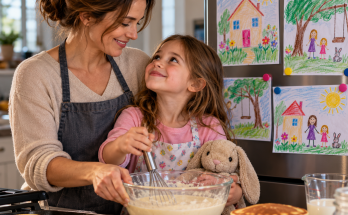
The next morning, Maya asked if we could put her new drawing on the refrigerator.
I moved the earlier pictures slightly to make room.
The house with the bright front door stayed in the middle.
The park picture went beside it.
The new tree and swing fit near the edge.
Maya stepped back to inspect the arrangement.
“Now all my pictures can see each other.”
I laughed.
“That's important.”
She nodded seriously.
Then she ran off to get her shoes.
I stayed in front of the refrigerator for another moment.
The drawings were crooked.
One corner of the first picture had started to curl.
The magnets did not match.
But together, they made the kitchen feel like a place where our lives were still happening.
Not a place where everything had been decided.
A place where we were still making breakfast, packing schoolbags, and finding reasons to laugh.
That evening, I read Maya her favorite book.
She interrupted me several times to correct my pronunciation of a character's name.
I let her.
When I reached the last page, she tucked the rabbit beside her pillow.
“Can you stay for a little bit?”
“Of course.”
I sat beside her bed.
After a few minutes, she spoke without opening her eyes.
“I'm glad we're still us.”
My chest tightened.
“So am I.”
I stayed until she fell asleep.
Then I turned off the bedside lamp and left the hallway light on.
I could not promise Maya that she would never feel sad about the divorce.
I could not promise that Julian and I would never disagree again.
I could promise that she would not have to earn my love by taking care of me.
I could promise that I would listen when she needed help.
And I could promise to keep working toward a life where she could enjoy both parents without believing that her happiness hurt one of us.
It was not a perfect promise.
It was one I could keep.
Click here to continue reading: PART 20: When the Divorce Was Finally Settled, I Understood That My Daughter Had Not Saved Me From Losing Everything—She Had Reminded Me What Was Worth Saving
My Husband Wanted Everything, but I Had No Idea What My Little Girl Was Carrying Into That Courtroom
Part 19 of 20