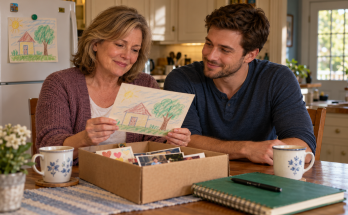
By the time another month had passed, Mom had begun to develop her own rhythm.
She still woke early, but she no longer treated every morning as a race.
She took walks when the weather was pleasant.
She read in the afternoons.
She called friends she had not spoken to in a while.
Sometimes she made a meal that reminded her of the school cafeteria.
When she did, she always laughed at how little food she needed.
“I used to make enough for hundreds,” she told me one evening.
“Now I'm wondering whether I should boil two potatoes or three.”
I smiled.
“Two will be enough.”
She looked at the pot.
“Perhaps three.”
We both laughed.
It was a small moment, but I found myself enjoying it more than I would have before.
I had once believed that the important parts of life announced themselves.
A major achievement.
A difficult decision.
A day when something changed forever.
Now I was beginning to understand that many important things happened without ceremony.
They happened in kitchens.
At tables.
During ordinary conversations.
They happened when someone noticed a need and chose not to ignore it.
That evening, Mom prepared dinner while I set the table.
She placed a bowl of potatoes beside the plates and brought over a dish of vegetables.
I poured water into our glasses.
Then we sat down together.
The food was simple.
The room was quiet.
Mom looked at the table and smiled.
“That's enough for us.”
I thought about the thousands of meals she had prepared over the years.
I thought about the children who had passed through the cafeteria line.
I thought about Daniel, standing there in the winter of 1996, trying to leave because he believed he could not afford to eat.
And I thought about the tray Mom had placed in front of him.
A meal.
A few ordinary words.
A refusal to let him walk away hungry.
That was how the story had begun.
Not with a ceremony.
Not with a promise made in front of an audience.
Not with a decision that anyone expected to become important decades later.
It had begun with someone paying attention.
After dinner, we stayed at the table.
Mom told me about a former colleague who had sent her a message.
They had worked together for years, and the colleague wanted to meet for coffee.
Mom seemed pleased.
“I think I'll go,” she said.
“You should.”
“I haven't had much time to sit and talk with people lately.”
I laughed.
“You have plenty of time now.”
She gave me a look.
“Don't remind me.”
We both smiled.
Then she became thoughtful.
“You know, when I started working at the school, I didn't imagine I'd stay forty-two years.”
“What did you expect?”
“Perhaps a few years.”
She shook her head.
“Then life kept moving. I got used to the work. I got to know the people. One year became another.”
I listened.
She had never described her career as a grand plan.
She had simply continued doing a job she believed was worth doing.
There had been difficult days.
There had been long hours.
There had been times when the kitchen was hot and the line seemed endless.
There had been children who complained about the food and days when the work left her exhausted.
But there had also been students who smiled when they saw her.
Teachers who stopped to talk.
Children who came back to say hello after graduation.
And now there was Daniel, who had carried a receipt for years and returned to tell her why.
“Were you ever tempted to leave?” I asked.
“Of course.”
She smiled.
“Everybody gets tired sometimes.”
“What made you stay?”
She thought for a moment.
“I liked knowing the children would have lunch.”
The answer was so simple that I almost missed its weight.
She had stayed because the work mattered.
Not because every day was easy.
Not because people always thanked her.
Not because she expected to be remembered.
She had stayed because she could see a practical need and knew she could help meet it.
I looked at her across the table.
“That's what you mean when you say you just showed up.”
She nodded.
“You can't do everything in one day.”
She folded her napkin.
“But you can do the part that's yours.”
I thought about those words long after we cleared the table.
You can do the part that's yours.
Mom had never been able to solve every problem a student carried into the cafeteria.
She could not change every family's circumstances.
She could not know every private struggle.
She could not guarantee that every child would leave school happy.
But she could prepare the food.
She could keep the kitchen running.
She could notice when a student seemed to be struggling.
She could offer kindness without making a spectacle of it.
That was her part.
She had done it for forty-two years.
And she had done it without knowing which moments would remain in someone's memory.
I began to think about my own life.
There were things I had postponed because they did not seem important enough.
Conversations I had rushed through.
People I had assumed were fine because they had not asked for help.
Small tasks I had left for someone else because I believed my time was better spent elsewhere.
I could not change the years I had spent misunderstanding Mom's work.
But I could change how I approached the days ahead.
I could be more patient.
I could listen without trying to finish someone else's sentence.
I could offer help without demanding a full explanation.
I could remember that people sometimes hid their needs because they were afraid of how others would respond.
And I could stop believing that an action had to be extraordinary to be worthwhile.
A few days later, Mom and I sat together in the living room.
The retirement box was on the shelf.
The photograph of her at the cafeteria counter was tucked inside it.
I had begun to think of that photograph differently.
It was no longer just an old picture of Mom at work.
It showed her in the middle of a life she had built through repeated ordinary choices.
Behind the counter, she had looked focused.
She had probably been thinking about the line, the food, and the bell.
She could not have known that one day Daniel would remember her kindness and return to thank her.
She could not have known that the photograph would become part of a collection of memories she would carry into retirement.
She had been doing the work in front of her.
That was all.
“Do you miss it?” I asked.
Mom looked toward the shelf.
“Sometimes.”
“What part?”
“The children. The people I worked with. The feeling that I knew what each day needed from me.”
She paused.
“But I'm glad I retired.”
I smiled.
“You deserve the rest.”
She looked at me.
“I'm not finished being useful.”
“I know.”
She seemed relieved that I understood.
“I just have to learn what useful looks like now.”
I thought about Daniel's call.
I thought about the neighbor she had greeted on our walk.
I thought about the way she still worried whether people were eating properly and getting enough sleep.
Her work had ended.
Her care had not.
She could no longer feed a cafeteria full of students, but she could still listen to a friend.
She could still offer advice.
She could still notice when someone needed a little patience.
And she could still teach me without realizing she was doing it.
I reached for the box and placed it on the table.
“Would you like to look at the cards again?”
Mom smiled.
“Why not?”
We opened the lid.
She read a few messages aloud.
Some made her laugh.
Others made her quiet.
When she reached a card that thanked her for being kind to students who were having difficult days, she stopped for a moment.
Then she placed it carefully back in the envelope.
“I hope they all found people who treated them well,” she said.
“So do I.”
She closed the box.
I returned it to the shelf.
The room grew quiet again.
I thought about Daniel's promise.
He had been asked to help someone else when he had the chance.
He had taken that lesson into his life.
He had become a surgeon, but the important thing was not simply the title he held.
It was the way he had remembered the boy he used to be.
It was the way he had recognized the importance of kindness.
It was the way he had returned to thank the woman who had helped him.
Mom had given him lunch.
He had given her the knowledge that the moment mattered.
And he had given me a way to understand my mother that I had somehow missed for years.
I looked at her sitting beside me.
She was no longer wearing her work shoes.
She no longer had to wake before dawn to prepare for a school day.
The cafeteria belonged to someone else now.
But the lesson she had taught there remained with us.
I finally understood what she meant by showing up every day.
It did not mean that every day would be remarkable.
It meant that someone might need you on an ordinary day, when you were tired, when nobody was watching, and when you had no idea whether your kindness would be remembered.
You showed up anyway.
You did the part that was yours.
And you trusted that the rest of the story belonged to the people whose lives you touched.
Click here to continue reading: PART 17: The Morning Mom Returned to the School and Discovered That Some Things Never Really Leave
I Thought My Mother’s Retirement Would Be Just Another School Gathering Until Someone Walked In and Asked for Her
Part 16 of 20