A few weeks after Mom retired, I found her standing in front of the refrigerator with a small notepad in her hand.
She was making a grocery list.
Milk, eggs, bread, potatoes, and coffee were written in her familiar handwriting.
At the bottom, she had added a few things we did not need yet.
I pointed at the list.
“Why are you buying so much milk?”
She looked down.
“Am I?”
“We still have two cartons.”
She studied the refrigerator as if the milk might have disappeared while we were talking.
Then she laughed.
“I suppose I'm still thinking about the cafeteria.”
I knew exactly what she meant.
For forty-two years, she had measured food in quantities large enough to feed hundreds of students.
She had learned to think ahead.
There had to be enough milk for everyone.
There had to be enough rolls for the children who wanted seconds.
There had to be extra food in case the number of students was higher than expected.
Even now, with only the two of us eating breakfast at home, she was preparing for a crowd that no longer came.
I took the notepad from her hand and crossed out one of the cartons.
“You don't have to feed the whole school anymore.”
“I know that.”
She smiled.
“It's going to take me a while to believe it.”
We finished the list together.
Then Mom folded it and tucked it into her pocket.
I watched her walk toward the pantry.
She checked the shelf where we kept the bread, then opened a cabinet to see how many cans of soup remained.
There was nothing unusual about any of it.
Yet I kept thinking about the way she had worked.
She had spent decades making sure no child went without a meal if she could help it.
She had done that work so regularly that it had become part of her understanding of an ordinary day.
I wondered whether she had ever stopped to count the children she had helped.
That evening, I asked her.
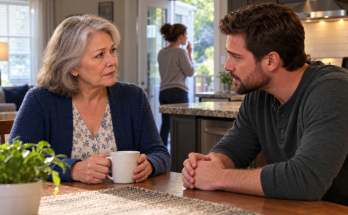
We were sitting at the kitchen table after dinner.
The dishes had been washed, and the old cafeteria schedule was still tucked inside the box of retirement cards on the shelf.
Mom was reading a letter from a former teacher.
I waited until she put it down.
“Do you ever wonder how many students you fed over the years?”
She looked at me.
“Thousands, probably.”
“Have you ever tried to count?”
She shook her head.
“No.”
“Not even once?”
“Why would I?”
I considered that question.
I had no good answer.
She returned the letter to its envelope.
“The school kept records of meals, of course. But I never thought about the number of children as something I needed to remember.”
“What did you remember?”
She smiled.
“The children.”
I waited for her to say more.
She leaned back in her chair.
“Some had big appetites. Some were fussy about vegetables. Some talked so much that they forgot to eat until the bell was almost ready to ring.”
I laughed.
She continued.
“There were children who came in every day with their friends, and children who sat quietly by themselves. There were children who seemed happy one week and very quiet the next.”
She paused.
“You learn to notice those things when you see the same faces every day.”
I thought about Daniel.
He had been one face among hundreds.
Yet Mom had remembered the blue science book he carried.
She had remembered the extra gravy.
She had remembered that he had tried to leave without eating.
Those details had stayed with her because she had paid attention to him as an individual.
She had not needed to know how his story would end.
She had simply noticed what was happening in front of her.
“Do you remember every student?” I asked.
“Of course not.”
She gave me a patient look.
“I worked there for forty-two years. Children came and went. Some graduated before I learned their names.”
“Then how did you know when someone needed help?”
“Sometimes you didn't know.”
Her answer was quiet.
“You could make an educated guess. You could ask a question. You could offer something and see whether they accepted it.”
She looked down at her hands.
“But you had to be careful not to assume you knew everything about someone.”
That stayed with me.
I had been thinking about kindness as something that required noticing a need.
Mom was reminding me that noticing was only the beginning.
A person could be hungry for reasons I did not understand.
Someone could be quiet because of a difficult morning, a family problem, embarrassment, or simply a preference for silence.
I could not know everything from a single glance.
But I could pay attention without deciding that I understood the whole story.
“What if someone refused your help?” I asked.
“Then you respected that.”
She answered without hesitation.
“You could let them know the offer was there. You didn't have to force them to accept it.”
I thought about Daniel offering eleven cents.
Mom had refused the money, but she had not refused him.
She had made the meal available without turning it into a transaction.
I wondered how much courage it had taken him to stand there and offer those coins.
Perhaps he had believed that paying something would protect his dignity.
Perhaps he had been afraid that accepting a free meal would make him look helpless.
Whatever he had felt, Mom had not made him defend himself.
She had let him eat.
And she had allowed the moment to remain private.
“I think that's what I admire most about what you did for Daniel,” I said.
Mom raised her eyebrows.
“What did I do?”
“You helped him without making him feel like a problem.”
She looked thoughtful.
“I hope that's how he felt.”
“He came back after all those years to tell you.”
“Yes.”
She smiled.
“That was a lovely thing for him to do.”
I waited for her to say that she had been proud of herself.
She did not.
Instead, she asked whether I had remembered to buy the bread.
I laughed.
“It's on the list.”
“Good.”
She stood and carried her cup to the sink.
I stayed at the table, thinking about the conversation.
Mom had not counted the children she helped.
She had not kept a list of every meal that mattered.
She had not collected stories about herself.
She had done her work and moved on to the next day.
That was probably why Daniel's visit had touched her so deeply.
He had brought back a memory she had never known he was carrying.
He had shown her a result she could not have predicted.
And he had reminded her that the ordinary work she had done was part of someone else's life in a way she could never have measured.
The next morning, I went to the grocery store with Mom.
We bought one carton of milk.
She checked the list twice before we reached the checkout.
When we returned home, she placed the groceries in the pantry.
Then she stood for a moment in front of the shelves.
“It's strange,” she said.
“What is?”
“Buying food for just a few people.”
I smiled.
“You'll get used to it.”
“I suppose.”
She placed the last can on the shelf.
Then she turned toward me.
“But I don't think I'll ever stop looking at a table and wondering whether there's enough.”
I understood.
For her, having enough had never been only about quantities.
It had meant being prepared for the person who arrived hungry.
It had meant making sure that a child did not have to explain a private struggle before receiving something to eat.
It had meant doing what she could with what she had.
That afternoon, I helped her put the grocery list away.
She tucked it into a kitchen drawer beside the old pens and rubber bands.
I glanced at the drawer before closing it.
There were years of small routines in that kitchen.
Lists.
Receipts.
Notes.
Things she had kept because they might be useful later.
I thought about Daniel's receipt again.
Perhaps the paper had begun as an ordinary object, too.
But it had carried something he did not want to lose.
Mom had never counted how many students she fed.
Daniel had counted the years he remembered her kindness.
Neither number could tell the entire story.
But together, they helped me understand something I had missed for too long.
The work had mattered even when nobody was keeping score.
Click here to continue reading: PART 14: The Quiet Afternoon When I Learned That Gratitude Did Not Need an Audience
I Thought My Mother’s Retirement Would Be Just Another School Gathering Until Someone Walked In and Asked for Her
Part 13 of 20