
I could not forget what my mother had said about Nana.
She had claimed Nana was too ill to understand the amendment.
It was a serious accusation.
And she had made it without hesitation.
I knew Nana had been near death.
Mr. Caldwell had told us exactly when she signed.
Three days before she died.
That timing mattered.
But it did not automatically mean she lacked the ability to make decisions.
Mr. Caldwell had made that clear.
He told us Nana’s attending physician had confirmed her competence in writing.
I remembered how calmly he delivered the explanation.
There had been no argument about feelings.
No attempt to shame my mother.
Just a statement about the medical confirmation.
I found myself thinking about how much depended on that distinction.
Being gravely ill was one thing.
Being unable to understand a legal decision was another.
My mother had treated them as though they were identical.
The lawyer had presented evidence that they were not.
I wanted to believe that would settle her objection.
But I could not claim it settled everything.
I had not heard every possible legal argument.
I had not examined the physician’s statement myself.
I only knew what Mr. Caldwell had told us.
And I had to describe it accurately.
He said Nana was mentally competent when she signed.
That was the evidence available.
It mattered because Nana’s right to make her own decisions mattered.
I thought about the final days of her life.
I did not know what she had been thinking.
I did not know why she decided to amend the estate instructions.
I did not know whether she had discussed her wishes with anyone in the family.
Those details were missing.
I could not create them.
But I knew she had signed the amendment.
And I knew the lawyer had explained the formal steps surrounding it.
Two independent witnesses.
A notary.
A physician’s written confirmation.
I kept returning to those details because they gave me something reliable.
My mother’s anger was real.
My father’s fear was real to me.
But their reactions did not establish what Nana intended.
The document did.
And that was why I wanted the reading to continue.
I looked toward my mother.
I wondered whether she had considered what her accusation meant.
To say Nana had been incapable of understanding was not a small objection.
It questioned the legitimacy of one of her final decisions.
I could understand asking for evidence.
I could understand wanting assurance that a dying person had not been confused or pressured.
But the evidence Mr. Caldwell described deserved to be considered.
I did not want it brushed aside simply because it supported a result my mother disliked.
Then I caught myself.
I did not actually know what result she disliked.
The amendment’s contents remained unread in the portion of the account available to me.
I could not say she was losing money.
I could not say Nana had changed beneficiaries.
I could not say the amendment exposed something hidden.
Those would be inventions.
I had to leave her motive uncertain.
That was frustrating.
But I would rather remain uncertain than accuse someone without evidence.
I thought about my own reaction.
I had felt angry when my mother told me to stay out of the discussion.
That anger was understandable.
She had tried to silence me.
But anger could push me toward the same mistake she seemed to be making.
I could become so determined to oppose her that I treated every fact as proof against her.
I did not want that.
I wanted to understand Nana’s instructions.
I wanted to hear the lawyer.
I wanted to know why the amendment mattered.
Those were reasonable desires.
They did not require me to invent wrongdoing.
I looked at Mr. Caldwell.
He had remained focused on the document.
That was what I respected.
He had not tried to turn the reading into a family argument.
He had simply addressed the objections raised.
When my mother challenged the amendment’s existence, he explained its execution.
When she challenged Nana’s mental capacity, he referred to the physician’s written confirmation.
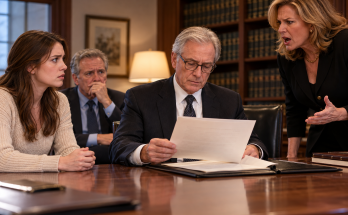
When I asked him to continue, he unfolded the second page.
There was a clear order to those events.
I remembered that order because it showed how the argument had interrupted the purpose of the meeting.
We were there to hear Nana’s estate instructions.
Instead, we had spent those minutes debating whether her late amendment could be accepted.
And still, the document waited.
I wished I could say I felt relieved once the doctor’s confirmation was mentioned.
Part of me did.
I was glad Nana’s capacity had been considered.
But relief was not the whole feeling.
I was still uneasy.
My father had looked terrified.
My mother had tried to stop the reading.
And I did not know what the next page said.
I could not make those questions disappear.
So I stopped trying.
I let them remain questions.
I reminded myself that the truth did not need my imagination to help it.
If Nana had left clear instructions, they would speak through the document.
If the amendment raised further concerns, those concerns would have to be addressed with evidence.
And if my parents had explanations for their reactions, those explanations would have to come from them.
I could not supply them.
I had already spoken once.
I had told my mother I would remain.
I did not need another confrontation.
I needed patience.
And I needed to be willing to hear something I might not like.
That thought surprised me.
I had spent so much of the reading wondering why my parents were upset that I had barely considered my own possible disappointment.
Nana’s amendment could contain decisions I did not expect.
It could affect me in ways I did not understand.
I had no guarantee that hearing it would make me happy.
But that did not change my position.
Her wishes deserved to be heard.
Even if I disliked them.
Even if they complicated my understanding of the family.
Even if they left me with more questions.
I looked at the second page.
I wanted the words, not another argument about whether Nana had been permitted to write them.
And I understood that I would have to give her decision the same respect I was asking my mother to show.
Click here to continue reading: PART 15: I Had Refused to Leave the Will Reading, but I Still Could Not Explain the Fear I Saw on My Father’s Face
I Thought My Grandmother’s Will Would Finally Bring Us Answers, Until the Lawyer Announced Something My Mother Refused to Accept
Part 14 of 20

One Comment on “PART 14 – My Mother Had Questioned Nana’s Mind, but the Physician’s Written Confirmation Forced Me to Think About Whose Voice Deserved to Be Heard”