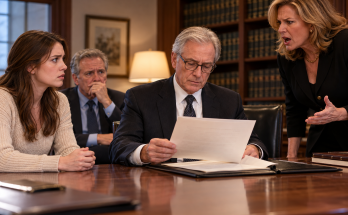
I kept my attention on Mr. Caldwell.
That was my decision.
My mother had already told me to stay out of the matter.
I had already refused.
There was nothing useful about repeating the argument.
I did not need to prove that I could speak louder than she could.
I needed to hear Nana’s amendment.
That was why I remained in my chair.
The second page had been opened.
My father had not explained his fear.
My mother had not withdrawn her objections.
And the lawyer had not yet disclosed the full contents of the amendment.
Those facts left me in an uncomfortable place.
I knew something important had happened.
I did not know what it meant.
I knew Nana had changed instructions concerning her estate.
I did not know how the change affected anyone.
I knew my parents had reacted strongly.
I did not know why.
For a while, that uncertainty felt unbearable.
I wanted the missing pieces.
I wanted to understand the whole thing in a single moment.
But I could not force an answer out of expressions and interrupted sentences.
I had to wait for the document itself.
I thought about how easily the reading had become a contest of voices.
My mother had challenged the amendment before its substance was explained.
Mr. Caldwell had responded with facts about its execution.
Then my mother had challenged Nana’s competence.
The lawyer had responded with the physician’s written confirmation.
I had watched the exchange.
And I had watched my father.
That was how I had begun to fear the amendment involved more than an ordinary disagreement over an estate.
But fear was not proof.
I kept returning to that distinction.
I did not want to become so desperate for an explanation that I invented one.
Especially not when the person whose wishes mattered most could no longer correct us.
Nana was gone.
Her signature remained.
That simple fact hurt more than I expected.
It meant the argument was happening without her.
People were questioning whether she understood her decision.
People were reacting to instructions she had left.
And she was not there to tell us how she felt.
I could not bring her back.
I could not ask her to explain the amendment.
I could only listen to what had been formally recorded.
My mother’s accusation about Nana’s mental state still bothered me.
She had spoken as though being near death meant being unable to decide.
Mr. Caldwell had told us that Nana’s doctor confirmed otherwise.
I was relieved to hear that the question had been considered.
But I did not turn that relief into certainty about everything else.
A validly executed document could still contain instructions I did not expect.
It could disappoint me.
It could surprise me.
It could raise questions I had never considered.
I knew that.
And I wanted to be prepared to hear it without demanding that the outcome suit me.
That was the standard I had begun to expect from my mother.
I needed to hold myself to it too.
I looked toward her.
Her reaction had been painful to witness.
Not merely because she was angry.
But because she had tried to decide whether I should participate.
When I asked Mr. Caldwell to continue, she had ordered me out of the conversation.
I remembered the feeling that followed.
For one brief moment, I had considered obeying.
It seemed easier than another confrontation.
Then I realized that I would be giving up something important.
The right to hear Nana’s own instructions.
I was not willing to do that.
So I told my mother I would remain.
It was not a dramatic speech.
It was simply an answer.
But I was glad I had given it.
I did not want the reading to become a fight between us.
That would only distract from what we were there to learn.
I wanted the lawyer to complete his work.
And I wanted every person in the room to hear the same words.
Whatever the amendment said.
Whatever it changed.
Whatever questions remained afterward.
We needed the actual instructions before we could understand their consequences.
I knew that much.
My father’s frightened expression kept returning to my mind.
I wished I could separate it from the document.
I wished I could believe he was only upset by the argument.
Maybe he was.
I had no way to know.
But the fear had been unmistakable to me.
It was why I had begun to suspect the estate amendment mattered for reasons that were not yet visible.
I did not want to accuse him.
I did not want to accuse my mother.
Not without knowing what Nana had written.
Yet I would not ignore what I had witnessed simply because it made me uncomfortable.
Both things could be true.
I could withhold judgment.
And I could keep asking questions.
I could love my family.
And I could refuse to let them speak for me.
I could respect Nana.
And I could admit I did not yet know her reasons.
Those thoughts helped me more than trying to guess the ending.
I had no ending to give myself.
The second page was still the last part of the amendment I had seen opened.
Mr. Caldwell had not supplied the answers beyond that point in the account I had.
I would not pretend otherwise.
I would not invent what was written there.
I would not assign property or money to people without evidence.
I would not claim that Nana had revealed a secret I had not actually heard.
And I would not decide that my parents were guilty of something because of their reactions.
I knew how tempting it was to build a complete explanation from a few frightening details.
The timing of the amendment.
The witnesses.
The notary.
The physician’s letter.
My mother’s anger.
My father’s fear.
My own refusal to stay silent.
Each detail mattered.
But none of them, by itself, told me what the amendment contained.
I had to accept that.
There was one promise I could make to myself.
I would not let uncertainty become an excuse to surrender my judgment.
I would listen to the evidence.
I would distinguish what someone claimed from what had actually been established.
And I would not let my mother’s anger decide what I was permitted to hear.
Those were choices I could make without knowing what came next.
They did not settle Nana’s estate.
They did not resolve the conflict with my parents.
They did not tell me why my father looked terrified.
But they gave me a way to remain honest about what I had seen.
Mr. Caldwell had opened the second page.
Nana’s amendment was in front of him.
And I was still there.
Ready to listen.
Ready to learn.
But no longer willing to mistake anyone else’s reaction for the truth.
Click here to continue reading: PART 9: As Nana’s Second Page Lay Before Us, I Realized How Much of My Fear Came From Questions Nobody Had Answered
I Thought My Grandmother’s Will Would Finally Bring Us Answers, Until the Lawyer Announced Something My Mother Refused to Accept
Part 8 of 20