Ordinary life kept going.
My daughter still needed me.
There were still meals to prepare, things to organize, and small responsibilities that could not be postponed because I was worried about a bank account.
Sometimes I was grateful for those tasks.
They gave my mind somewhere else to go.
Other times, the quiet moments brought the questions back.
I would remember the application and wonder how it had come to exist.
I would remember the dates and try to understand why the account had been opened so shortly before the first transfer.
I would remember my mother's explanation and wonder why she had been so quick to suggest that I might have forgotten.
Then I would look at my daughter and remind myself that I needed to keep living while I searched for answers.
I couldn't spend every hour imagining possibilities.
I had to leave room for ordinary life.
That was harder than it sounds when the problem touches something you thought you could trust.
Before Thanksgiving, I had not thought much about the details of my husband's financial arrangements.
I knew he had made plans.
I trusted that those plans would help us.
I had been too busy recovering and caring for my daughter to question every part of the process.
Now every detail seemed important.
The bank's name.
The account number.
The opening date.
The signature.
I found myself wishing I had paid more attention earlier.
Then I reminded myself that I had been trying to recover from an accident.
I had been learning how to manage with one working hand.
I had been caring for a newborn child while grieving the man I had expected to raise her with.
I could not fairly judge that version of myself as if she had been living an ordinary life.
She had been doing what she could.
I had to give her some credit for that.
The thought made me less angry with myself.
It did not make the missing money any less concerning.
I still needed answers.
I kept returning to the distinction between what I knew and what I suspected.
I knew I had not knowingly opened the account.
I knew the signature did not look like mine.
I knew the money had not reached me.
I suspected there was more to the situation than a simple delay.
But suspicion was not proof.
I had to remain honest about that.
I did not want to become the kind of person who treated a fear as a fact just because the fear felt convincing.
I had enough uncertainty already.
I wanted the answers to come from the records, not from the stories I created in my head.
Grandma's steady approach helped me remember that.
She had asked the question that started everything, but she had not used it to make a public accusation.
She had wanted to understand.
That was still what she wanted.
I found comfort in knowing that someone else saw the importance of the missing funds without requiring me to explain why they mattered.
The money had been intended for my future.
It was meant to help me care for my daughter.
It was connected to a decision my husband had made while thinking about the people he loved.
I did not have to apologize for wanting to know what had happened to it.
Sometimes I worried that focusing on the money made me seem ungrateful for the help I had received after the accident.
I didn't want anyone to think I had forgotten the people who had supported me.
But gratitude and accountability were not opposites.
I could appreciate help without surrendering my right to ask questions.
I could remember kindness without accepting a signature that wasn't mine.
And I could acknowledge my mother's role in my recovery without agreeing that my medication explained the account.
Those things could exist together.
I was learning to stop making myself choose one truth at the expense of another.
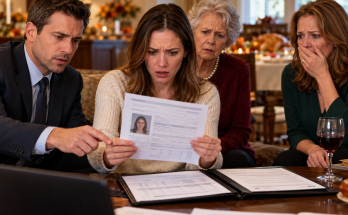
The application remained the clearest piece of information we had.
It was not a complete explanation.
It was a document that raised questions.
I needed to treat it that way.
I wondered what my husband would have thought if he had known I would one day be examining such a form.
I couldn't answer that.
I knew he had wanted to protect us.
I knew he had taken the future seriously.
I did not know what arrangements he had expected other people to handle or what he would have made of the account at Westbridge Community Bank.
I wished I could ask him.
That wish was not new.
I had been living with it since his death.
But now it had a particular shape.
I wanted him to explain what he had intended.
I wanted to hear him tell me that the money was supposed to reach me.
I wanted to know whether there was something about the arrangement I had misunderstood.
Instead, I had to work with the records that remained.
I could not make the past answer questions it had never answered for me.
I could only keep examining what was available.
That became my way of coping.
When I felt overwhelmed, I returned to the facts.
When I became angry, I reminded myself that I did not yet know who was responsible.
When I felt guilty for asking questions, I reminded myself that the money had been intended for my daughter and me.
And when I started imagining that the whole situation might disappear if I stopped talking about it, I remembered the signature.
It was still there.
The account was still there.
The missing money was still a real problem.
Ignoring it would not make it smaller.
I wanted to move forward.
I wanted to spend less time thinking about bank records and more time building a life for my daughter.
But moving forward did not mean pretending the past had been settled.
It meant facing what had happened and doing what I could to understand it.
I was not ready to decide what the answers would mean for my family.
I didn't need to decide that yet.
First, I needed the answers themselves.
Click here to continue reading: PART 15: I Had Once Believed That Trust Meant Giving People the Benefit of the Doubt, but I Was Learning That It Also Meant Trusting Myself
The Thanksgiving Question That Turned a Family Gathering Into Something None of Us Could Pretend Was Ordinary Anymore
Part 14 of 20