March 11.
March 14.
I repeated those dates so often that they began to feel like something I should have known all along.
The first was the date the account had been opened.
The second was the date of the first transfer.
Three days between them.
I didn't know why those particular dates had been chosen.
I didn't know who had arranged the account opening or who had directed the transfer.
But I knew the sequence mattered.
The account had not appeared in the records without a date.
The transfer had not happened without a record of its own.
Somebody had completed the steps that brought the account into existence and allowed it to receive money.
The application attributed those steps to me.
I disputed that.
It was a straightforward problem, even if the answer wasn't straightforward at all.
I found myself thinking about how easy it would have been to overlook the details.
If Grandma hadn't asked about the money, I might never have seen the application.
If I hadn't looked closely at the signature, I might have accepted the account information as an ordinary administrative matter.
If I had been less certain of my own handwriting, I might have allowed my mother's explanation to settle the question.
Each possibility made me uneasy.
I wasn't proud of how much I had depended on other people to tell me what was happening during my recovery.
But I understood why I had done it.
I had been hurt.
I had lost my husband.
I was caring for a baby while trying to recover physically.
There had been days when I could barely think beyond the next thing that needed doing.
I had not been careless because I didn't care about our future.
I had been trying to survive.
That was a difference I needed to remember.
My husband had made arrangements because he understood that life could become difficult without warning.
He had tried to make sure that I would have help when I needed it.
I had trusted those arrangements because I trusted him.
I hadn't expected to become the person who needed to investigate them.
The realization hurt more than I wanted to admit.
It wasn't just that money was missing.
It was that the protection he had tried to provide had become something I could not rely on without asking questions.
I wanted to believe the problem could still be resolved.
I wanted the account explained and the money accounted for.
I wanted to return to thinking about my husband without wondering whether someone had used his final arrangements for a purpose he never intended.
But I had to be careful about what I expected.
Hope was useful.
Certainty without evidence was not.
Grandma continued to focus on the information available to us.
She did not claim to know what had happened beyond what the records showed.
She did not tell me that the dates proved a particular person had done something wrong.
She understood that the dates established a sequence, not a complete account of responsibility.
That helped me stay grounded.
I tried to follow the same rule.
I would not turn the timing into an accusation.
I would use it to ask better questions.
Why had the account been opened three days before the transfer?
Who had supplied the application?
Who had authorized the movement of the funds?
And why had I never received the money?
Those questions were enough.
I didn't need to add anything to make them serious.
I remembered my mother's reaction again.
She had been quick to suggest that I might have signed the form while taking medication.
I wished she had simply admitted that she didn't know how the account had been opened.
That would not have solved anything, but at least it would have left the question where it belonged.
Instead, her explanation had made me feel that I needed to defend my own memory.
I resented that feeling.
Then I felt guilty for resenting it.
That was the trouble with family.
Even when you had a reasonable question, you could spend hours wondering whether asking it made you a bad daughter.
I had to stop doing that to myself.
I was not asking my mother to confess to anything.
I was asking for an explanation of a document that carried my name.
I was not declaring that somebody had taken the money.
I was insisting that the missing funds be accounted for.
Those were reasonable things to ask.
I began to feel steadier when I put it that way.
I didn't have to know the ending to take the next step.
I didn't have to decide whom to trust forever.
I only had to remain honest about what I knew.
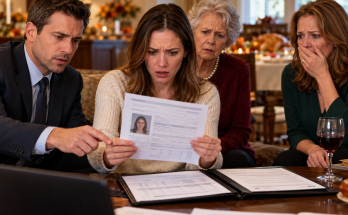
The application had my photograph.
It had my address.
It had my date of birth.
It had a signature I did not recognize.
The account had been opened on March 11.
The first transfer had followed on March 14.
I had received nothing.
I kept those facts together in my mind.
They were the foundation of everything that followed.
I wished the foundation had been something happier.
I wished I had been sitting with my husband, listening to him explain how he wanted to provide for our daughter.
I wished the papers in front of me had been ordinary documents from an ordinary life.
But wishing could not change what I was facing.
So I stopped asking myself whether I wanted to know the truth.
Of course I did.
The harder question was whether I could accept it if the truth changed how I saw the people I loved.
I didn't know.
I wasn't going to pretend I did.
For now, I would keep looking at the records and asking what they meant.
That was the only honest place to begin.
Click here to continue reading: PART 11: I Had Been Trying to Keep My Family Together, Until I Realized That Silence Could Not Repair What the Missing Money Had Broken
The Thanksgiving Question That Turned a Family Gathering Into Something None of Us Could Pretend Was Ordinary Anymore
Part 10 of 20