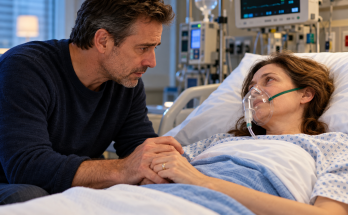
When Clara woke again, the first thing she asked was whether I had rested.
I told her I had closed my eyes for a few minutes.
She didn't believe me.
"You need more than that."
"So do you."
She gave a tired smile.
For a moment, I felt the comfort of an ordinary exchange.
Then she shifted against the pillow and winced.
I leaned forward.
"Does it hurt?"
"A little."
I reached for the call button, but she shook her head.
"Not yet."
I stopped.
She adjusted her position carefully.
When she seemed more comfortable, I sat back.
I wanted to help her with everything.
I also knew that there were limits to what I could do.
I couldn't make the pain disappear.
I couldn't undo the emergency.
I couldn't promise that the next hours would be easy.
All I could do was remain available and listen when she needed me.
I tried to remember that.
Clara looked toward the table.
Her phone was still there.
She didn't reach for it.
I didn't mention it.
We sat quietly for a while.
Then she asked me what I had been thinking about before she woke.
I could have given her an easy answer.
I could have said I was thinking about the baby, the doctors, or when we might leave the hospital.
Those things were true.
They weren't the whole truth.
I looked at her.
"I've been thinking about us."
Clara became still.
I felt my heart begin to beat faster.
I hadn't meant to make the conversation sound so serious.
But I couldn't take the words back.
"What about us?" she asked.
I took a breath.
"I don't want us to be afraid to talk to each other."
She looked down.
I continued carefully.
"That's all I'm trying to say."
She didn't answer.
I waited.
The silence felt different now because I had finally put something real into it.
I wanted to ask whether she understood.
I wanted to ask whether she agreed.
Instead, I gave her time.
After a while, she spoke.
"I don't know what to say."
"That's okay."
She looked at me.
"Is it?"
I considered the question.
I didn't want to reassure her just to make the moment easier.
"Yes. For now, it is."
She seemed to think about that.
Then she nodded.
I felt relieved, but I didn't mistake the feeling for a solution.
We had taken one small step.
Nothing more.
Clara closed her eyes and rested.
I stayed in the chair, trying to keep my thoughts from running ahead of what had actually happened.
She hadn't explained anything about the phone.
She hadn't told me that something was wrong.
She hadn't told me that everything was fine, either.
We were still in the same uncertain place.
But at least I had stopped pretending that the uncertainty existed only inside my own head.
A nurse came in and checked Clara's blood pressure again.
I stepped aside.
The nurse worked quietly, then reviewed the reading.
She spoke to Clara about resting and continuing to let the staff know if she felt unwell.
Clara listened.
When the nurse left, I returned to the chair.
"How are you feeling?" I asked.
"Tired."
I nodded.
"Anything else?"
She thought for a moment.
"Overwhelmed."
I felt a pang of sympathy.
I wanted to tell her that she didn't have to carry everything alone.
But I remembered how often people said comforting things without knowing what the other person was carrying.
So I asked a simpler question.
"Is there anything I can do?"
She looked at me.
"Just stay with me."
"I can do that."
She turned toward the pillow.
I took her hand again.
For several minutes, we sat quietly.
I thought about the conversation we still needed to have.
I thought about the phone and the unanswered questions.
But I also thought about the person beside me, who had endured a frightening delivery and was now trying to recover.
I didn't want my need for certainty to make her recovery harder.
At the same time, I couldn't promise myself that I would never feel anxious again.
I had to accept that both things could be true.
I could care about her health and still need honesty.
I could respect her privacy and still want to understand what had made her so uneasy.
I could wait without agreeing to remain confused forever.
Those were difficult distinctions to make while sitting in a hospital chair.
They were even harder to live by.
Clara opened her eyes.
"You're quiet."
"I'm listening."
She looked at me for a long moment.
Then she nodded.
I wasn't sure what she heard in my answer.
Perhaps she heard reassurance.
Perhaps she heard the question I was still holding back.
I couldn't know.
But I had finally stopped trying to force an answer from every expression on her face.
I would have to let her tell me what she meant.
That evening, the light in the room changed again.
The plastic cup was replaced.
The nurse adjusted the equipment.
The phone remained on the table, sometimes dark and sometimes briefly illuminated.
I no longer counted every notification.
I didn't pretend I had stopped noticing them.
I simply stopped treating each one as a decision I had to make.
When Clara looked at her phone, I gave her privacy.
When she looked at me, I listened.
And when neither of us had anything to say, I let the silence remain.
I still wanted answers.
I still feared what those answers might mean.
But I was beginning to understand that the only honest way forward was to make room for a conversation neither of us could control.
Click here to continue reading: PART 12: I Had Finally Said That We Needed to Talk, Yet the Hardest Part Was Accepting That Clara Might Need Time I Could Not Measure
The Night Everything Changed, and the Question I Was Too Afraid to Ask Before Walking Through That Hospital Door
Part 11 of 20