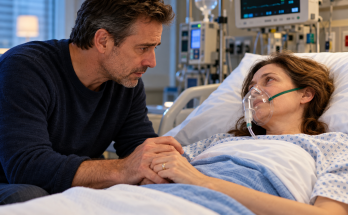
After the doctor left, I sat quietly beside Maggie.
I kept thinking about what he had said.
The blood results were only part of the explanation.
The medical team needed to consider everything.
They were still evaluating her.
I understood the words.
But my thoughts kept returning to the same place.
Three days.
Maybe four.
I looked at Maggie.
Her face was pale.
Her eyes were closed.
She was lying beneath a hospital blanket with an oxygen mask covering her mouth and nose.
I wanted to know when her condition had first become serious.
I wanted to know whether I had missed something obvious.
I wanted to know whether anything could have been different.
Those questions hurt.
I had been asking them silently since the ambulance ride.
The hospital hadn't made them disappear.
I leaned forward.
"Maggie."
Her eyelids moved.
I waited.
She opened her eyes slightly.
I smiled.
"Hello, sweetheart."
She looked toward me.
I wanted to apologize again.
The words were already forming in my mouth.
I wanted to tell her how sorry I was that I hadn't understood.
But then I saw how exhausted she looked.
She didn't need another apology.
She needed rest.
So I kept my voice gentle.
"I'm right here."
Her eyes stayed on me briefly.
Then they closed.
I rubbed her hand.
The familiar circle.
I had made that movement so many times that I could do it without looking.
I wondered whether she recognized it even when she couldn't open her eyes.
I hoped she did.
A nurse entered.
She checked Maggie's condition.
I moved my chair back.
"Do you need me to step outside?"
"Not right now."
I nodded.
I watched her work.
She checked the equipment.
She spoke to Maggie.
She waited for a response.
I noticed how carefully she watched my wife's face.
I was grateful for that.
Maggie had always been expressive.
When she felt well, I could usually tell what she was thinking.
Now there was very little expression to read.
The nurse had to look for smaller signs.
I had been doing the same thing.
The difference was that she knew how to use what she observed.
I looked toward her.
"Can I ask you something?"
"Yes."
"Does she know I'm here?"
The nurse glanced toward Maggie.
"She's been responding to your voice."
I nodded.
"That's what the paramedic said too."
I looked down.
"I keep asking because I can't stand not knowing."
The nurse listened.
I felt embarrassed.
It seemed childish to need so much reassurance.
But I was frightened.
And Maggie had always been the person who reassured me.
Now she couldn't.
The nurse finished checking her.
I moved closer again.
I took Maggie's hand.
I looked at her wedding ring.
The metal felt cool against my thumb.
I thought about the first years of our marriage.
We had learned how to live beside each other.
Not through grand gestures.
Through ordinary days.
Small conversations.
Shared worries.
Knowing when the other person needed quiet.
I had always believed I was good at recognizing what Maggie needed.
Now I wasn't sure.
I had wanted her to speak in the ambulance.
I had wanted her to open her eyes whenever I called.
I had wanted her to reassure me that everything would be fine.
I hadn't realized how much I was asking until I saw the effort it cost her.
I looked at her closed eyes.
"I'm sorry I kept making you look at me."
She didn't answer.
I smiled sadly.
"You never had to do that."
I stopped talking.
I knew I was slipping back into apologies.
Maggie couldn't take care of my guilt while she was lying there.
I had to manage that myself.
The nurse returned to the doorway.
She asked whether I needed anything.
I shook my head.
"Thank you."
Then I hesitated.
"Actually, could you tell me what I should be watching for?"
She explained that the medical staff were monitoring Maggie and that I should let them know if I noticed a change from how she had been responding.
I nodded.
That was something I could understand.
I knew how she had been behaving.
I knew the pattern of opening her eyes when spoken to.
I knew how quickly she tired.
I could tell someone if that changed.
I didn't need to interpret medical equipment.
I didn't need to diagnose her.
I simply needed to pay attention.
"All right."
The nurse nodded and continued her work.
I looked back at Maggie.
I realized that guilt had been occupying so much of my attention that I was sometimes more focused on what I hadn't done than on what she needed now.
That wasn't helping either of us.
The missing days mattered.
I wasn't going to forget them.
But I couldn't relive them inside this hospital room.
I couldn't go backward.
I couldn't ask Maggie to make them clear while she was so weak.
I could only tell the medical team what I knew.
And I could remain present.
I adjusted my chair.
I brought it close enough to hold her hand without leaning awkwardly.
My back was aching from the ambulance ride.
I had barely noticed it until now.
I settled into a position where I could sit quietly.
Then I looked at Maggie's face.
Her eyelids moved.
I leaned slightly forward.
"Hello."
She opened her eyes.
I smiled.
No questions.
No requests.
Just a smile.
She looked at me for a moment.
Then she rested.
I stayed still.
The hospital noises continued around us.
Footsteps in the corridor.
Voices nearby.
The faint sounds of equipment.
I had expected those things to become less noticeable.
Instead, I heard every one of them.
Whenever a voice approached the room, I wondered whether someone had new information.
Whenever footsteps slowed outside, I looked toward the doorway.
I wanted answers.
But I was learning not to turn every sound into a promise.
A doctor walking past wasn't necessarily coming to explain Maggie's illness.
A nurse checking her condition wasn't necessarily bringing a major change.
Sometimes people were simply doing their work.
And I needed to let them.
I looked at our hands.
Maggie's wedding ring rested against my thumb.
I rubbed the familiar circle again.
I thought about how many times she had been patient with me.
When I worried too much.
When I misunderstood something.
When I asked a question she had already answered.
She had never expected me to be perfect.
I wondered why I was expecting perfection from myself now.
I couldn't change the answers I had given the doctors.
They were truthful.
That had to matter.
I could not help Maggie by inventing certainty.
I could only help by being honest.
I leaned closer.
"Sweetheart, I'm going to keep listening to what they tell me."
Her eyes remained closed.
"And I'll tell them anything I remember."
I paused.
"I won't guess."
The words seemed small.
But I meant them.
I wanted to be useful.
Not impressive.
Not confident when I had no reason to be.
Useful.
The nurse came back to check Maggie.
I moved aside.
She spoke to her gently.
Maggie opened her eyes for a moment.
The nurse completed her assessment.
When there was room, I took Maggie's hand again.
I looked at her.
"You did good, sweetheart."
Then I stopped myself.
She didn't need to be judged on how well she responded.
I smiled.
"Just rest."
Her eyes closed.
I sat quietly.
I still felt guilty.
That feeling hadn't disappeared.
But I was no longer letting it decide every word I spoke.
Maggie needed the people around her to pay attention.
The nurses were doing that.
The doctors were doing that.
And I could do it too.
I watched her breathing.
I kept her hand inside mine.
And when someone asked me a question, I answered as honestly as I could.
Click here to continue reading: PART 19: I Sat Beside Maggie Through the Hospital’s Quiet Moments and Began to Understand That Recovery Could Not Be Rushed by My Fear
I Rode Beside My Wife in the Ambulance, Knowing She Had Been Seriously Ill for Days Without Me Understanding Why
Part 18 of 20