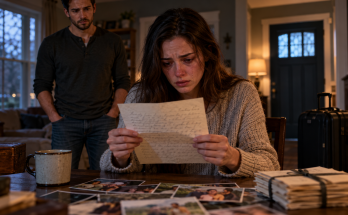
I looked at the yellow legal pad for the last time that evening.
The pages hadn't changed.
Todd's handwriting was still there.
The household expenses.
The figures he had used to reach eight hundred dollars.
And the second list.
The one that had made me stop reading when I first saw it.
Privacy.
Independence.
Retirement money.
My freedom to decide when I spent time caring for my grandchildren.
I had read those words so many times that I no longer needed the paper to remember them.
That was what struck me.
Todd had brought the pad because he wanted to explain what he'd overlooked.
But the words had become important to me for another reason.
They reminded me that my needs had existed long before anyone thought to write them down.
I looked at him.
He was sitting across from me.
Michelle remained beside the table.
Her coat was still on.
Her eyes were tired.
And I was tired too.
Not physically, exactly.
I was tired of being afraid that an honest answer would hurt someone I loved.
I was tired of questioning whether I had a right to make decisions about my own life.
And I was tired of feeling guilty for wanting the ordinary things Todd had finally acknowledged.
I took a breath.
"I think I've said what I needed to say."
Todd nodded.
"I think you have."
I looked at Michelle.
She was watching me.
I wanted to tell her that everything was going to be all right.
But I didn't know that.
Not in the simple way people sometimes meant it.
We still had practical questions.
The basement was still available as an idea.
The household expenses were still real.
My retirement money still needed careful consideration.
And the children still needed their parents to decide how their care would be managed.
None of those things had been solved.
I wasn't going to pretend otherwise.
But the conversation had changed something important.
The original arrangement no longer stood in my mind as something I was expected to accept.
It was simply an offer.
One I could consider.
One I could question.
One I could decline.
That was enough for now.
I looked at Todd.
"I don't want another calculation today."
He nodded.
"All right."
"And I don't want another schedule."
"I understand."
I paused.
"I just want time to think about what I want."
He looked at me.
"Of course."
I looked toward Michelle.
She nodded too.
I felt a quiet relief.
Not happiness.
Not yet.
But relief.
For nine days, I had worried that I was being selfish.
I had questioned whether a good mother would accept the basement because her daughter had offered it.
I had wondered whether a loving grandmother should agree to four days of childcare without hesitation.
I had asked myself whether my retirement money mattered more than helping my family.
Those questions had been unfair.
Not because helping my family was unimportant.
Because I had treated my own needs as though they were evidence against me.
Now I could see the difference.
I could help because I wanted to.
I could contribute if an arrangement made sense for me.
I could spend time with my grandchildren because I loved them.
But I didn't have to agree to fixed obligations simply to prove those feelings were real.
I looked at Michelle.
"I want you to know that my love for you hasn't changed."
She looked at me.
"I know, Mom."
I paused.
"And it won't depend on whether I live in your house."
Her eyes filled again.
I felt that familiar ache.
But this time, I didn't immediately search for another promise to make her feel better.
I let the words stand.
They were true.
I had loved Michelle before the basement offer.
I had loved her during the nine days of doubt.
And I loved her now.
The disagreement hadn't changed that.
I looked at Todd.
"I appreciate that you came back and admitted what you got wrong."
He nodded.
"I'm sorry it took me nine days."
I looked down.
Nine days.
It was strange how long they had felt.
Nine days of replaying a conversation.
Nine days of remembering the two circles around eight hundred dollars.
Nine days of picturing the basement window.
Nine days of wondering whether I was failing my daughter.
I couldn't get that time back.
But I didn't need to keep living inside it either.
I looked at Todd.
"I believe you're sorry."
He seemed relieved.
I continued.
"But I need you to understand that an apology doesn't decide what I do next."
He nodded.
"I understand."
That was important.
I didn't want to turn his regret into another obligation.
I didn't want to feel that I owed him a yes because he'd found the courage to admit a mistake.
And I didn't want to punish him by refusing to acknowledge that he'd made an effort.
I could accept the apology.
And keep my decision separate.
I looked at the legal pad.
The first list represented the way Todd had approached the arrangement.
He had calculated costs.
Estimated expenses.
And decided on a monthly amount.
Then he had added four days of childcare.
He had believed that made the arrangement balanced.
But the second list showed what he had missed.
The things that couldn't be measured so easily.
My privacy.
My independence.
My retirement security.
My relationship with my grandchildren.
I didn't need to assign a price to those things.
I needed to know they mattered.
Todd had finally acknowledged that.
And I had finally allowed myself to believe it.
I looked toward Michelle.
I thought about how she had appeared when she arrived.
Her eyes red.
Her coat still on.
Her hands clasped tightly.
She had looked exhausted.
The same way she had after Dale's funeral.
That memory had made me want to protect her from every uncomfortable word.
But I understood something now.
Protecting my daughter didn't mean preventing her from hearing difficult truths.
And loving her didn't mean accepting decisions that frightened me.
She was an adult.
She had her own household.
Her own responsibilities.
Her own feelings.
I respected those things.
I needed mine respected too.
I looked at her.
"I don't want this conversation to change how we treat one another."
She shook her head.
"Neither do I."
I nodded.
I hoped we would remember that.
Not because I believed one conversation could settle every future disagreement.
It couldn't.
But because I wanted us to begin from a better understanding.
If we discussed living arrangements again, I wanted us to talk before deciding.
If we discussed money, I wanted my circumstances considered.
If we discussed childcare, I wanted my willingness to help treated as a choice.
And if I said no, I wanted that answer to be understood as a decision.
Not a rejection of my family.
I looked at Todd.
"I don't want any more plans made for me without me."
He nodded.
"That's fair."
I looked at Michelle.
She nodded too.
I felt something settle inside me.
Not certainty about the basement.
Not certainty about the money.
But certainty about how I wanted decisions to be made.
That was the part I had been missing.
For nine days, I had been trying to decide whether the terms were reasonable.
Now I could see that the process itself had been wrong.
Todd and Michelle had prepared an arrangement.
I had been expected to respond.
But my future wasn't something that could be planned without my participation.
I had a voice.
I had preferences.
I had responsibilities to myself.
And those things deserved consideration.
I looked down at my hands.
I wasn't a young woman beginning her adult life.
I wasn't someone who could casually ignore the effect of a financial commitment.
I had to think carefully about my retirement money.
I had to protect the independence I still had.
I had to decide how I wanted to spend my time.
Those weren't signs that I loved my family less.
They were part of being responsible for myself.
I wished I had recognized that sooner.
But I wasn't going to spend another nine days blaming myself for not finding the words immediately.
I had found them now.
And I had said them.
That mattered.
I looked at Todd.
"Thank you for listening."
He nodded.
"Thank you for telling us."
I looked toward Michelle.
She was still beside the table.
I could see the strain in her face.
I wanted to hold her hand again.
So I reached toward her.
She took it.
For a moment, neither of us spoke.
I looked at our hands.
I thought about how much fear I had attached to the idea of disappointing her.
How quickly I had treated a practical disagreement as though it might threaten our relationship.
And how relieved I felt to be holding her hand without having promised anything.
I hadn't agreed to move.
I hadn't agreed to pay eight hundred dollars.
I hadn't agreed to care for the children four days a week.
Yet she was still my daughter.
And I was still her mother.
The relationship hadn't disappeared because the arrangement remained unsettled.
I felt my eyes sting.
I didn't try to hide it.
Michelle squeezed my hand gently.
I didn't need to make the moment larger than it was.
There was no dramatic speech.
No sudden solution.
Just my daughter standing beside me while we allowed an uncomfortable conversation to end without forcing an answer.
I looked at Todd.
The yellow pad lay open in front of him.
I remembered how he'd looked when he first arrived.
Standing beside the table.
Holding the paper as though he wasn't sure whether he should hand it over.
He had admitted that he'd been wrong.
He had explained the calculations.
And then he had shown me what he had failed to consider.
That had been the turning point.
Not because the paper contained a perfect solution.
It didn't.
But because it proved he had finally looked beyond his own household expenses.
He had considered what the arrangement would cost me.
I couldn't ask the paper to do more than that.
It couldn't tell me where to live.
It couldn't decide what I could afford.
It couldn't determine how much time I wanted to spend with my grandchildren.
And it couldn't erase the hurt caused by the original offer.
Those things were still mine to work through.
I looked at the four items once more.
I knew them now.
I didn't need to read them aloud.
They had become part of how I understood the decision.
I looked toward Michelle.
"I still need time."
She nodded.
"I know."
I looked at Todd.
"And I don't want to be rushed."
He nodded.
"You won't be."
I believed he intended to respect that.
I didn't know what the future would bring.
I didn't know whether there would be another conversation about the basement.
I didn't know whether a different arrangement might eventually make sense.
The source of my uncertainty hadn't disappeared.
But my right to be uncertain had finally been acknowledged.
And that changed how I felt.
I looked down at the yellow legal pad.
The number eight hundred had once seemed like the center of everything.
Then the four days of babysitting had become the part I couldn't stop thinking about.
Now I understood that neither number was the real measure of what mattered.
The important question was whether I could remain myself while accepting whatever help my family offered.
Whether I could keep my independence.
Whether I could protect my retirement money.
Whether I could enjoy my grandchildren without treating time with them as a debt.
And whether I could make decisions without feeling ashamed of disappointing someone I loved.
I didn't have every answer.
I wasn't going to pretend I did.
But I no longer believed that uncertainty made me selfish.
I looked at Michelle.
I loved her.
I looked at Todd.
I appreciated his willingness to reconsider.
And I thought of the grandchildren.
I wanted to keep loving them in the uncomplicated way they deserved.
Those feelings could exist alongside my need for privacy and independence.
They weren't opposites.
I had spent nine days believing I had to choose.
Now I knew better.
I didn't need to choose between being a loving mother and being a person with needs of her own.
I could be both.
I rested my hand on the yellow paper.
The figures were still there.
The four items were still there.
And the original decision remained unsettled.
But I had stopped treating the arrangement as something I owed my family.
It was a choice.
My choice.
Todd had written down what he should have considered.
Michelle had heard why I was hurt.
And I had finally said what I needed without taking it back to make everyone comfortable.
That was the real outcome of the conversation.
Not a signed agreement.
Not a new monthly payment.
Not a promise of childcare.
An understanding that my life could not be decided for me.
I looked at the legal pad one final time.
It hadn't given me a complete answer.
But it had helped me recognize the question I should have been asking from the beginning.
Not whether I was a good enough mother to accept what my daughter wanted.
Whether I could accept the arrangement freely, knowing that my own needs had been heard.
I still needed time to answer that.
And this time, I was going to take it.
The End
Read more original stories on Feel Every Story.
Nine Days After My Daughter Offered Me Her Basement, Her Husband Came Back Carrying the Paperwork I Had Tried to Forget
Part 20 of 20