The next time the reunion came to mind, I was folding laundry.
I had just finished a stack of towels when I remembered the moment Brenda offered me the apron.
I could picture her hand holding it out.
I could hear the tone she used.
I could see the faces around the table.
The memory was clear.
But something had changed.
For the first time, I remembered my answer just as clearly.
“No, thank you.”
Those three words had been quiet.
They had not been clever.
They had not been designed to embarrass Brenda in return.
They had simply been mine.
I sat on the edge of the bed with a towel across my lap.
I remembered how surprised I had been by my own response.
For a moment, I had expected myself to laugh.
I had expected the old reflex to take over.
Instead, I had refused.
Then Brenda had tried to explain that she was joking.
I had told her I understood, but I did not find it funny.
I had not needed to insult her.
I had not needed to tell the room about the green floral dress.
I had not needed to prove that she had been cruel at school.
I had said enough to make my position clear.
At the time, I had worried that my answer was too small.
I had imagined that a stronger response might have made Brenda understand.
Now I saw the value of the answer I had given.
It was honest.
It was measured.
It did not require me to become someone I was not.
I finished folding the towel and placed it on the stack.
Then I carried the laundry away.
As I worked, I thought about how many times in my life I had believed that courage had to be loud.
I had imagined a person standing straight, speaking sharply, and leaving no doubt about what they thought.
That could be courage.
But it was not the only kind.
Sometimes courage was a quiet refusal.
Sometimes it was admitting that a joke had hurt.
Sometimes it was declining to explain yourself again after you had already been clear.
I had done those things at the reunion.
I had not done them perfectly.
I had felt embarrassed.
I had worried about what the others thought.
I had spent days replaying the event.
But the presence of those feelings did not cancel the choices I had made.
I could be nervous and still be brave.
I could be hurt and still be clear.
I could wish I had said more and still recognize that what I had said was enough.
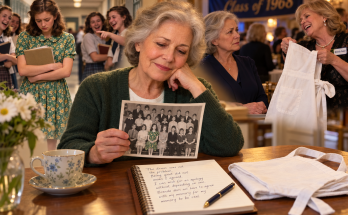
That afternoon, I opened my notebook and found the page where I had written about the apron.
I read the earlier entries slowly.
Some sounded more certain than I felt.
Others revealed how much I had doubted myself.
I did not criticize either version.
I had been working through the memory as best I could.
I took a pen and wrote beneath the old lines.
My answer was enough because it was true.
I put the pen down.
The sentence made me feel calm.
I did not need to create a better version of myself for the reunion.
I did not need to return to that room in my imagination and deliver a speech that would silence everyone.
I had been there.
I had answered.
I had left when I wanted to leave.
The evening had ended.
The rest of the work had happened afterward, in the quiet days when I decided what I wanted to believe about myself.
I closed the notebook.
Later, Eleanor came by with a small container of biscuits she had made.
She had called earlier to ask whether I would be home.
I invited her in, and we sat at the kitchen table.
She noticed the school photograph on the shelf.
“You've kept that out,” she said.
“Yes.”
“How do you feel when you look at it now?”
I considered the question.
“Different.”
“Different how?”
“I still remember what happened. But I don't see the dress as the problem anymore.”
Eleanor smiled.
“Good.”
“I also think I remember my answer at the reunion more clearly now.”
She waited.
“I said no.”
“You did.”
“And I told Brenda I didn't find the joke funny.”
“Yes.”
I looked at the photograph again.
“I used to think about what I should have said in the hallway. I kept trying to find the perfect answer for the girl I was.”
“Did you find one?”
“No.”
I smiled a little.
“But I think I was asking the wrong question.”
Eleanor took a biscuit from the container.
“What question should you have asked?”
“I should have asked what that girl needed to hear.”
“And what was that?”
I looked down at my hands.
“That she hadn't done anything wrong.”
Eleanor nodded.
We sat quietly for a moment.
Then she said, “You can tell her that now.”
I smiled.
“I think I have been.”
We talked about other things after that.
Eleanor told me about a book she had started reading.
I told her about a recipe I wanted to try.
The conversation wandered from one subject to another without needing to return to the reunion.
I enjoyed that.
When she left, I carried the empty cups to the sink.
The house felt peaceful.
I had not solved every question about Brenda.
I had not received an apology.
I had not changed the hallway at Oakridge High.
But I had changed the way I spoke to the girl who had stood there.
I no longer asked why she had failed to defend herself.
I asked what she had needed.
I no longer judged her for being quiet.
I remembered that she had been young.
I no longer treated the green floral dress as evidence of something lacking.
I remembered that it had been one of the few dresses she owned, and that she had worn it because she needed it.
There was nothing wrong with any of those facts.
The wrong had been in the way somebody used them to make her feel inferior.
That distinction had taken me a long time to make.
Now I wanted to keep it.
That evening, I stood before the shelf and looked at the school photograph one more time.
I did not imagine Brenda standing beside me.
I did not picture the reunion room.
I looked at the girl in the back row.
She seemed smaller than I remembered.
Perhaps all teenagers look small when we see them decades later.
I wanted to tell her that she would grow older.
I wanted to tell her that she would have a life full of things that could never be captured in that photograph.
There would be ordinary days.
There would be difficult ones.
There would be people who treated her well and people who did not.
She would make mistakes.
She would learn.
She would love people, lose people, and keep going.
One cruel afternoon would become part of her history, but it would not be the whole of it.
I could not tell her those things aloud.
I could only let myself believe them.
I turned off the kitchen light and went to bed.
The memory remained, but it no longer seemed to be waiting for me to finish an argument.
I had answered Brenda in the way I could.
I had answered the memory in the way I needed.
And I was learning to let both answers stand.
Click here to continue reading: PART 20: Fifty-Five Years Later, I Finally Let the Girl in the Green Floral Dress Walk Away Without Looking Back
The Woman Who Once Made Me Ashamed of My Clothes Had No Idea What My Life Had Become
Part 19 of 20