
A few days later, I found myself thinking about the reunion while making breakfast.
The memory came without warning.
I was spreading butter on a piece of toast when I remembered Brenda holding out the white apron.
For a moment, I felt the old tightness in my chest.
Then I set the knife down.
I waited.
I had begun to understand that I did not have to fight every painful thought as soon as it appeared.
I could notice it.
I could acknowledge it.
I could let it pass without turning it into an argument with myself.
I finished breakfast and washed the plate.
The memory remained somewhere in the background, but it no longer demanded all my attention.
That was new.
In the past, I might have spent the morning reviewing every detail.
I would have wondered whether Brenda had intended to insult me.
I would have replayed my answer and decided I should have said something sharper.
I would have imagined what the other guests thought when I left.
Then I would have felt foolish for caring.
The cycle could continue for hours.
Now I was learning to interrupt it.
Not by telling myself the incident did not matter.
It had mattered.
I was hurt.
But the hurt did not need to occupy every available space in my day.
After breakfast, I opened the curtains and let the morning light into the kitchen.
I stood for a moment looking at the ordinary things around me.
The cup on the counter.
The folded dish towel.
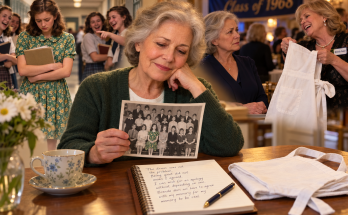
The notebook beside the photograph.
My life had been built from such ordinary things.
It had not been built from the opinions of one classmate.
I made a cup of tea and sat down.
The school photograph caught my eye.
I looked at the girl in the back row.
I thought about the four dresses I had owned when I was young.
I remembered how carefully I had made them last.
I had learned to notice loose threads, missing buttons, and hems that needed attention.
I had learned how to repair small problems before they became larger ones.
Those skills had been practical.
They had helped me get through school without asking for things my family could not afford.
There was no shame in them.
For years, however, I had remembered the dresses mainly as evidence of what I lacked.
I had allowed Brenda's response to turn resourcefulness into embarrassment.
That morning, I wanted to remember the other side.
I had taken care of what I owned.
I had made things last.
I had found ways to manage with less.
Those were not reasons to feel inferior.
They were simply facts about the life I had lived.
I opened the notebook and wrote them down.
Then I closed it before I could turn the exercise into a list of lessons.
I did not need to prove that every difficult experience had made me stronger.
I had been a person before Brenda laughed at me.
I had remained a person afterward.
That was enough.
Later in the day, I went shopping.
I had a short list and no reason to hurry.
Near the entrance, a display of kitchen supplies caught my attention.
Several white aprons hung from hooks.
I stopped.
The sight surprised me.
For a second, I felt as though I had been taken back to the reunion.
Then I looked more closely.
The aprons were plain.
Some had pockets.
Others had narrow ties.
A small sign advertised a discount.
They were ordinary household items, displayed among dozens of other things.
I stood there until the first wave of discomfort faded.
I could have walked away.
There would have been nothing wrong with that.
But I didn't want to spend my life avoiding every object that reminded me of an unpleasant moment.
I reached out and touched the fabric of one apron.
It was soft cotton.
The stitching around the pocket was neat.
I thought about the apron in my own drawer, the one I had folded after discovering it among the household linens.
I had used it for years without embarrassment.
Brenda's gesture had not changed the object itself.
It had changed the feeling attached to it.
That feeling was real, but it did not have to remain permanent.
I let the apron hang where it was.
I did not buy it.
I did not need another one.
Then I continued shopping.
The small encounter stayed with me, not because it had frightened me, but because I had remained present through it.
I had seen the aprons.
I had remembered the reunion.
I had allowed the discomfort to settle.
Then I had carried on.
When I returned home, I put away my groceries and made lunch.
I felt quietly pleased with myself.
Not because I had accomplished something extraordinary.
Because I had not treated an ordinary household object as proof that I was still trapped in the past.
That evening, Eleanor called.
We spoke about our plans for the coming week.
She asked whether I had been out.
“Yes,” I said. “I saw a display of aprons.”
There was a short pause.
Then she laughed softly.
“And how did that go?”
“Better than I expected.”
I told her what had happened.
“I didn't buy one,” I said. “But I didn't run away from the display, either.”
“That's progress.”
“Perhaps.”
I thought for a moment.
“I don't want to turn every small thing into a test.”
“Then don't.”
Her answer was so simple that I laughed.
“I suppose I keep looking for proof that I'm doing this properly.”
“Doing what properly?”
“Moving on.”
Eleanor was quiet for a moment.
“Maybe moving on isn't something you pass or fail.”
I leaned back in my chair.
I had spent years measuring myself against other people's standards.
I had worried about whether I was dressed correctly, speaking correctly, reacting correctly.
Even now, I had begun to measure my recovery.
I wanted to know whether I was remembering too often, feeling too much, or making too little progress.
I had turned healing into another examination.
“I think I needed to hear that,” I said.
“You don't need to earn the right to have a peaceful day.”
I looked at the window.
Outside, the light was beginning to fade.
“No,” I said. “I suppose I don't.”
After the call, I made a cup of tea.
I sat near the window and allowed myself to enjoy the quiet.
I did not open the notebook.
I did not study the photograph.
I did not rehearse what I might say to Brenda.
I watched the sky grow darker and listened to the sounds of the neighborhood.
The memory could wait.
It would still be there if I wanted to think about it tomorrow.
I did not have to attend to it every time it knocked.
Before bed, I passed the shelf where the school photograph stood.
I glanced at it and smiled.
The girl in the green dress had not become a different person because I had finally learned to look at her kindly.
She was still the same girl.
What had changed was the way I understood her.
I no longer saw a girl who had failed to protect herself from humiliation.
I saw a girl who had been treated unkindly and had continued living.
I could be sorry that she had been hurt.
I could wish that somebody had stood beside her.
I could wish that Brenda had chosen kindness.
And I could still be proud of the life that girl went on to live.
I turned off the light.
For once, I did not carry the reunion into my dreams as an unfinished conversation.
I let the day end.
Click here to continue reading: PART 19: When I Thought About the Reunion Again, I Remembered My Answer Before I Remembered Brenda’s Joke
The Woman Who Once Made Me Ashamed of My Clothes Had No Idea What My Life Had Become
Part 18 of 20

One Comment on “PART 18 – I Learned That a Peaceful Life Did Not Require Me to Pretend the Hurt Had Never Happened”