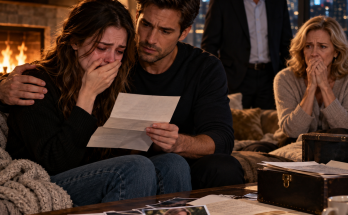
Claire read the last page of the declaration again after returning home. The instruction was unmistakable: if the original seal had been removed, the beneficiary was to receive the accompanying letter. Her father had anticipated the possibility that the declaration might be separated from its seal, which meant the missing letter had not been an afterthought. It was part of the protection he had tried to establish for her.
Margaret Ellis had already contacted Richard Hale's former firm, requesting an urgent search of the archive. Claire had expected an answer that afternoon, but the administrator warned that the records had been transferred several times and that the accompanying letter might have been stored separately from the declaration. The firm would need to examine its old inventory before confirming anything.
Claire hated the delay, but she understood why Margaret insisted on doing things properly. The original declaration had finally established that she was the named beneficiary of the reserve fund. Any additional document could affect the way the fund was administered, and she did not want another person deciding what the papers meant before she had an opportunity to read them herself.
Daniel had sent her a message shortly after noon, saying he had found another folder among the records he had kept from Arthur Hartwell's office. He wanted to bring it to her, but Claire asked him to send photographs first. She was no longer willing to accept a document simply because he placed it in front of her and told her it explained everything.
The photographs arrived twenty minutes later. The folder contained correspondence from Hartwell Advisory, several account summaries, and a letter dated three months before her father's death. Most of the material concerned the property transaction, but the final page referred to a separate archive maintained by a company called Valecrest Records Management.
Claire recognized the name from one of the older account statements. Valecrest had been responsible for storing certain legal documents after Hartwell Advisory reorganized its files. The letter instructed Arthur to transfer the sealed correspondence relating to the Morgan estate to Valecrest, where it would remain inaccessible until the beneficiary's identity was confirmed.
Claire forwarded the photographs to Margaret.
The solicitor called almost immediately.
“This is significant,” Margaret said. “It gives us another location to investigate. If the letter was transferred to Valecrest, we may be able to trace it through the archive's custody records.”
“Can they refuse to release it?”
“They may require proof that you're entitled to receive it. Fortunately, the certified declaration supports that request. I'll contact them through the appropriate legal channel.”
Claire thanked her and ended the call. For the first time since the declaration had been recovered, she felt the investigation moving toward a specific destination rather than circling the same missing documents.
She called Michael next.
“Have you heard of Valecrest Records Management?”
“Yes,” he replied. “They stored some of Hartwell Advisory's files after the company reorganized. Arthur used them for records he didn't want mixed with ordinary business correspondence.”
“Did you ever visit their archive?”
“Once, years ago. I delivered a box of documents, but I wasn't told what happened to it afterward.”
“Do you remember who accepted the box?”
Michael thought for a moment.
“A man named Paul Mercer. He was responsible for the intake records at the time.”
Claire wrote the name down.
“Could he have received the sealed letter?”
“It's possible. But I don't know whether he handled the Morgan estate file.”
“Can you help me contact him?”
“I can try to locate his current details. I don't want to promise anything until I've confirmed he's still connected to the archive.”
Claire appreciated the qualification. Michael had become more careful about distinguishing what he knew from what he merely suspected, and she wished the others had done the same from the beginning.
That evening, Claire arranged the documents in chronological order. She placed her father's instruction card at the beginning, followed by the trust instrument, the certified beneficiary declaration, the disputed transfer authorization, and the letter referencing Valecrest. The sequence showed that her father had made repeated attempts to protect the reserve fund, even as the records passed from one person to another.
At the bottom of the folder, she added a new page titled Questions Requiring Documentary Answers. She listed the location of the accompanying letter, the identity of the person who removed the original seal, the authority for the transfer into Northbridge, and the current balance of the reserve account.
She also added a question about the $150,000 she had transferred from her own savings. Northbridge had accepted the payment and placed it under review, but she still had no confirmation that it had been applied to Daniel's debt. Until the company provided a complete accounting, she could not know whether the payment had settled anything at all.
At nine the following morning, Margaret called with an update.
“Valecrest has located an entry relating to your father's estate,” she said. “They haven't confirmed that the letter is still in their possession, but the record identifies a sealed packet received from Hartwell Advisory eleven years ago.”
Claire stood from the kitchen table.
“What does the entry say?”
“It lists the packet as restricted correspondence. The recipient's name is recorded as Thomas Morgan, but the person who delivered it was Arthur Hartwell.”
“Was it ever collected?”
“The initial record doesn't show a collection. However, there is a later notation indicating that the packet was transferred to a secondary archive.”
“Where?”
“That's what we're trying to establish.”
Claire pressed her fingertips against the table. The letter had existed. It had been sealed, registered, and moved through an archive system. This was no longer a question of whether her father had written the document. It was a question of who had handled it and why it had never reached the beneficiary.
Margaret promised to keep pressing for the full custody record. She also asked Claire to avoid contacting anyone at Valecrest independently until the solicitor had established the proper procedure for requesting the packet.
Claire agreed, though the instruction felt frustratingly similar to the advice she had received from every other person connected to the estate. Wait for the records. Wait for authorization. Wait for someone else to decide what she was allowed to know.
She reminded herself that the difference now was that she had independent legal representation and documentary proof of her rights.
Later that morning, Michael sent her the contact information for Paul Mercer. He had confirmed that Mercer no longer worked at Valecrest but had retired from the records industry several years earlier. Michael had spoken to him briefly and explained that Claire was trying to locate an archive packet connected to the Morgan estate.
Mercer had agreed to speak with her, provided Margaret was present.
Claire forwarded the details to her solicitor, who arranged a video meeting for the following afternoon. Margaret advised Claire to prepare a list of questions and let Mercer explain what he remembered before showing him the documents she possessed.
That night, Claire called Daniel.
“I've located a record showing that my father's sealed letter was transferred to Valecrest,” she told him.
Daniel was silent for a moment.
“Valecrest?”
“Yes. Did you know Arthur stored estate documents there?”
“I knew he used an outside archive. I didn't know the name of every company involved.”
“Did you ever retrieve anything from them?”
“No.”
“Did you know about a sealed packet addressed to my father?”
“No.”
Claire listened carefully, but she could not determine whether his answers reflected genuine ignorance. She had learned that Daniel often knew pieces of a story without knowing its full structure, and that he had sometimes treated those gaps as reasons not to investigate further.
“I'm speaking with Paul Mercer tomorrow,” she said. “He handled some of the archive records.”
“Be careful.”
“I'm not going to stop investigating because you tell me to be careful.”
“I wasn't asking you to stop.”
“Then don't make it sound as though the truth is something I should be afraid to find.”
Daniel apologized quietly. Claire accepted the apology without offering reassurance. She was beginning to understand that an apology could be sincere and still fail to repair the damage that had made it necessary.
The following afternoon, Margaret joined Claire in a private conference room at her office. A laptop stood open on the table, displaying the face of an older man with silver hair and thin-framed glasses. He introduced himself as Paul Mercer and confirmed that he had worked for Valecrest Records Management when the Morgan estate packet was received.
“I remember the name,” Mercer said. “The file was marked restricted, and the instructions were unusual. The packet wasn't to be opened by archive staff, and no one could collect it without written authorization from the designated trustee.”
“Do you remember who delivered it?” Margaret asked.
“Arthur Hartwell. He brought it personally.”
“Was the packet sealed?”
“Yes. It had a tamper-evident strip across the flap, and the intake form required me to record the condition of the seal.”
Claire leaned forward.
“Was the seal intact when you received it?”
Mercer looked down at his notes.
“According to the intake record, yes. I wrote that the packet was received intact, with the seal undamaged.”
Claire felt a sudden rush of hope. If the letter had been properly sealed when it entered the archive, the missing original might still be recoverable.
“Did anyone collect it afterward?” she asked.
Mercer hesitated.
“There was a transfer request about eighteen months later. The packet was moved to a secondary storage location, but I wasn't the person who authorized the transfer.”
“Who did?”
“I can't say from memory. The authorization should be in the custody log.”
“Can you access that log?”
“Not directly. Valecrest's successor company maintains the records now. I can tell you what I remember, but I don't want to mislead you about documents I haven't seen in years.”
Margaret thanked him for being precise. She asked whether the packet had ever been returned to the original archive, and Mercer said he could not recall such an entry. He did remember that the transfer request had been flagged because the receiving party had not provided a new authorization signed by the beneficiary.
Claire stared at the screen.
“Someone moved my father's sealed letter without the required authorization?”
“That is what the notation appears to suggest,” Mercer said. “But I would need to see the original custody log before drawing that conclusion.”
Margaret asked him to provide a written statement of his recollection and to identify the successor company holding the archive records. Mercer agreed.
Before the meeting ended, Claire asked one final question.
“Do you remember the name of the person who requested the transfer?”
Mercer paused, then leaned closer to his screen.
“I remember the surname because it appeared on the form twice. The request came from a man named Mercer.”
Claire frowned.
“Your name?”
“Yes. But it wasn't me. My initials and employee number were different. I believe the person who submitted the request was Paul Mercer as well, perhaps someone from another office or a contractor using the same name.”
“Did you ever meet him?”
“No.”
“Could he have been connected to Hartwell Advisory?”
“I don't know.”
Margaret thanked him and ended the meeting.
For several seconds, Claire sat without speaking. The custody record had introduced another person with the same surname as the archive employee, someone who might have requested the transfer of her father's letter. The coincidence could be innocent, but the timing made it difficult to dismiss.
Margaret wrote down the details and promised to request the full custody log from Valecrest's successor company. She also warned Claire that the archive trail might take time to reconstruct because the records had passed through multiple custodians.
Claire left the office with more questions than answers, but one fact had become clear: the letter had been intact when Arthur delivered it, and someone had later requested its transfer without the required beneficiary authorization.
That evening, she returned home and placed the certified declaration on the desk beside her father's original instruction card. She read the two documents together, searching for any reference that might explain why the letter had been kept separate.
On the reverse of the instruction card, beneath the three document references, she noticed a faint pencil mark she had overlooked before.
It was a name.
Not Daniel. Not Evelyn. Not Michael.
Thomas had written a single word in the margin.
Bellweather.
Claire photographed the card and sent it to Margaret.
She did not know whether Bellweather was a person, a trust, a company, or another archive. But the name appeared beside the instruction concerning the original declaration, and her father had taken care to write it separately from the other references.
The letter had been sealed, moved, and withheld. The declaration had been separated from its original seal. Someone had claimed authority to act on Claire's behalf before she knew the estate existed.
Now her father's final notes pointed toward another entity that had not yet appeared in the formal records.
Claire closed the folder.
She had spent years believing her father had left her only memories and a modest inheritance. The documents suggested that he had left something else: a carefully constructed trail intended to survive even if the people responsible for protecting it failed.
The question was whether the trail had survived long enough to lead her to the truth.
Click here to continue reading: PART 14: The Bellweather Records Revealed a Hidden Beneficiary Clause, and Claire Learned Why Her Father Had Kept the Letter Apart from the Estate File
She Thought Saving Her Marriage Would Cost Her Everything, Until a Knock at Dawn Changed the Meaning of Her Sacrifice
Part 13 of 30