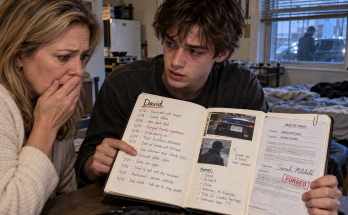
The meeting happened through lawyers.
No mansion.
No hotel.
No emotional confrontation.
Gregory appeared by video from his attorney’s office.
Amanda sat in another conference room with separate counsel Farrah had insisted she retain.
Isaac attended only as a company representative.
Daniel attended because his rights were directly affected.
I attended because my assets had been targeted.
Farrah sat beside me.
Gregory looked older than he had days earlier.
Still composed.
Still expensive.
But diminished.
Perhaps power depended partly on people believing you controlled the room.
He no longer did.
His attorney began.
“My client is prepared to provide context for the disputed transactions.”
Farrah responded, “Facts would be preferable.”
Gregory’s mouth tightened.
The attorney ignored the remark.
A document appeared on screen.
Dated five months before my wedding.
Amanda’s signature at the bottom.
I recognized it immediately.
Farrah had authenticated several examples.
The heading read:
Strategic Continuity Instructions.
My stomach tightened.
Gregory spoke.
“Amanda instructed me to preserve family control of the company and residence by all lawful means.”
Amanda’s attorney interrupted.
“Read the final words again.”
Gregory looked irritated.
“By all lawful means.”
That mattered.
Farrah leaned toward me.
Gregory continued.
“She authorized delaying refinancing.”
Amanda’s attorney said, “Subject to Charles’s approval.”
Gregory frowned.
The document contained that language too.
Subject to Charles’s approval.
Charles never approved.
He explicitly refused.
Gregory kept going.
“She authorized evaluation of outside capital connected to Isaac’s marriage.”
My skin crawled.
Amanda’s attorney did not deny that.
Amanda already had.
Gregory shared another page.
This one was worse.
Potential family capital source: prospective spouse.
My name appeared below.
So did estimates of my family’s assets.
I looked at Amanda’s video window.
She could not meet my eyes.
Gregory said, “She knew exactly what we were evaluating.”
“I admitted that,” Amanda said.
Her attorney touched her arm.
She stopped.
Gregory looked almost satisfied.
Then he produced a signed instruction.
Proceed with continuity strategy. Avoid unnecessary disclosure to Isaac until transaction path is confirmed.
Isaac leaned forward.
“Transaction path?”
Gregory’s attorney warned him not to interrupt.
Isaac sat back.
Farrah asked, “Where is the complete document?”
Gregory’s expression shifted.
“This is complete.”
“No.”
Farrah pointed toward the footer.
“Page three of four.”
Silence.
Gregory’s attorney looked at him.
Gregory said, “The fourth page was an attachment.”
“Produce it.”
“I don’t have it.”
“Convenient.”
His attorney objected.
Farrah ignored the objection.
“Was page four present when Amanda signed?”
Gregory hesitated.
Amanda answered.
“Yes.”
Everyone turned toward her screen.
Her lawyer looked unhappy.
“What was on it?” Farrah asked.
Amanda stared at Gregory.
“A list of prohibited actions.”
The room changed.
Gregory’s face hardened.
“What actions?”
Amanda’s voice became stronger.
“Forgery.”
Gregory’s attorney immediately intervened.
“My client disputes—”
Amanda continued.
“Misrepresentation to lenders. Unauthorized assumption of debt. Interference with Daniel’s trust.”
Daniel went still.
Gregory leaned toward his camera.
“That attachment was added later.”
Amanda stared at him.
“You wrote it.”
“No.”
“You sat in my kitchen and wrote it because I told you Charles would never accept anything illegal.”
Gregory laughed.
“Now you remember?”
“Yes.”
“After all these years?”
“Yes.”
Farrah asked, “Do you have a copy?”
Amanda shook her head.
“No.”
Gregory smiled.
Then Daniel spoke.
“I might.”
Every face turned toward him.
“What?”
He looked at Farrah.
“My mother kept something labeled Continuity.”
My pulse quickened.
“From Gregory?”
“I assumed it was estate material.”
“Where?”
“In the second box.”
Farrah stood immediately.
The records specialist retrieved the inventory.
Folder number seventeen.
CONTINUITY.
The sealed archival sleeve was brought into the room.
Daniel authorized opening.
Inside were photocopies.
Page one.
Page two.
Page three.
Then page four.
Nobody spoke.
The prohibited-actions list existed.
Amanda’s initials appeared at the bottom.
Gregory’s initials appeared beside hers.
Farrah read silently.
No alteration or fabrication of signatures.
No representations regarding Charles’s wishes without direct confirmation.
No interference with Daniel Mercer’s vested interests absent independent legal review.
No use of prospective marital assets without voluntary post-marital agreement.
The final line mattered most.
All restructuring remains subject to Charles Hartwell’s written approval while competent.
Gregory stared at the page on screen.
His attorney whispered something to him.
Amanda began crying.
Not with relief.
With the horror of seeing how far events had departed from what she had originally authorized.
Farrah asked Daniel, “How did Rebecca get this?”
He searched the folder.
A cover letter answered.
Gregory had sent Rebecca a copy during settlement discussions.
He had apparently used the first three pages to demonstrate Amanda’s authority.
He had included page four because, at that point, he still wanted Rebecca to believe everything was being handled lawfully.
Rebecca kept the complete set.
Gregory had forgotten.
Or assumed her records were gone.
Daniel looked toward his mother’s old papers.
“She saved everything.”
Isaac whispered, “Thank God.”
Gregory’s attorney requested a break.
Farrah agreed.
The video feeds muted.
Isaac turned toward Amanda’s frozen image.
“She still used you,” he said to me.
“Yes.”
“She still delayed the refinancing.”
“Yes.”
“She still lied about Dad.”
“Yes.”
“But she didn’t authorize the forgeries.”
“Apparently not.”
Daniel said, “That doesn’t erase what she did.”
“No.”
I looked at him.
“It changes what we can truthfully say she did.”
He nodded.
That distinction mattered.
When the meeting resumed, Gregory no longer spoke voluntarily.
His attorney did most of the talking.
Farrah asked one question.
“Did your client forge Charles Hartwell’s signature?”
Gregory’s attorney declined to answer.
“Rebecca Mercer’s?”
Declined.
“Isaac Hartwell’s?”
Declined.
“Did he create the false signing record placing Charles downtown while hospital records show him admitted?”
Declined.
“Did he profit from debt positions whose value increased after the company rescue?”
The attorney answered carefully.
“My client held lawful investments.”
“Did he disclose those interests to Charles?”
No answer.
“To Amanda?”
No answer.
“To Isaac?”
No answer.
Farrah closed her notebook.
“We’re done.”
Gregory finally spoke.
“No.”
His attorney turned toward him.
“Gregory.”
He ignored him.
“You all want a villain.”
Nobody answered.
“You think I invented this family’s problems?”
“No,” I said.
He looked at me.
“I think you monetized them.”
His expression changed.
Only slightly.
Enough.
“You don’t know what it was like,” he said. “Charles was reckless. Amanda was terrified. Isaac was unprepared. Daniel complicated succession.”
Daniel laughed.
“I existed.”
“You complicated succession by existing.”
The cruelty of the phrasing shocked even Gregory’s attorney.
Daniel’s face went cold.
Gregory continued.
“And then she appeared.”
He meant me.
“Rich family. Private holdings. Devoted to Isaac. Exactly what the company needed.”
“I was a person.”
“So was everyone.”
“Then why did you reduce us to leverage?”
“Because leverage is what saves companies.”
“No.”
I held his gaze.
“Competent restructuring saves companies.”
Farrah almost smiled.
Gregory did not.
“You think your money made you smarter than everyone.”
“No.”
“My money made it easier for everyone to avoid fixing what was wrong.”
That silenced him.
His attorney ended the meeting shortly afterward.
Amanda called me privately later.
I answered.
“I want you to know something.”
“What?”
“I am not going to use page four as an excuse.”
I sat down.
“That’s good.”
“I still knew we were waiting for your money.”
“Yes.”
“I still lied about Charles.”
“Yes.”
“I still helped Gregory isolate Daniel.”
“Yes.”
She breathed shakily.
“But I didn’t tell him to forge anything.”
“I believe the evidence supports that.”
She cried quietly.
Then she said, “I used to think being innocent of the worst thing meant I was innocent.”
I looked out the window.
“It doesn’t.”
“No.”
We ended the call.
Farrah entered minutes later carrying another report.
“What now?”
“The forensic accountant traced Gregory’s profits.”
“How much?”
“Just under eight million across several years.”
I stared.
“From the distressed debt?”
“Mostly.”
“And the rescue increased its value.”
“Yes.”
“So he benefited because the company remained distressed.”
“Yes.”
“Can we prove he deliberately kept it distressed for profit?”
“Not completely.”
“Yet.”
She nodded.
Then she placed another page in front of me.
“One transfer bothers me.”
A payment from Gregory’s investment partnership.
Three hundred thousand dollars.
Sent the week after my wedding.
Recipient hidden behind another entity.
Farrah traced it.
The recipient was a consultant.
“What consultant?”
“A private intelligence firm.”
My stomach tightened.
“Who were they investigating?”
“We obtained the engagement reference.”
She turned the page.
My name.
Again.
After the wedding.
“What did Gregory still need to know?”
“That’s the question.”
The firm’s surviving invoice described its assignment vaguely.
Asset-access assessment.
Marital structures.
Trust vulnerability.
I felt physically ill.
“He wasn’t just waiting for me to volunteer.”
“No.”
“He was researching whether my assets could be reached.”
“Yes.”
“Did Amanda know?”
“No evidence yet.”
“Isaac?”
“Almost certainly not.”
I stood.
“What did they find?”
Farrah looked grim.
“That most of your assets were protected.”
I almost laughed.
“Good.”
“But one thing was vulnerable.”
“What?”
“Your willingness to guarantee obligations voluntarily.”
There it was again.
My character.
Not my legal structure.
Not my trust.
Me.
Gregory had discovered the only path to my money was consent.
So he built circumstances in which saying no would feel like allowing Isaac’s company and employees to collapse.
“He engineered pressure.”
“Potentially.”
I paced.
“What happened after the intelligence report?”
Farrah opened the timeline.
“Three weeks later, one lender refused another extension.”
“Which lender?”
“The fund connected to Gregory.”
My skin prickled.
“He controlled the pressure.”
“His investment partnership had influence, yes.”
“And then?”
“Payroll crisis.”
I remembered the night.
Isaac sitting at our kitchen island.
Hands shaking.
Telling me they might miss payroll within three weeks.
I had called Farrah the next morning.
Within days, my holding company provided emergency support.
Exactly as Gregory expected.
“How much did his investment gain after my guarantee?”
“Several million.”
I stopped pacing.
That was the mechanism.
Not theft from me.
Not forged access to my trust.
Something more elegant.
Gregory made the company’s pain acute enough that I chose to intervene.
My consent was real.
The crisis around it may not have been.
Farrah’s phone rang.
Martin.
She answered.
His voice was urgent.
“I found the payroll correspondence.”
“What correspondence?”
“The lender that refused extension.”
Farrah put him on speaker.
Martin continued.
“I always thought the decision came from their credit committee.”
“It didn’t?”
“No.”
“Who?”
“A representative of the debt fund.”
My pulse quickened.
“Name?”
Martin gave it.
Farrah searched.
The man was Gregory’s investment partner.
I closed my eyes.
The pattern was no longer subtle.
Gregory researched my vulnerability.
His fund applied pressure.
The company approached payroll crisis.
I intervened voluntarily.
His investment increased in value.
Isaac whispered, “He used my employees to force her hand.”
Martin remained silent.
Daniel said, “And none of us saw it.”
I looked at Isaac.
“No.”
“He saw us.”
That was Gregory’s real skill.
Not law.
Not finance.
People.
Their pride.
Fear.
Love.
Shame.
And what they would do to avoid pain.
My phone buzzed.
A message from Amanda.
I just remembered why Gregory wanted your wedding date moved earlier.
I stared.
“What?”
Isaac asked.
I showed him.
Originally, we had planned to marry in October.
Amanda had unexpectedly pushed for August.
She claimed October weather was unreliable.
I had agreed.
Two months should not have mattered.
Unless someone was waiting for my legal relationship to Isaac to change before applying financial pressure.
I called Amanda.
“Why did he want August?”
Her answer came quietly.
“He said the company might not make it to October.”
“Did you know why?”
“No.”
“Did he?”
Amanda hesitated.
“I think he did.”
The company’s worst liquidity pressure began in September.
After the wedding.
After Gregory’s intelligence firm completed its analysis.
After his connected lender tightened terms.
The timeline was almost too clean.
Isaac stared at the wall.
“He moved our wedding.”
“Not alone.”
Amanda heard him.
“I helped.”
Isaac looked exhausted.
“Yes, Mom.”
“You did.”
Amanda began crying.
He did not comfort her.
He did not attack her either.
He simply told the truth.
That evening, Farrah received formal notice that Gregory’s counsel was withdrawing from the proposed cooperative resolution.
No more information would be offered voluntarily.
Daniel read the notice.
“Why stop now?”
“Because page four destroyed his attempt to shift primary responsibility onto Amanda,” Farrah said.
“And the lender records?”
“Potentially worse.”
Isaac looked at me.
“What happens next?”
“Evidence.”
He nodded.
Not rescue.
Not revenge.
Evidence.
Farrah’s investigator entered carrying one final recovered file from Gregory’s office backup.
An internal memo.
Written after the private intelligence report.
Gregory’s own notes.
The final paragraph contained one sentence.
Trust assets inaccessible absent voluntary action. Emotional pressure through husband/company remains most viable route.
No ambiguity.
No polite language.
No family loyalty.
He had written it himself.
Isaac read the sentence.
Then looked at me.
For the first time since this began, he did not apologize.
He simply said, “He knew you loved me.”
“Yes.”
“And he turned that into a financial instrument.”
I looked at Gregory’s words.
“Yes.”
Click here to continue reading: PART 19: Isaac Offered to Surrender the Company Rather Than Let Gregory’s Scheme Define Our Marriage, but Daniel Refused an Easy Ending
The Night Isaac Ordered Me Out of the Mansion He Had Never Realized Was Legally Mine
Part 18 of 35