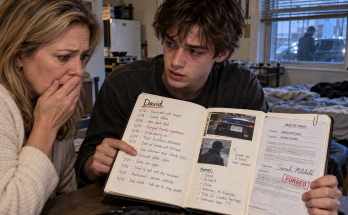
Nine months later, the beach house smelled like paint.
Real paint.
Nothing symbolic about it.
Contractors had repaired water damage, replaced two windows, refinished the floor in Liam’s bedroom, and removed a section of wall after discovering mold unrelated to any criminal conspiracy.
That last part pleased me more than it should have.
Normal problems.
Expensive.
Annoying.
Fixable.
The forged deed had been voided.
My title restored.
The fraudulent mortgage was unwound through a settlement involving Mariner’s receiver, the public benefit trust, David’s repayment, and insurance coverage from two professional-liability policies.
It took fourteen lawyers.
Nobody went to jail over the wall mold.
Progress.
Liam still did not live there.
He had rented a small apartment near campus with two friends.
His choice.
The beach house rented short-term to visiting faculty and families during the school year.
Rent covered taxes, maintenance, and most remaining legitimate costs.
Someday Liam might want it.
Someday he might sell it.
I no longer thought property needed to carry family destiny.
A house could just be a house.
Mitchell Coastal no longer existed under that name.
The public benefit trustees reorganized the legitimate businesses under a new parent entity with no family surname attached.
The old holding company entered supervised wind-down.
Dirty subsidiaries were dissolved.
Legitimate operating companies were retained or sold.
Several executive teams were replaced.
Two factories continued under new management.
A property-management division was sold to employees and outside investors.
Three lending entities closed entirely.
Pension funding was preserved.
Not perfectly.
Nothing was perfect.
But thousands of employees did not lose jobs simply because the people above them had committed crimes.
The restitution fund passed one hundred twelve million dollars after asset sales.
More would come.
The first full report listed 1,843 submitted historical claims.
Four hundred twelve approved.
Seven hundred under review.
Some rejected for lack of evidence.
Some appealed.
The process hurt.
Families brought photographs, receipts, old foreclosure notices, diaries.
One woman carried a grocery-store key her father had kept for thirty years after losing the building.
No check could give him those years back.
The administrator still issued one.
Because imperfect repair was better than elegant regret.
Environmental testing confirmed serious contamination at the old manufacturing site.
Less severe problems at the fuel parcel.
Minimal contamination at the former dry-cleaning site, despite Hale’s package suggesting catastrophe.
Real harm mixed with fabrication.
Exactly as expected.
Cleanup began.
The public benefit trust funded relocation for six families near the river property while remediation proceeded.
Richard’s hidden reports became evidence in regulatory proceedings.
He admitted concealment.
That mattered.
He did not ask anyone to call the disclosure courageous.
Also mattered.
Thomas Mercer was indicted on fraud conspiracy, obstruction, evidence tampering, bribery-related charges, and offenses tied to Daniel’s crash investigation.
Prosecutors did not charge him with murder.
Evidence did not support saying he intentionally caused my father’s death.
They did charge conduct surrounding the effort to stop Daniel, the delayed emergency response, subsequent concealment, and related conspiracies.
I was grateful they drew the distinction.
My father did not need a more dramatic crime to make what happened terrible.
Peter Donnelly was dead.
His record was formally reopened and documented.
Victor Pike’s role became complicated in public reports.
He had committed violence and surveillance crimes.
He had also tried to intervene during the final chase.
Both were true.
Owen provided records through counsel.
He faced his own charges for intimidation and unlawful surveillance connected to later activity.
His cooperation affected sentencing recommendations but did not erase what he did.
Samuel Pike’s warehouse death was officially reopened.
Federal prosecutors eventually charged Hale with conspiracy connected to the arson that killed Samuel.
That case remained pending.
Rachel Cole’s death remained unresolved.
The old house fire could not yet be conclusively tied to Hale.
Melissa hated that uncertainty.
She also accepted it.
“Not knowing is better than pretending,” she told me.
That might have been the most important thing any of us learned.
Jennifer Cole entered a plea agreement for knowingly filing false corporate records and related conduct.
She kept her law license only temporarily while disciplinary proceedings unfolded.
She expected to lose it.
She did not ask Melissa to forgive her.
The sisters began speaking anyway.
Not daily.
Not warmly at first.
But honestly.
Sometimes repair started as a phone call neither person enjoyed.
Mark pleaded guilty to kidnapping, fraud conspiracy, identity-related offenses, and obstruction.
His cooperation exposed pieces of Hale’s contingency system.
Chloe divorced him.
Completely.
No reconciliation.
No secret promise that his motives made the marriage salvageable.
He had frightened her.
Used her signatures.
Threatened custody.
Grabbed her.
Helped terrorize Liam.
He had also sometimes tried to protect them.
Both could be true.
Chloe chose not to build her future around the better half of a dangerous pattern.
Her land remained hers.
Mariner’s mortgage was refinanced through an independent bank after the new lease took effect.
The public benefit entity paid market rent.
No special family terms.
Her boys would inherit ordinary property.
Not control of a corporate empire.
She liked that.
David sold investments to satisfy his restitution and repayment obligations.
Final amount: six hundred eleven thousand dollars.
Less than feared.
More than he hoped.
He paid.
No speeches.
He also returned certain fees he had received indirectly through Bennett trust structures.
His attorneys preserved legitimate compensation where supported.
That distinction mattered to him.
It mattered to me too.
Accountability was not supposed to become self-destruction.
He moved into a small house outside Wilmington.
Not small by normal standards.
Small by David standards.
Liam visited sometimes.
I did not ask what they discussed.
David and I spoke when necessary.
Sometimes more.
Never pretending marriage would return.
That question eventually disappeared on its own.
There was still affection.
Still history.
Still anger.
None required ownership.
One afternoon, six months after the hearings, David called.
“I found something.”
My whole body tensed.
He heard it.
“Sorry.”
“Never start a conversation that way.”
“Fair.”
“What did you find?”
“Your blue casserole dish.”
I stared.
“What?”
“It was in an old box.”
“That thing survived all this?”
“Apparently.”
“You kept it?”
“You left it.”
“I left because you were lying to me.”
“Yes.”
“Don’t romanticize cookware.”
“I wasn’t.”
A pause.
“Do you want it?”
I thought.
“No.”
“You sure?”
“Yes.”
“What should I do with it?”
“Use it.”
He laughed.
“Okay.”
That was our relationship now.
Sometimes devastating history.
Sometimes casserole dishes.
Richard lived seven months after the conversion.
Longer than doctors expected.
Less than Chloe hoped.
He spent most of that time cooperating with investigators and accountants.
He gave up hidden records before anyone found them.
Not all at once.
He still had habits.
Twice Ruiz discovered accounts Richard had “forgotten.”
The second time, Ruiz threatened to put a whiteboard beside his bed titled THINGS RICHARD FORGOT.
Richard found that offensive.
I found it funny.
He paid personal restitution and penalties from his estate.
His eight-million estimate became eleven-point-four after forensic review.
He complained about methodology.
Then paid.
The scholarship foundation he mentioned was legitimate.
The trustees kept it independent but expanded eligibility.
It no longer focused only on borrowers’ children.
It included descendants of documented Recovery Group victims and students from affected communities.
Richard did not get naming rights.
That was my condition for passing along the information.
He agreed.
Two months before he died, he asked me to visit alone.
His house had become quiet.
No assistants.
No business calls.
No men waiting with folders.
Just Richard in a chair beside a window.
“I’m writing apologies,” he said.
I sat.
“That sounds dangerous.”
“They’re bad.”
“Probably.”
“I keep explaining.”
“Stop.”
He looked at me.
“Just say what you did.”
“And that I’m sorry.”
“If true.”
“It is.”
“Then stop making the apology prove you’re complicated.”
He thought about that.
“Carol would have said the same thing.”
“Do not ruin the advice.”
He almost smiled.
“Fair.”
He gave me one letter.
Not for me.
For Liam.
“Do I have to give it to him?”
“No.”
“Good.”
“What will you do?”
“Tell him it exists.”
“Then he chooses.”
“Yes.”
Richard nodded.
“Better.”
Liam eventually took the letter.
He did not read it immediately.
Kept it in a drawer for six weeks.
Then one afternoon he called Richard.
They spoke for forty minutes.
That was all I knew.
Richard died two days later.
Not dramatically.
Not during a confession.
Not after revealing another hidden account.
He died at home with Chloe beside him.
David arrived twenty minutes too late.
Liam did not make it in time.
Neither did I.
I was relieved.
Then felt guilty for the relief.
Then stopped judging myself for it.
At the funeral, David followed Richard’s request and did not turn the event into strategy.
Small service.
No corporate speeches.
No praise pretending money erased harm.
No public confession pretending a funeral was a courtroom.
Chloe spoke about her father teaching her to swim.
David spoke about how Richard could repair almost anything mechanical and almost nothing emotional.
People laughed.
Then cried.
Liam did not speak.
He placed a folded note inside the casket.
I never asked what it said.
Hale’s case took longer.
He survived the gunshot.
Survived federal detention.
Survived three motions to suppress.
Survived multiple co-defendants deciding cooperation was better than loyalty.
He did not survive the evidence.
Not metaphorically.
Legally.
The immutable Sarah audit.
The altered Schedule D.
The second ledger.
Meridian termination.
The dead-man release system.
The MHS documents.
Jennifer’s files.
Mark’s testimony.
Catherine’s records.
Daniel’s tapes.
Carol’s archives.
The Clean Exit Agreement.
Every system he built to make truth too complicated eventually created more documentation.
That was the irony.
Complexity protected him for decades.
Then buried him.
Hale eventually pleaded guilty to a federal racketeering conspiracy, financial fraud, obstruction, witness intimidation, and charges tied to Samuel’s death, with additional state matters resolved separately.
The agreement did not include responsibility for my father’s death.
The evidence still pointed most directly to Mercer’s order and Donnelly’s chase.
Hale helped create the conditions.
Helped alter the agreement.
Helped build the identity structure.
But truth mattered enough not to add what prosecutors could not prove.
I attended sentencing.
Not because I wanted closure.
I had stopped believing courtrooms could provide that.
I went because I wanted to see the process become public record.
Hale saw me.
He smiled faintly.
The same expression he had used in the warehouse.
As if we still shared a private game.
After sentencing, he asked through counsel whether I would speak with him.
I declined.
No final confrontation.
No clever last words.
He had occupied enough rooms in our lives.
He could sit in one without us.
Carol’s estate accounting finished almost a year after the beach-house discovery.
Final restitution due from her estate: seven hundred thirty-eight thousand dollars.
I authorized payment.
The remaining inheritance was still significant.
Less than I began with.
Enough.
More than enough.
I kept some.
That mattered too.
I did not give away every dollar to prove moral purity.
Money earned legitimately by my mother and later investment growth remained mine under the accounting.
I accepted it.
Used part to pay legal costs.
Set aside part for retirement.
Created no secret trust.
Put no one else’s name on anything.
Liam laughed when I showed him the account structure.
“It’s boring.”
“Yes.”
“Like, aggressively boring.”
“That’s the goal.”
“No shell companies?”
“No.”
“No dead cousins?”
“Absolutely no dead cousins.”
“Good.”
The public benefit trust’s first annual meeting was streamed publicly.
I watched from home.
Not a board member.
Not honorary chair.
Not founder’s daughter.
Just a viewer.
Victims’ representatives questioned management.
Employees asked about pension funding.
Environmental groups challenged cleanup timelines.
Accountants presented ugly numbers.
No one was told to be grateful.
No family name sat above the stage.
I liked that most.
The interim trustees transitioned into a permanent independent board after public nomination and court review.
One seat was reserved for a restitution claimant representative.
One for employees.
One for community-development expertise.
One for environmental oversight.
No hereditary seats.
No automatic family influence.
The structure was imperfect.
It could become corrupt someday.
Any system could.
The difference was no one had to inherit it silently.
Records were public.
Audits mandatory.
Terms limited.
Power dispersed.
Fear no longer served as governance.
Two years after the first discovery, I returned to my childhood neighborhood.
The house where my father said I used to hide beneath the stairs had been renovated beyond recognition.
Different paint.
Different porch.
A young family lived there.
I did not knock.
I stood across the street for a while.
That was enough.
My father had spent his last night trying to keep me from inheriting an empire.
My mother spent the rest of her life trying to control the damage after failing to honor that wish cleanly.
Neither had been purely right.
Neither purely wrong.
Daniel wanted disclosure.
Carol feared premature collapse.
He underestimated how dangerous exposure could be.
She underestimated how dangerous delay became.
They loved me.
They used my future as part of their argument.
Both were true.
That was the hardest truth.
Love did not automatically make decisions ethical.
Fear did not automatically make them necessary.
Good intentions did not erase another person’s right to choose.
I understood that better because of Liam.
He was twenty now.
Studying engineering.
Still overthinking everything.
Still noticing details no one else saw.
He stopped keeping the black notebook.
Not because I asked.
One day I noticed it was gone.
“What happened to it?”
“Recycled.”
“What?”
“I scanned the pages that mattered.”
“And the rest?”
“Didn't need them.”
That answer nearly undid me.
He did not need to preserve every fear as evidence.
“Any regrets?”
“About recycling paper?”
“You know what I mean.”
He thought.
“No.”
Then:
“Maybe one.”
“What?”
“I should’ve kept the page where I wrote that Dad’s gray SUV guy had terrible shoes.”
I laughed.
“Owen would appreciate that.”
“He would not.”
Probably true.
Liam eventually moved back into the beach house.
Not immediately.
After graduation.
He painted his room himself.
Badly.
Refused professional help.
The first night he slept there, I drove down for dinner.
No family meeting.
No lawyers.
No files.
He cooked pasta.
Burned the garlic.
We ate on the porch.
At sunset, he asked:
“Do you ever wonder what would’ve happened if Grandma just told you everything?”
“Yes.”
“What do you think?”
“I would’ve confronted someone too early.”
“Grandpa?”
“Probably.”
“Hale?”
“Maybe.”
“Dad?”
“Definitely.”
He smiled.
“Would that have been bad?”
“Maybe.”
“But?”
“But not telling me also caused harm.”
“So what was the right answer?”
I looked toward the water.
“I don’t think there was one perfect answer.”
“That’s annoying.”
“Yes.”
“What would you do?”
“With you?”
“Yes.”
“I’d tell you the part you needed to make your own decision.”
He nodded.
“And if I made the wrong one?”
“I’d try very hard not to steal it from you.”
He smiled.
“That sounds difficult.”
“It is.”
“Good.”
“Good?”
“Easy parenting seems suspicious now.”
Fair.
The final legal proceeding connected to the original trust happened that winter.
A judge entered an order permanently terminating the hereditary beneficiary provisions tied to the Bennett Family Preservation Trust and Northstar.
Liam’s name came out.
Future descendants too.
No automatic successor.
No hidden contingent beneficiary.
No child born fifty years later could wake up owning a criminal legacy because someone before them believed bloodline meant responsibility.
Laura sent me the order.
One sentence mattered most.
NO INDIVIDUAL SHALL ACQUIRE GOVERNANCE AUTHORITY SOLELY BY DESCENT.
I printed that page.
Not the whole order.
Just that page.
I put it in a frame.
Liam saw it.
“You’re framing a court order.”
“Yes.”
“That’s deeply weird.”
“Yes.”
He stared at it.
“Okay, this one I understand.”
I placed it near my desk.
Not as evidence.
As reminder.
One evening, years after everything began, I opened the last box from my mother’s estate.
Not a hidden box.
Not sealed.
No code.
Just a box I had postponed because I was tired of objects carrying secrets.
Inside were recipes.
Old tax returns.
Photographs.
A scarf.
My father’s watch.
And one envelope addressed to me.
My mother’s handwriting.
For Sarah — not instructions.
I sat down.
For a long time, I did not open it.
Then I laughed.
My mother had known exactly what I would fear.
Not instructions.
Inside was one page.
Sarah,
If you have reached this letter, I hope there is nothing left for me to ask you to do.
My throat tightened.
I have spent too much of my life deciding what other people should know, when they should know it, and what they should do afterward.
I told myself that was protection.
Sometimes it was.
Sometimes it was control wearing a kinder name.
I stopped.
Read again.
She had finally named it.
Daniel understood this before I did.
I was angry with him for that.
Then angry at myself for proving him right.
I smiled through tears.
Classic Mom.
She continued.
If you keep any money, keep it because it is yours.
If you give any away, give it because you choose to.
If you forgive me, do not do it because I am your mother.
If you do not, do not punish yourself for that either.
I covered my mouth.
And if Liam ever becomes part of this, tell him I am sorry.
Not for what happened before he was born.
For every decision I made afterward that assumed his future belonged in my plan.
I looked out the window.
Liam was outside arguing with a delivery driver about the location of a package.
Ordinary.
Beautifully ordinary.
The last paragraph:
Your father wanted you free.
I wanted you safe.
I wish I had understood sooner that those are not opposites unless fear makes them so.
Love,
Mom
No account number.
No key.
No clue.
No next step.
I read it again.
Then folded it.
Not into evidence storage.
Not into a safe.
Just the envelope.
I kept the letter.
Because I wanted to.
That night, Liam and I walked to the beach.
The air was cool.
Wind pushed small waves against the shore.
He asked what Grandma’s letter said.
I handed it to him.
He read.
Then gave it back.
“You okay?”
“Yes.”
“Real answer?”
I smiled.
“Still yes.”
We walked farther.
Behind us, the house lights stayed on.
No one watched from a gray SUV.
No one photographed us.
No one waited with paperwork.
My father’s last request had not been to preserve his name.
My mother’s final instruction had not been to preserve hers.
The company no longer carried Richard’s.
Hale’s files no longer defined reality simply because they existed.
David’s choices belonged to David.
Chloe’s land belonged to Chloe.
Liam’s future belonged to Liam.
And mine, finally, belonged to me.
I used to think freedom would feel like getting something back.
The house.
The money.
My mother’s innocence.
My father’s truth.
My marriage before it broke.
It didn’t.
Freedom felt more ordinary.
It felt like knowing what happened without needing to turn that knowledge into control.
It felt like paying what we owed without inventing debts no one else had assigned us.
It felt like refusing money when I did not want the obligation attached to it and keeping money when it was legitimately mine.
It felt like telling Liam enough truth to choose.
It felt like letting him choose differently.
He stopped near the water.
“Mom.”
“What?”
“Do you think it’s over?”
I looked at him.
Not the investigations.
Some lawsuits remained.
Not the memories.
Those would remain too.
Not every victim had been found.
Not every truth recovered.
Some never would be.
But the central thing that had passed through our family for decades had changed.
No hidden owner waited behind Liam.
No forged beneficiary sat beneath his future.
No empire expected him.
No one could point to blood and call it consent.
“Yes,” I said.
He looked surprised.
“You usually give a complicated answer.”
“I’m trying something new.”
He smiled.
“So it’s over.”
“The part that was ours to end.”
That was precise enough.
He nodded.
We turned back toward the house.
I thought once more of my father dying beside a wet road.
Tell Sarah she owes us nothing.
For years, everyone around me had done the opposite.
They handed me fear.
Money.
Property.
Secrets.
Proof.
Responsibility.
Love tangled with leverage.
Then expected me to know which parts were inheritance and which were debt.
Now I did.
The answer was simple.
Inheritance was what I chose to carry.
Debt was what evidence showed I owed.
Fear belonged to whoever created it.
And Liam owed none of us his future.
At the porch steps, he opened the door.
“Coffee?”
“At this hour?”
“Yes.”
“You’re becoming your father.”
“Take that back.”
I laughed.
Inside, he filled the kettle.
I sat at the kitchen table.
No hidden ledger beneath it.
No false bottom.
No encoded letter.
Just scratched wood.
Salt on the window.
A bowl of oranges.
A stack of unopened mail that, for once, I was not afraid to read.
Liam put two mugs down.
Neither matched.
I looked at them.
“This is offensive.”
“They were on sale.”
“Your grandmother would approve.”
He smiled.
We drank coffee too late at night.
Talked about his classes.
His roommate.
A job interview.
Whether the porch needed repainting.
Nothing urgent.
Nothing inherited.
Nothing hidden.
And when he told me his plans for next year, I listened.
I did not revise them.
I did not protect him from choosing badly.
I did not turn fear into advice he could not refuse.
I simply listened.
That was how it ended.
Not with the empire in my hands.
Not with everything burned down.
Not with every guilty person punished or every wound repaired.
It ended with the thing my father had asked for, my mother had learned too late, and Richard had finally surrendered.
A choice no one else owned.
The End
Read more original stories on Feel Every Story.
I Expected an Empty Driveway and My Son’s Smile, but the House I Bought Him Already Belonged to Someone Else
Part 46 of 46