Five years after the night I came home from the hospital alone, I woke with chest pain again.
This time, I did not panic.
Not immediately.
I sat up.
Breathed.
Waited.
Then remembered Richard.
That was enough.
I called 911.
Not Jennifer.
Not Michael.
Not Lisa.
Emergency services.
Because children were not medical plans.
Family was not infrastructure.
That lesson had stayed.
At the hospital, doctors ran tests.
Nothing catastrophic.
Again.
An irregular rhythm they wanted monitored.
Medication adjustment.
Overnight observation.
I lay beneath a thin blanket listening to machines.
The similarity to that first night was almost funny.
Same fluorescent light.
Same paper cup.
Same uncertainty.
But I was different.
My phone sat on the tray.
I called Evelyn.
She answered on the second ring.
"You dying?"
"Apparently not."
"Disappointing."
"Very."
"I'll come tomorrow."
"Good."
Then I sent one group message to my children.
At hospital. I'm okay. Doctors keeping me overnight for monitoring. No need to rush. I'll update tomorrow.
Three replies appeared.
Jennifer:
Glad you're okay. Do you want company?
Michael:
Do you need anything brought from home?
Lisa:
Want me there or want quiet?
I stared.
No one announced they were coming.
No one made my illness about their fear.
No one asked about documents.
I replied:
Quiet tonight. Tomorrow maybe.
Three versions of okay came back.
I smiled.
The next morning, Lisa arrived at ten.
After asking first.
She brought coffee.
Bad coffee.
"Hospital café."
"I can tell."
Jennifer came at noon.
Michael at two.
Not together.
Not coordinated.
No family intervention.
Each stayed about an hour.
Each left when I tired.
Michael looked at the monitor.
"Does this remind you of Dad?"
"Yes."
He nodded.
"Me too."
Then he sat quietly.
No fixing.
That might have been his greatest transformation.
When I was discharged, Jennifer asked, "Who is driving you?"
"Evelyn."
She blinked.
"Okay."
No offense.
No competition.
Evelyn arrived complaining about parking fees.
Perfect.
At home, she made tea.
"You look old."
"I'm seventy-seven."
"Excuses."
I laughed.
After she left, I sat in my kitchen.
Five years.
The old house belonged to the Chens.
The maple still stood.
Claire had sent me a photograph once after passing the property.
I kept it.
The foundation had funded thirty-two businesses.
Some succeeded.
Some failed.
That was allowed.
A grant was an opportunity.
Not a guarantee.
Samuel Ortiz still talked too much.
Carmen still corrected his budgets.
Michael had eventually spoken at a foundation workshop.
Once.
Not as administrator.
Not as financial expert.
As a man describing how shame, debt, gambling, and secrecy had nearly destroyed his family.
I sat in the back.
He did not look at me until the end.
Good.
The talk was not for me.
Afterward, a young contractor asked him how to know when borrowing had become dangerous.
Michael answered:
"When you need the next loan to keep the last lie alive."
I wrote that down.
Jennifer rebuilt her career slowly.
Not to its old level.
She no longer seemed obsessed with returning there.
She worked for a small nonprofit communications firm.
Less money.
Fewer titles.
More sleep.
Once, she told me she had finally stopped introducing herself with her job.
I said I had not noticed she did.
She called that devastating.
Lisa remained a teacher.
She became a vice principal, hated it, and voluntarily returned to the classroom the following year.
Old Lisa would have stayed because leaving felt like failure.
New Lisa said:
"I hated it."
Good enough.
Rebecca remarried.
Michael attended the children's family events without creating scenes.
That took more maturity than some people understood.
Daniel graduated college.
He used Richard's chisels.
Not professionally.
He made terrible furniture.
I bought one of his terrible side tables.
Richard's useless-money account paid for it.
Daniel protested.
I overpaid.
That was allowed.
I traveled more.
Spain.
Canada.
New Orleans.
Italy again.
Sometimes alone.
Sometimes Evelyn.
Once with Lisa.
Never all three children.
I had learned family travel was a level of intimacy none of us needed to test.
The red handbag survived.
Barely.
Thomas finally retired.
Mostly.
He still answered my calls.
Mostly.
Dr. Ellis said I no longer needed regular therapy.
I told her she was abandoning me.
She said that joke meant I was ready.
Annoying woman.
My estate plan remained almost exactly as I had set it years earlier.
That surprised people when they learned.
Improved relationships did not cause me to restore the old equal inheritance.
I did make adjustments.
Grandchildren's trusts grew.
The foundation received more.
Jennifer, Michael, and Lisa each received specific personal items and modest gifts.
Lisa's earlier trust provision was simplified.
No child received control over the bulk of my estate.
No child became executor.
Thomas's successor handled that with an independent fiduciary.
I told them.
Not amounts.
Structure.
We sat around my townhouse table.
No lawyers.
No Christmas.
Just conversation.
"I don't want surprises after I die."
Jennifer nodded.
Michael asked, "Are you sure you want us to know?"
"Yes."
Lisa looked nervous.
I explained.
The foundation.
Grandchildren.
Charities.
Personal items.
Independent administration.
Then:
"The three of you are not inheriting the estate equally."
Silence.
Five years earlier, those words might have detonated the room.
Now Michael asked, "Okay."
Jennifer smiled at him.
"That wasn't a question."
"I know."
Lisa asked, "Are you comfortable with it?"
I looked at her.
"Yes."
"Then okay."
Jennifer took a breath.
"I'd be lying if I said I don't feel something."
"Good."
"What?"
"Disappointment."
"Allowed."
"Embarrassment that I'm disappointed."
"Optional."
She laughed.
Michael said, "I'm disappointed too."
"Good."
Lisa looked between them.
"Am I supposed to be disappointed?"
"You can feel whatever you feel."
She smiled.
"Then mostly relieved."
I understood.
Money had been a dangerous language in our family.
Nobody wanted to speak it anymore.
Michael leaned forward.
"Can I ask what happens to Dad's desk?"
I stared.
Then laughed.
He raised both hands.
"Not claiming it."
"Good."
"Just asking."
I looked toward the upstairs room.
"I haven't decided."
"Okay."
"Daniel might get it."
Michael smiled.
"He'd ruin it."
"It's a desk."
"Dad's desk."
"Things aren't people."
He stopped.
Then nodded.
"Right."
There it was.
Five years later.
The lesson still needed repeating.
That was fine.
Growth was not permanent enlightenment.
It was practice.
I gave Jennifer the ceramic four-legged swan eventually.
She displayed it in her living room.
Proudly.
I gave Lisa Richard's pancake recipe.
The real one.
I gave Michael the restored carpenter square.
The one I had already offered years before became his most treasured object.
None were valuable enough to fight over.
That was intentional.
The final decision about Richard's desk came later.
I donated it to the foundation's training room.
Not Michael.
Not Daniel.
Not a museum of our family's pain.
A desk.
Used.
Applicants filled out forms on it.
Samuel spilled coffee on it during the first week.
I was delighted.
The hidden compartment remained empty.
No evidence.
No secrets.
Nothing waiting for someone to discover.
That mattered to me.
On my seventy-eighth birthday, all three children came to dinner.
They asked first.
Jennifer brought dessert.
Lisa vegetables.
Michael potatoes.
The joke had become tradition.
Grandchildren filled the townhouse.
Evelyn complained about noise while creating most of it.
Thomas came despite claiming he hated parties.
Samuel appeared with foundation applicants who had become recipients.
My home was too small.
People sat on stairs.
Someone broke a glass.
Michael cleaned it.
Jennifer did not organize anyone.
Lisa did not disappear when two people argued about parking.
Progress everywhere.
After cake, Michael tapped his glass.
"No speeches," I said.
"Too late."
Everyone groaned.
He looked at me.
"Mom, five years ago you stopped calling us."
The room quieted.
My throat tightened.
Jennifer looked down.
Lisa reached for her water.
Michael continued.
"We thought you were punishing us."
I remembered those months.
The silence.
The gate.
Christmas.
"I was partly."
He smiled.
"Fair."
I raised an eyebrow.
Everyone laughed.
Then he said, "But I think you were also stopping something."
"What?"
"Doing all the work."
My eyes filled.
He continued.
"We had our own lives."
There it was.
The sentence.
The one that had once broken something open inside me.
"We said that like your life was the part that had to fit around ours."
Jennifer wiped her eyes.
Lisa was already crying.
Michael looked at them.
"We were wrong."
I swallowed.
"You were adults."
"That's not the same thing."
"No."
"We did have our own lives."
"Yes."
"But so did you."
My throat tightened.
That was it.
Not that children must call every day.
Not that mothers must come first.
Not that adult children owe constant access.
The problem had never been that they had their own lives.
The problem was believing mine mattered less.
Michael raised his glass.
"To Mom's life."
Jennifer raised hers.
Lisa too.
Everyone followed.
I laughed because crying in front of that many people felt excessive.
Then cried anyway.
Later, after everyone left, I found three envelopes on the kitchen table.
My body reacted automatically.
Then I laughed at myself.
Five years and paper could still do that.
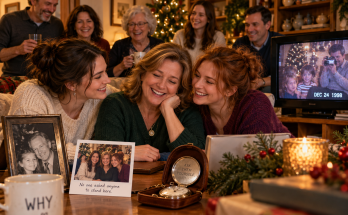
Jennifer's envelope contained a photograph.
The four of us in the empty kitchen during the final walkthrough of the old house.
On the back:
Thank you for teaching me that losing access to something is not the same as losing love.
Lisa's contained a handwritten note.
She thanked me for letting her stop being "the good one."
She wrote that boundaries had once felt cruel because she had confused peace with avoiding discomfort.
Michael's envelope was last.
One page.
Mom,
I used to think inheritance was what parents left after they died.
Now I think Dad left us consequences he didn't finish giving us, and you were brave enough not to take them away.
I know that cost you.
I also know you changed your will.
You never changed the fact that you're my mother.
Those are different things.
It took me too long to understand that.
Love,
Michael
I sat alone at the table.
The house was quiet.
But not like the old quiet.
That silence had once felt like evidence that I had been forgotten.
This silence belonged to a full day ending.
I folded the letters.
Not hidden.
Never hidden.
I placed them in the top drawer of my desk.
My desk.
Not Richard's.
I had bought it in Florence on my second trip to Italy.
Ridiculously expensive shipping.
Completely impractical.
Richard would have approved.
Then I poured tea and walked onto the patio.
The tomatoes were better that year.
Not excellent.
Better.
I had learned to accept that category too.
My phone buzzed.
A message from Jennifer.
Home safe. Love you.
Then Lisa.
Home. Thank you for tonight.
Then Michael.
Potatoes were objectively excellent.
I laughed.
I did not answer immediately.
Not because I was testing them.
Not because I wanted them to worry.
I was watching the evening sky change color.
I had my own life.
Twenty minutes later, I replied to all three.
Love you. Good night.
That was enough.
I had once believed motherhood meant keeping every door open.
Richard had believed fatherhood meant absorbing every consequence he could afford.
My children had believed family meant permanent access.
We had all been wrong in different ways.
Love did not require unlocked gates.
It did not require shared passwords.
It did not require equal inheritances.
It did not require answering every call.
It did not mean saving people from what their own choices had created.
Sometimes love was dinner.
Sometimes it was a hospital visit after asking permission.
Sometimes it was telling the truth before discovery.
Sometimes it was refusing money.
Sometimes it was giving someone a carpenter square and nothing else.
Sometimes it was saying no and staying in the relationship afterward.
I had changed my will.
I never changed it back to what it had been.
That was not revenge.
It was not a test my children had failed.
It was simply the estate plan that reflected the life I had finally chosen.
My children had their own lives.
So did I.
And once we stopped treating those truths as opposites, we finally became a family again.
The End
Read more original stories on Feel Every Story.
The Night I Came Home From the Hospital Alone, I Finally Noticed What My Children Asked About Instead of Me
Part 35 of 35