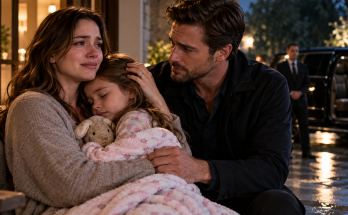
When twelve-year-old Emma came home from school that Tuesday afternoon, she dropped her backpack by the door and quietly walked upstairs without saying hello.
That alone told me something was wrong.
Normally she’d tell me about science class, complain about homework, or ask what was for dinner.
Instead, silence.
I found her curled into the corner of her bed, hugging an old stuffed rabbit she’d had since preschool.
“Sweetheart?” I asked softly.
She didn’t look at me.
After nearly a minute she whispered,
“Mom… everyone hates me.”
I sat beside her.
“That’s not true.”
She finally looked up.
Her eyes were swollen.
“It is.”
She swallowed hard.
“I eat lunch alone every day.”
“I walk through the halls alone.”
“No one wants to be my partner.”
“No one even looks at me.”
Then came the sentence that broke my heart.
“I don’t think anyone would notice if I stopped coming.”
The next morning I called the school.
The counselor assured me everything looked normal.
“Emma is just naturally quiet.”
The principal added,
“We’ve seen no reports of bullying.”
Her teacher echoed the same thing.
“She’s reserved, but she seems fine.”
Something about their answers felt rehearsed.
Too quick.
Too confident.
That evening Emma fell asleep early.
I picked up her phone.
I wasn’t trying to invade her privacy.
I was trying to protect my daughter.
The first notification made my stomach tighten.
Then another.
And another.
I opened one message.
Nobody wants you here.
Another.
Just disappear already.
Another.
The world would honestly be better without you.
There were hundreds.
Fake accounts.
Classmates.
Anonymous usernames.
Even messages from adults.
Parents.
People old enough to know better.
Some attached edited pictures.
Others spread lies.
One account posted a countdown called:
“Days Until Emma Finally Leaves.”
I couldn’t breathe.
I printed everything.
Page after page after page.
By midnight the printer had produced over four hundred pages.
Every threat.
Every screenshot.
Every username.
Every timestamp.
I organized them into binders.
The next morning I marched into the principal’s office.
Without saying a word, I placed the stack onto her desk.
The weight made the wood shake.
She stared at it.
Then slowly looked at me.
Before I could speak, she quietly said,
“Mrs. Harper…”
“There’s something you need to see first.”
She turned her computer monitor toward me.
I expected security footage.
Maybe hallway videos.
Instead I saw an internal report.
Every hateful message had already been flagged by the school’s monitoring software.
Weeks ago.
The administration had received automatic alerts.
Each one marked:
High Risk Student.
Emma.
My hands began shaking.
“You knew?”
The principal lowered her eyes.
“We knew there was concerning online activity.”
“You did nothing?”
She hesitated.
“We believed it was happening outside school jurisdiction.”
I couldn’t believe what I was hearing.
Then she clicked another folder.
This one wasn’t about Emma.
It was labeled:
Parent Community Group.
Hundreds of screenshots appeared.
Parents discussing children.
Mocking students.
Ranking which kids were “worth inviting.”
Sharing rumors.
Encouraging other parents not to let their children associate with certain classmates.
Emma’s name appeared dozens of times.
One message read:
Keep your daughters away from Emma. Her mother is trouble.
Another said:
If nobody talks to her, maybe they’ll finally move away.
I stared in disbelief.
This wasn’t children starting the bullying.
They had learned it.
From adults.
I demanded copies of everything.
The principal refused.
District policy.
So I hired an attorney.
Within forty-eight hours, preservation letters were sent to the school district and social media companies.
Digital evidence couldn’t disappear now.
The investigation uncovered something even darker.
Months earlier, another student had reported similar harassment.
The school buried it.
Then another.
And another.
Emma wasn’t the first.
She was simply the latest child being sacrificed to avoid bad publicity.
News stations soon picked up the story.
Parents who had participated in the online group insisted they were “just venting.”
But the screenshots told another story.
Teachers admitted they’d been warned not to escalate incidents unless physical violence occurred.
Former students came forward.
Some confessed they’d joined the bullying because their own parents encouraged them.
One girl cried during an interview.
“My mom told me Emma was weird. I thought I was supposed to avoid her.”
That sentence haunted me.
Children weren’t born hating one another.
Someone taught them.
The school board held an emergency meeting.
Hundreds of residents filled the auditorium.
Some defended the district.
Others demanded resignations.
Then Emma surprised everyone.
She asked if she could speak.
She walked slowly to the microphone.
Her hands trembled.
“I spent a whole year believing there was something wrong with me.”
She paused.
“There wasn’t.”
“There was something wrong with the people teaching kids how to treat other people.”
The room fell silent.
Several parents quietly lowered their heads.
Others cried.
For the first time in months, my daughter stood tall.
Over the following weeks, the superintendent resigned.
The district adopted mandatory anti-cyberbullying reporting policies.
Outside experts were brought in.
Several parents publicly apologized.
A few never did.
Civil lawsuits followed.
More importantly, support groups were created for students who had suffered in silence.
Emma slowly began healing.
She joined the school’s art club.
Then the robotics team.
She made one friend.
Then two.
Then a small group that accepted her exactly as she was.
One evening, months later, she smiled while doing homework.
A genuine smile.
The first I’d seen in a very long time.
She looked at me and said,
“Mom?”
“Remember when I said everyone hated me?”
I nodded.
She grinned.
“I was wrong.”
“Some people were just louder than everyone else.”
At that moment, I realized something every parent should remember:
Cruel voices may echo the longest—but they are never the only voices that matter.