I didn't sleep in my own bed that night.
Neither did my brother.
After the ambulance took my mother away, everything happened in a way I could barely understand.
There were more conversations.
There were questions.
There were adults trying to decide what should happen to two children whose mother was in the hospital and whose father had been taken into custody.
I remember being tired.
Not ordinary tired.
I felt as though every part of me had been holding itself together for hours.
Now that the danger had stopped, I didn't know what to do with myself.
My brother stayed close to me.
Whenever somebody unfamiliar approached, he reached for my hand.
I held it.
I had been trying to protect him all night.
I couldn't stop simply because the police were there.
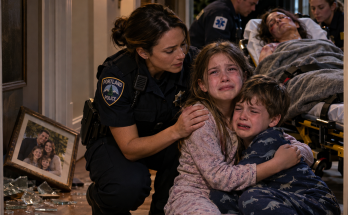
Jessica noticed how closely we stayed together.
She made sure we weren't separated unnecessarily.
I was grateful for that.
I couldn't have explained why being near my brother mattered so much.
It was just that I had spent those terrible minutes thinking he might be hurt.
Now he was standing beside me.
He was frightened.
But he was alive.
And I needed to know where he was.
Our first hours away from the house were confusing.
A child welfare worker helped arrange a safe place for us while my mother received medical care.
I remember asking about her again and again.
"Is Mom awake?"
"Can we see her?"
"When is she coming back?"
Nobody could answer every question immediately.
They told me she was being treated.
They told me she was receiving the help she needed.
They told me we were safe.
But safe didn't feel like a simple word anymore.
I had been told before that everything would be fine.
My father had said things like that after hurting my mother.
He had apologized.
He had promised he would stop drinking.
He had promised things would change.
And then they hadn't.
I was afraid to believe any promise.
Even a promise made by somebody who wanted to help.
That first night, I kept thinking about my mother on the stretcher.
I remembered the injuries on her face.
I remembered how weak her voice sounded.
I remembered her asking whether we were safe.
I wanted to tell her more than I had been able to say.
I wanted to tell her my brother was with me.
I wanted to tell her the police had found us.
I wanted to tell her I wasn't angry that she couldn't come home immediately.
Mostly, I wanted to see her open her eyes and smile.
I didn't need anything else.
The next day, we learned that my mother had survived the assault.
She was still injured.
She needed medical treatment and time to recover.
But she was alive.
I remember hearing those words and feeling something inside me loosen.
I hadn't realized how tightly I had been holding my fear.
For so many hours, I had been imagining the worst.
Now somebody was telling me that my mother would have a chance to recover.
I cried.
Then I wanted to see her.
When we were finally allowed to visit, I was frightened by how different she looked.
She was lying in a hospital bed.
Her face was swollen.
There were bruises I had never seen before.
She looked exhausted.
But when she saw us, she tried to smile.
That smile was small.
It wasn't the bright smile from the family photograph.
But it was real.
I went toward her.
I wanted to hug her tightly.
Then I stopped.
I was afraid I might hurt her.
She noticed.
"Come here, sweetheart."
Her voice was weak.
I moved closer.
She reached for my hand.
I held it carefully.
My brother stood beside me.
For a while, the three of us stayed like that.
Nobody said very much.
There were too many things I wanted to tell her.
I didn't know where to start.
Finally, I whispered something I had been carrying since the night before.
"I'm sorry."
My mother looked at me.
"Sorry for what?"
I stared at our hands.
"I couldn't make them stop."
Her expression changed.
"Chloe."
I began to cry.
"I tried to help."
She squeezed my hand gently.
"I know you did."
"I called the police."
"I know, sweetheart."
I looked at her.
"I was scared Dad would find me."
My mother took a slow breath.
Then she said something I needed more than I understood.
"You saved us."
I shook my head.
I didn't feel like somebody who had saved anyone.
I had hidden in a closet.
I had left my brother crying behind a locked door.
I had listened while my mother was being hurt.
I hadn't fought anybody.
I hadn't stopped the violence myself.
I had only made a telephone call.
But my mother understood something I didn't.
I had asked for help when nobody inside the house could make the violence stop.
And that call had brought the police.
She looked at me again.
"None of this was your fault."
I wanted to believe her.
But guilt doesn't always disappear when somebody tells you the truth.
For a long time afterward, I kept wondering whether I should have called sooner.
What if I had picked up the phone when the shouting started?
What if I had called when the glass broke?
What if I hadn't waited until I was so frightened I could barely breathe?
Those questions followed me for years.
I didn't have answers.
I only knew that I had been nine years old.
And nobody should have expected a nine-year-old child to know how to stop two violent adults.
My father and Vince faced criminal investigations for what had happened.
The police documented the injuries and the condition of the house.
My mother's account became part of the case.
So did the evidence officers had found.
The broken dishes.
The overturned chair.
The damage throughout the home.
The injuries.
And the emergency call I had made.
I wasn't old enough to understand every legal step.
I knew the men couldn't simply pretend nothing had happened.
I knew the police had seen my mother.
I knew they had seen the destruction inside our house.
And I knew there were now records of things our family had tried to keep hidden.
That was important.
For a long time, violence had happened behind our front door, and the next morning life would continue as though the terrible things had been forgotten.
My father would apologize.
My mother would try to recover.
My brother and I would go on being children who didn't know what to say.
Then the cycle would begin again.
But that night changed something.
There were witnesses outside our family.
There was a recorded call.
There were police reports.
There was medical evidence.
There were people who could no longer be persuaded that everything was normal.
My father couldn't erase what the officers had seen.
Vince couldn't make my mother's injuries disappear by calling them an accident.
And I didn't have to pretend that my fear had come from nowhere.
We didn't return to living with my father after that night.
My mother needed time to heal.
She also needed help finding a way to build a life where we could be safe.
It wasn't easy.
Recovering from what happened took longer than the hospital stay.
There were physical injuries.
There were memories.
There were practical problems that didn't disappear just because the violence had stopped.
Money was difficult.
Our routines had changed.
My brother was frightened by loud noises.
I had trouble sleeping.
Sometimes I would wake up convinced I could hear my father's footsteps.
I would sit in bed and listen.
Then I would remember he wasn't there.
But remembering didn't always calm me down.
Sometimes the fear stayed anyway.
My brother had his own way of dealing with what happened.
He wanted to know where I was.
If I left a room, he sometimes followed.
If a door closed unexpectedly, he became upset.
I understood.
I remembered locking him in my bedroom.
I remembered hearing him cry.
Even though I had been trying to protect him, the memory hurt.
One day, I asked whether he was angry with me.
He looked confused.
"Why?"
"Because I left you alone."
He didn't answer immediately.
Then he said he had been scared.
I started crying.
He reached for my hand.
"I was happy when you came back."
That was all he said.
He didn't blame me.
He didn't ask me why I hadn't stayed with him.
He remembered that I had come back.
I held his hand for a long time.
My mother worked hard to help us feel safe again.
Sometimes that meant ordinary things.
Meals at regular times.
Quiet evenings.
Knowing where we were going to sleep.
Being able to ask questions without worrying that somebody would start shouting.
Those things had once seemed too small to notice.
After that night, they became important.
I remember the first time I heard something break and didn't immediately think somebody was being hurt.
It was an ordinary accident.
Nobody screamed.
Nobody threatened anyone.
Nobody had to hide.
But my body reacted before my mind understood what had happened.
My mother noticed.
She came to sit beside me.
"It's okay."
I looked at her.
"Are you sure?"
She nodded.
"Yes."
That time, I believed her a little more.
Healing didn't happen all at once.
There wasn't one morning when everything suddenly felt normal.
There were good days and difficult days.
There were nights when I slept peacefully.
There were nights when I dreamed about the closet.
Sometimes I remembered the dispatcher.
Sometimes I remembered Jessica.
Sometimes I remembered my mother's face as the paramedics carried her away.
Those memories were part of me.
I couldn't simply decide to forget them.
As I grew older, I began to understand more about what had happened to our family.
Losing a job had been difficult for my father.
I understood that.
But being unemployed hadn't given him the right to hurt my mother.
Drinking hadn't made the violence acceptable.
And Vince's presence hadn't made it any less serious.
Those were choices the adults had made.
I hadn't caused them.
My brother hadn't caused them.
My mother hadn't deserved them.
It took me years to understand those things without questioning myself.
For a long time, I wondered whether our family could have been different if my father had found another job.
Maybe he wouldn't have started drinking so heavily.
Maybe the arguments wouldn't have become violent.
Maybe the man who decorated our house at Christmas would have stayed the father I remembered.
But I eventually understood that those questions couldn't change what he had done.
He was responsible for his behavior.
Not me.
Not my mother.
Not my brother.
I could remember the good things about him without pretending the bad things hadn't happened.
That was difficult.
But it was necessary.
I still remembered him waving to neighbors.
I still remembered the Christmas lights.
I still remembered the way our family looked in the photograph.
And I also remembered the bruises on my mother's skin.
I remembered Vince laughing.
I remembered the broken glass.
I remembered the silence that made me reach for the phone.
All of those memories belonged to the same family.
I didn't have to choose one version and pretend the other had never existed.
When I became older, I thought often about Officer Jessica Hayes.
She was the first police officer I saw after the call.
I remembered her kneeling beside the closet.
I remembered her speaking gently.
I remembered her telling me I had done the right thing.
She hadn't treated me like a nuisance.
She hadn't blamed me for leaving my brother alone.
She had recognized that I was a frightened child trying to keep another child safe.
That kindness mattered.
It mattered because I had spent so long being afraid of adults.
It mattered because I had begun to believe grown-ups were people who could hurt you and then tell you to be quiet.
Jessica showed me something different.
An adult could listen.
An adult could protect.
An adult could believe a child.
I thought about the dispatcher, too.
I never forgot the sound of her voice.
At 11:47 p.m., when I was almost too frightened to speak, she answered.
She asked my name.
She asked where I was.
She listened when I told her about my brother.
And she stayed with me while officers came to our house.
I didn't know her face.
For years, I didn't even know much about her beyond the fact that she had answered my call.
But I knew what her patience had meant to me.
I had been frightened that somebody might think I was lying.
Instead, she believed there was danger.
She acted.
And that action helped save my mother.
As an adult, I learned that calling for help doesn't always mean the danger ends immediately.
Sometimes people need medical care.
Sometimes families need somewhere else to live.
Sometimes children need support long after the emergency vehicles have gone.
My family needed all of those things in different ways.
The police stopped the immediate violence.
The hospital helped my mother survive her injuries.
Other people helped us begin building a safer life.
And time gave us opportunities to recover that we couldn't imagine on the night of the assault.
My mother didn't become the same person she had been before the violence.
Neither did I.
Neither did my brother.
But we learned to live without being afraid of every sound in the hallway.
We learned that a quiet evening could really be quiet.
We learned that an apology didn't mean much without changed behavior.
And we learned that love wasn't supposed to require hiding from the person who claimed to love you.
I remember looking at my mother one evening after things had become more stable.
She was sitting quietly.
My brother was nearby.
Nobody was shouting.
There was no loud music.
No bottles.
No frightened whispering.
I asked her something I had wondered about for a long time.
"Mom, do you remember that night?"
She looked at me.
"Yes."
I hesitated.
"Do you wish I had done something different?"
She put down what she was holding.
Then she reached for my hand.
"No, Chloe."
I looked at her.
"Not even calling sooner?"
She shook her head.
"You were a little girl."
I started to speak, but she continued.
"You were my daughter. You weren't responsible for stopping what those men did."
I looked down.
She squeezed my hand.
"You asked for help. That's what mattered."
I didn't answer.
I was crying.
But those tears felt different from the ones I had cried in the closet.
I wasn't waiting for somebody to rescue us anymore.
I was sitting beside my mother in a place where we were safe.
And she was alive to tell me that I hadn't failed her.
That was something I never wanted to forget.
Years later, when people heard about what happened, some described me as brave.
I never knew exactly how to respond.
I remembered being terrified.
I remembered shaking so badly that holding the phone was difficult.
I remembered hiding because I couldn't face my father.
I remembered how desperately I wanted somebody else to take control.
Brave wasn't how I had felt.
I had felt small.
Helpless.
Afraid.
But I came to understand that fear and courage could exist together.
I hadn't called because I was fearless.
I had called because I was frightened of what would happen if nobody came.
I wanted my mother to live.
I wanted my brother to be safe.
I wanted the violence to stop.
That was enough to make me dial three numbers.
I still remember those numbers.
911\.
I remember the time.
11:47 p.m.
I remember the rain striking the windows near Portland.
I remember my father's voice.
I remember Vince.
I remember my mother's pleading.
I remember my brother crying.
And I remember the woman who answered.
Sometimes I think about the family portrait that was lying on the hallway floor when the police arrived.
My mother was smiling in it.
My brother was beside me.
My father had his hand on our family.
For years, I thought that picture represented the life we had lost.
Now I see it differently.
It showed four people standing together.
But it didn't show whether they were safe.
It didn't show what happened when the front door closed.
It didn't show the things a little girl had learned to fear.
The life we built after that night didn't look like the photograph.
My father was no longer living with us.
My mother had to recover from serious injuries.
My brother and I carried memories that no children should have.
There were difficult days.
There were times when everything felt uncertain.
But there was something our old family photograph had never been able to guarantee.
We were safe.
I could sleep without wondering whether shouting would wake me.
My brother didn't have to hide behind a locked bedroom door.
My mother didn't have to beg two drunk men to leave her alone.
That was worth more than the appearance of a perfect family.
When I think about the nine-year-old girl I used to be, I don't see somebody who failed to protect her mother.
I see a child who was frightened and did the best she could.
I see her holding a phone.
I see her trying to breathe.
I see her listening to a stranger who promised help was coming.
And I wish I could tell her what she would eventually understand.
She was not responsible for the violence.
She was not responsible for her father's drinking.
She was not responsible for Vince's behavior.
She was not responsible for fixing the marriage.
She was a child.
A child who deserved protection.
A child who deserved to feel safe in her own home.
A child who should never have needed to hide in a closet and call the police.
But when the moment came, she reached for help.
And that decision changed our lives.
My mother survived.
My brother survived.
I survived.
We carried the memories forward, but we didn't have to keep living inside them.
The night that began with music, drinking, and shouting ended with police officers, an ambulance, and a little girl learning that somebody would listen when she told the truth.
I still think about my mother's weak voice when she saw us beside the stretcher.
She had asked whether we were safe.
Even after everything that had happened to her, she was thinking about her children.
I think that was the moment I began to understand what love was supposed to look like.
Not threats.
Not bruises.
Not apologies that changed nothing.
Love was my mother worrying about us while she was being taken to the hospital.
Love was my brother holding my hand after I opened his bedroom door.
Love was somebody staying on the telephone with a frightened child until help arrived.
And love was being able to close my eyes at night without feeling afraid.
I didn't know any of that when I made the call.
All I knew was that my mother needed help.
So I whispered into the phone.
And somebody listened.
The End
Read more original stories on Feel Every Story.
I Was Nine Years Old When I Called 911 Because My Father and His Drunk Friend Were Hurting My Mother Again
Part 10 of 10