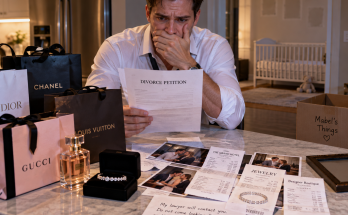
For several seconds after Detective Ortiz said Bruce Keller had named himself as petitioner, I thought I had misunderstood her.
“Bruce?”
“Yes.”
“He isn’t related to me.”
“No.”
“He has never been my caregiver.”
“No.”
“He has never handled my finances legally.”
“No.”
“He has entered my house without permission.”
“That is part of what we’re investigating.”
I looked at Thomas.
“How was he planning to explain any of that to a judge?”
Thomas held out his hand toward Detective Ortiz.
“May we see the petition?”
She could not release the original, but she had a working copy that could be reviewed under the circumstances.
She placed it between us.
The first page looked almost boring.
Court heading.
Names.
Boxes.
Case information.
My life reduced to blanks someone else had filled.
Then I read Bruce’s description of himself.
Interested party with longstanding knowledge of respondent and family circumstances.
I stared at the phrase.
“Longstanding knowledge?”
Thomas’s mouth tightened.
“Technically vague.”
“Deliberately vague?”
“Possibly.”
Bruce had not written former business enemy’s son.
He had not written prospective buyer of respondent’s property.
He had not written man who entered respondent’s home using a key supplied by her daughter-in-law.
He had chosen interested party.
Clean.
Neutral.
Concerned.
The petition alleged that my immediate family had become unable to protect me because of conflict.
That part was clever.
Mark’s involvement in the Silver Meadows plan made him compromised.
Alicia’s financial problems made her compromised.
Bruce positioned himself outside the conflict he had helped create.
“He manufactured the mess and then used the mess to make himself look independent,” I said.
Thomas nodded.
“That appears to be the theory.”
The petition requested temporary emergency authority pending a fuller hearing.
Not permanent control.
Not immediately.
A small legal doorway.
Just enough to freeze accounts, oversee property, coordinate medical evaluation, and prevent what Bruce described as further financial exploitation.
I almost admired the nerve.
The man whose company intended to buy my house was asking a court to protect me from financial exploitation.
“What evidence did he attach?”
Thomas turned the pages.
There was the Silver Meadows intake.
The false cognitive description.
Photographs.
My evening walk on Elm Street.
The gas-company service record after the stove incident.
The automobile service invoice for the low tire.
A copy of the missed electric bill.
A pharmacy receipt.
Even the wrong date I had written on a check was referenced.
Ordinary fragments.
Arranged carefully.
Detective Ortiz said, “There’s more.”
Thomas turned another page.
A declaration from Bruce.
He claimed he became concerned after observing my deteriorating judgment during several visits.
I laughed.
“He visited me twice with my knowledge.”
The declaration implied more.
He described conversations I did not remember having.
I supposedly told him Raymond still came home sometimes.
My laughter stopped.
“What?”
Thomas looked at me.
“You never said that?”
“No.”
The cruelty of it struck harder than the financial allegations.
Raymond had been dead four years.
Bruce had turned my grief into hallucination.
Another paragraph claimed I had once asked Bruce whether Mark was still in elementary school.
Mark would have been fifty years old.
I felt physically sick.
“None of that happened.”
Detective Ortiz wrote.
“I know you’ve said that. Say it again for the record.”
“It never happened.”
Thomas continued.
Bruce claimed I sometimes failed to recognize him.
That part was almost true.
The first time Alicia brought him, I did not remember meeting him years earlier at a charity function.
A perfectly ordinary lapse involving a man who meant nothing to me.
In Bruce’s declaration, it became cognitive decline.
I thought of Alicia’s confession.
Everyone your age shows something if the right questions are asked.
Bruce had not needed to invent everything.
He simply took normal human imperfection and placed it under a microscope.
Then invented the rest.
“What was supposed to happen after he filed?” I asked.
Thomas studied the requested orders.
“Potentially an expedited hearing.”
“How quickly?”
“Depends on the court and circumstances.”
“Could he have taken my house before I knew?”
“No.”
The certainty helped.
“But he could have created significant disruption.”
“How significant?”
“Accounts could be questioned. Transactions delayed. Evaluations ordered. You would need representation. The court would want evidence.”
“So he could not simply walk in tomorrow and own me.”
“No.”
I breathed out.
Important.
The scheme was frightening enough without exaggerating it.
Bruce had planned to misuse legal process.
That did not mean courts automatically handed strangers elderly people’s lives.
His plan depended on documents appearing credible.
On nobody reaching me quickly.
On Mark seeming conflicted.
On Alicia supporting the medical story.
On accumulated lies.
And on speed.
Thomas reached the attachments.
One was a proposed order.
Another listed assets.
My known assets.
$412,600.
The same number.
Then I noticed something.
The proposed order included authority over assets “known and subsequently discovered.”
I pointed.
“The trust.”
Thomas looked at me.
“He didn’t know about it.”
“But if he got authority?”
“He might have discovered it.”
My stomach turned.
The $278,000 Raymond had hidden from everyone except Thomas and the trustee would have fallen directly into Bruce’s path.
Bruce had spent years trying to recover what he believed my husband took.
He had no idea the largest pool connected to that history was sitting beyond his view.
Yet his plan could have uncovered it.
“Would he have been able to take it?”
“Not lawfully for himself.”
“That isn’t what I asked.”
Thomas paused.
“With court oversight, there would be safeguards. He could not simply transfer everything to himself without scrutiny.”
Again, important.
Bruce’s plan was dangerous.
Not magical.
He still needed people to believe his paperwork.
He needed Alicia.
Evelyn.
Possibly Daniel.
Possibly professionals who did not know they were being used.
Detective Ortiz’s phone rang.
She stepped away.
Thomas continued examining the petition.
Near the end, he stopped.
“What?”
He pointed to a paragraph.
Bruce claimed he had no financial interest in my property.
I read it twice.
Then a third time.
“That’s false.”
“If Keller Development is his company, yes.”
“We have the property records.”
“Yes.”
“And the purchase agreement.”
“Yes.”
“So he was going to sign this?”
“The petition appears prepared for signature.”
I looked at Detective Ortiz.
She returned from her call.
“Did Bruce sign it?”
“Not yet.”
Another distinction.
The false statement had been prepared.
Not filed.
Not sworn.
Still relevant.
Not the same thing as having committed whatever offense might follow from filing it.
I was becoming fluent in precision.
It was exhausting.
Ortiz sat.
“We have preliminary information from the flash drive.”
Thomas closed the petition.
“What kind?”
“Scans of financial records.”
“Dorothy’s?”
“Yes.”
“Mark’s?”
“Some.”
“Anything else?”
“Alicia’s.”
That surprised me.
Mark too.
“Why would Bruce have Alicia’s finances?”
Ortiz continued.
“Debt statements. Investment records. Credit-card information.”
Mark whispered, “Leverage.”
Perhaps.
Alicia had said Bruce threatened her.
Now we saw how much he knew.
The flash drive contained copies of her private debts.
Enough to expose her to Mark.
Enough to prove she had taken money.
Enough to keep her cooperating.
But there was something else.
A spreadsheet.
Payments.
Dates.
Names.
Bruce had tracked money between himself, Alicia, and Daniel.
Thomas asked whether it clarified the marina payment.
“Possibly.”
Detective Ortiz explained.
Bruce paid Alicia ten thousand dollars labeled consulting.
Weeks later, Alicia paid eighteen thousand toward Bruce’s marina obligations.
But the spreadsheet showed the eighteen thousand was not repayment of the ten.
It was marked bridge.
“Bridge to what?” I asked.
Ortiz shook her head.
“Unknown.”
Another entry three days later read:
D.H. funds confirmed.
My initials.
Dorothy Harper.
The stolen insurance check.
My money had been tracked in Bruce’s private spreadsheet.
That fact landed differently from Alicia’s confession.
Alicia could claim panic.
Bruce had recorded the money.
He knew where it came from.
Thomas asked, “Any indication Bruce knew the endorsement was unauthorized?”
“Not yet.”
Fair.
But the spreadsheet placed him closer.
Mark stared at the table.
“He knew Mom’s money was paying his marina bill.”
“Potentially,” Ortiz said. “We still establish what D.H. meant and what he knew.”
Then she showed us another entry.
January.
Two months after the insurance theft.
A.H. access established.
“What access?” I asked.
No explanation.
March:
Property path viable.
May:
Rear parcel option renewed.
June:
D.C. financing uncertain.
August:
M.H. cooperative.
Mark went pale.
“M.H.”
Likely Mark Harper.
Cooperative.
He had not knowingly cooperated with Bruce.
But every conversation with Alicia about downsizing had apparently been translated into progress.
October:
Medical route initiated.
The phrase made me grip the edge of the table.
Not medical concern.
Medical route.
A strategy.
A path.
And beneath it:
Target control date: 12/18.
The day I was supposed to enter Silver Meadows.
Everything converged there.
Not because December eighteenth was convenient.
Because Bruce had chosen it as the day control changed.
Detective Ortiz received another message.
She read silently.
Then looked at us.
“Bruce is requesting counsel.”
Thomas nodded.
“As he should.”
That surprised Mark.
“You’re defending him now?”
“No. I’m defending process.”
Thomas looked at him.
“Process is what protects your mother too.”
Mark went quiet.
I understood.
If we wanted truth rather than vengeance, rules mattered even when they benefited people we disliked.
Ortiz gathered her papers.
“Questioning will stop until counsel is addressed.”
“So what happens to him?”
“That depends on decisions made by investigators and prosecutors based on evidence.”
No television certainty.
No dramatic handcuffs promised.
Just procedure.
I appreciated it.
Then Thomas’s phone rang.
He answered.
Listened.
His expression changed.
“Are you certain?”
He looked at me.
“Who is it?”
“The trust company.”
My pulse quickened.
“What happened?”
Thomas asked another question.
Then ended the call.
“The dormant trust was accessed online yesterday.”
I stared.
“By whom?”
“They don’t know yet.”
“But Bruce didn’t know it existed.”
“Apparently someone did.”
I thought of Raymond’s sealed letter.
The account ending 9031.
Only Thomas, the trustee, Raymond, and now I were supposed to know.
Unless the information existed somewhere else.
Thomas looked shaken.
“That account has had no online activity in years.”
“What did the person do?”
“Nothing transferred.”
“Then what?”
“They requested beneficiary information.”
I felt cold.
“Who is the beneficiary?”
Thomas looked directly at me.
“You.”
“Anyone after me?”
He hesitated.
“Yes.”
Mark.
My son.
Mark’s face changed.
He had not known.
Neither had Alicia, supposedly.
Yet someone had asked the trust company who received the money if I could no longer control it.
And the request had been made before Raymond’s letter was opened.
Click here to continue reading: PART 22: Someone Knew About Raymond’s Hidden Trust Before We Opened His Letter, and the Access Trail Led to the Last Person We Suspected
For Nineteen Minutes, My Son and His Wife Forgot the Woman They Were Discussing Could Hear Every Word
Part 21 of 27