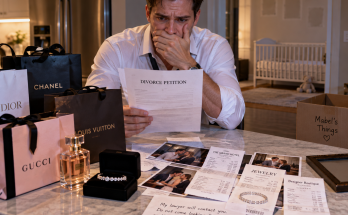
The box reached Detective Ortiz’s office that evening.
I did not see it then.
Evidence did not travel according to my impatience.
Officers documented where it was found.
Who handled it.
What condition it was in.
Thomas explained chain of custody while I tried not to imagine Bruce feeding papers into a shredder five minutes earlier.
By seven, Eleanor had gone home.
Mark remained.
I heated soup.
Nobody wanted it.
We ate anyway.
Bodies insist on ordinary maintenance even when lives are being dismantled.
The police advised me not to stay alone.
Eleanor offered her guest room.
I refused to leave the house.
So Eleanor moved into mine for the night.
Thomas objected.
I ignored him.
Mark offered to sleep on the sofa.
I said yes.
Not forgiveness.
Proximity.
There was a difference.
At nine-thirty, Detective Ortiz called.
She could not share every item from the box.
But enough had been catalogued to confirm that it contained years of Keller-related material involving Raymond.
Copies of litigation records.
Auction documents.
Photographs.
Newspaper clippings.
Property records.
Financial estimates.
And records relating to me.
Not merely recent.
Some dated back years.
“How many years?” I asked.
“Approximately six.”
My hand tightened around the phone.
Six.
Bruce had been watching my circumstances long before Alicia entered his plan.
Thomas, listening on speaker, asked what kind of records.
“Public property documents. Obituary. Social-media printouts. Charity event programs.”
Raymond’s obituary.
My attendance at events.
Pieces of a stranger’s life one could collect without ever speaking to her.
Mark sat motionless on the sofa.
“Anything illegal?”
Ortiz answered carefully.
“Possessing public information is not illegal by itself.”
Of course.
Obsession and crime were not the same thing.
But they could live in the same box.
Thomas asked, “Anything tied to the disputed signatures?”
“Yes.”
My pulse quickened.
“What?”
“Signature samples.”
The living room seemed to shrink.
“Mine?”
“Yes.”
Sources included holiday cards.
A charity donation form.
A copy of an old check.
And documents from my own house.
The missing Keller correspondence had been there too.
Bruce had taken it.
Or obtained it somehow.
“Can you prove he took it from my house?”
“Not yet.”
Important distinction.
I had learned to respect those words.
Not yet.
Mark asked, “Anything with my signature?”
“Yes.”
Tax forms.
A photocopied vehicle title.
A birthday card.
My son stared at the floor.
They had gathered our handwriting like tools.
Detective Ortiz continued.
“There are also draft versions of the power-of-attorney document.”
Thomas leaned forward.
“How many?”
“Several.”
Different dates.
Different authority provisions.
One narrow.
One broader.
One including property only.
One including bank access.
And one granting sweeping financial authority.
The evolution of the plan in paper.
Someone had refined it.
Practiced.
Expanded.
I asked, “Who drafted them?”
“Unknown at this stage.”
“Bruce?”
“We’re investigating.”
She would not give me certainty where none existed.
I appreciated that even while wanting certainty desperately.
Then Ortiz said, “There is something else.”
I waited.
“A sealed envelope.”
“What about it?”
“Your name is on it.”
My breath caught.
“Handwriting?”
“Possibly Raymond’s.”
I sat up.
Mark did too.
“Dad’s?”
Ortiz explained that the envelope had been inside the Harper box but separated from Bruce’s organized materials.
Old.
Yellowed.
Marked:
DOROTHY — IF FRANK KELLER EVER COMES BACK INTO OUR LIVES.
My throat closed.
Raymond.
Four years dead.
Speaking into the room.
“When can I see it?”
“Tomorrow.”
“I want it tonight.”
“I understand.”
“No, I mean I want it tonight.”
Ortiz remained calm.
“Mrs. Harper, it is evidence recovered during an active investigation. We need to document it first.”
I hated the answer.
It was the right one.
Thomas touched my arm.
I pulled away only because I did not want comfort yet.
“Did you open it?”
“Not yet.”
That surprised me.
“Why?”
“It was just located during the initial inventory.”
The envelope remained sealed.
Maybe by Raymond.
Maybe for years.
Maybe Bruce had never read it.
That possibility mattered.
How did it end up in Bruce’s box?
Perhaps he stole the whole correspondence folder and never noticed the envelope hidden inside.
Maybe Raymond had tucked it behind something.
Maybe it had been waiting in the filing cabinet until Alicia or Bruce removed everything.
My husband had left a message for exactly the circumstance now consuming my life.
And I had never known.
Sleep came badly.
At two in the morning, I heard Mark moving in the living room.
I found him sitting on the sofa in darkness.
“Can’t sleep?”
He shook his head.
I sat in Raymond’s chair.
For several minutes, neither of us spoke.
Then Mark said, “Do you hate me?”
I looked toward the window.
Streetlight across the curtains.
“No.”
He breathed out.
“That doesn’t mean I trust you.”
“I know.”
“You were willing to manipulate me.”
“Yes.”
“You were willing to let Alicia handle things because asking questions was inconvenient.”
“Yes.”
“You thought my house might solve your problems.”
He swallowed.
“Yes.”
I looked at him.
“That part was yours.”
He nodded.
“I know.”
Not Alicia’s.
Not Bruce’s.
Not Daniel’s.
His.
He had stopped trying to give it away.
That mattered.
He asked, “Can I fix it?”
“No.”
His face crumpled.
I continued.
“You can behave differently from now on. That is not the same as fixing what already happened.”
He nodded.
We sat in silence again.
Finally he said, “Dad would be ashamed of me.”
I thought of Raymond.
His stubbornness.
His mistakes.
The lawsuit.
The auction.
The secrets.
“Your father was imperfect.”
Mark looked at me.
“That isn’t an answer.”
“It’s the only one I have.”
By morning, I felt eighty-three instead of seventy-three.
Coffee helped slightly.
At nine, Thomas arrived.
At nine-thirty, Detective Ortiz called.
The envelope had been photographed and opened.
I could come in.
We drove to the station.
Mark remained at the house with Eleanor at my request.
This letter was addressed to me.
I wanted to read it first.
Ortiz placed a clear evidence sleeve on the table.
Inside was the old envelope.
Raymond’s handwriting.
No question.
I knew every angle.
Every impatient capital letter.
My name looked the same way he wrote it on anniversary cards.
Thomas sat beside me.
“Ready?”
“No.”
I opened the copy they provided.
The original remained protected.
Raymond’s letter began without ceremony.
Dorothy,
If you are reading this, then something I hoped would stay buried has reached you.
I stopped.
Thomas waited.
I continued.
Raymond explained the Keller lawsuit from his perspective.
Frank Keller had made mistakes.
Serious ones.
But the legal fight became personal.
Frank accused Raymond of wanting to destroy him.
Raymond denied it.
Then admitted something I had never known.
After the judgment, Raymond did buy Keller equipment at auction.
Not simply because it was cheap.
Because he was angry.
I closed my eyes.
Thomas said nothing.
Raymond wrote that anger had made him crueler than he liked admitting.
He told himself the sale was legal.
It was.
He told himself Frank had caused his own problems.
Partly true.
But Raymond knew purchasing those particular assets would humiliate Frank.
And he did it anyway.
I felt grief reopen in an unfamiliar place.
The dead do not become better merely because we miss them.
They remain who they were.
Raymond continued.
Months later, he regretted it.
He tried to return some equipment to Frank through an intermediary.
Frank refused.
By then, pride had hardened on both sides.
Then came the most important part.
Frank wrote Raymond a letter.
Not threatening.
Begging.
He asked Raymond to keep Bruce out of the dispute.
Bruce was young, furious, and obsessed with restoring the family name.
Frank feared his son would build his life around resentment.
Raymond kept the letter.
I turned the page.
His handwriting became shakier.
This part was written years later.
He said Bruce had approached him once.
Six years before Raymond died.
Bruce accused him of theft.
Said one day the Keller family would take back what had been taken.
Raymond dismissed him.
But afterward, he began keeping records.
He also asked Thomas to ensure our estate documents were secure.
I looked at Thomas.
“You knew?”
“Not this letter.”
“But you knew Bruce approached him.”
Thomas nodded.
“Yes.”
“Why didn’t you tell me?”
“Raymond asked me not to frighten you.”
Anger flashed.
“Men have done a remarkable amount of damage today while trying not to frighten me.”
Thomas accepted that.
“Yes.”
I returned to the letter.
Raymond apologized for keeping it from me.
Then he wrote something that made my hands tremble.
If Bruce ever comes after you, do not let guilt about me make you give him anything.
My mistakes were mine.
My anger was mine.
You owe him nothing.
The house is yours.
The money is yours.
Your life is yours.
I stopped.
The room blurred.
Thomas looked away to give me privacy.
I wiped my eyes.
Not because Raymond had been heroic.
Because he had understood the danger of guilt.
Bruce’s grievance was built around something real.
Raymond had acted spitefully.
But wrongdoing did not create an inheritance of ownership.
Bruce did not become entitled to my home because my husband once behaved badly toward his father.
Raymond wrote one final paragraph.
He said there was a separate account containing money from the eventual sale of Keller equipment.
He had never mixed it with our ordinary savings.
He had kept it untouched because he could not decide what was right.
My heart raced.
“What account?”
Thomas leaned closer.
I read.
Raymond instructed me to ask Thomas about a trust account ending in 9031.
Thomas froze.
“What?”
He stood.
“That account still exists.”
“How much?”
“I don’t know current value.”
“You manage it?”
“A trust company does.”
“Why didn’t I know?”
“Raymond instructed that it remain dormant unless certain conditions arose.”
My anger returned.
“Apparently men also enjoy leaving financial riddles for widows.”
Thomas almost smiled despite himself.
Then he became serious.
“I need to check.”
He made a call.
Verification took nearly half an hour.
When he returned, his face looked stunned.
“How much?”
“Two hundred seventy-eight thousand.”
I stared.
Mark had never known.
I had never known.
Bruce almost certainly had not known.
The asset inventory listed $412,600.
It did not include this.
Raymond had set aside proceeds connected to Keller equipment and investments derived from them.
Over nearly twenty years, the amount had grown.
I stared at the letter.
“What did Raymond want done with it?”
Thomas looked at the trust instructions.
“He left the ultimate decision to you.”
“To me?”
“Yes.”
The letter explained further.
If Frank or Bruce ever made a legitimate claim supported by law or agreement, the money could address it.
Otherwise, Raymond suggested I use it for something that repaired more than it rewarded.
Not payment to Bruce.
Not guilt money.
My choice.
I sat back.
The irony was almost unbearable.
Bruce had spent years trying to take my property to recover what he believed Raymond gained from Keller’s collapse.
All that time, Raymond had quietly separated a larger sum tied to the same events.
Bruce never knew it existed.
And because he never asked honestly, because he chose manipulation, forged authority, false medical claims, and secret access, he had turned a complicated moral history into something much simpler.
He was no longer merely the son of a man who had been wronged.
He had become a man willing to wrong someone else.
Detective Ortiz entered.
Her expression was serious.
“We have another development.”
Thomas closed the trust papers.
“What?”
“Bruce Keller has been detained for questioning.”
My pulse quickened.
“Why?”
Ortiz did not elaborate beyond what she could support.
But officers had recovered more than documents from the marina storage unit.
They found blank notarization forms.
Copies of my identification.
Multiple draft signatures.
And a flash drive containing scans of financial documents from my house.
Mark’s too.
Then she said, “There was also a document prepared for filing tomorrow morning.”
I felt cold.
“What document?”
She looked at me.
“The emergency guardianship petition.”
Tomorrow.
Not December.
Not after Silver Meadows.
Tomorrow.
Bruce had accelerated the plan once the morning began collapsing.
If Alicia had not warned us, if Eleanor had not noticed the car, if the marina records had disappeared, he might have tried to file before we understood how far he had gone.
Thomas asked the final question.
“Who was listed as petitioner?”
Ortiz looked directly at me.
“Not Mark.”
I frowned.
“Then who?”
She answered.
“Bruce Keller.”
The revenge had finally dropped its disguise.
He no longer intended to hide behind my son.
He was preparing to step into court himself and ask for control over my life.
Click here to continue reading: PART 21: Bruce’s Emergency Petition Claimed He Was Protecting Me, but the Evidence in His Own Storage Box Showed Exactly What He Wanted
For Nineteen Minutes, My Son and His Wife Forgot the Woman They Were Discussing Could Hear Every Word
Part 20 of 27