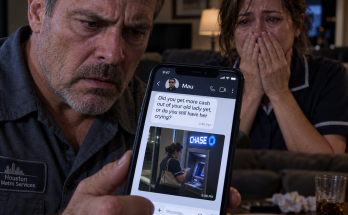
I stared at the photograph.
The envelope was unmistakable.
Cream paper.
My handwriting.
AUSTIN.
But I had torn up that letter.
I remembered standing at the kitchen counter, reading six pages of anger and grief, then ripping them in half.
Or had I?
That night before the cruise was a blur.
Three versions.
One long.
One angry.
One sentence.
Perhaps I tore up the second.
Perhaps I put the first away.
“Where did you find it?”
Austin replied:
Dad’s desk. Back drawer.
I called immediately.
“Don’t read it.”
Silence.
Then:
“Too late.”
My stomach dropped.
“How much?”
“All of it.”
I closed my eyes.
The letter had been written while the animal cages sat in my living room.
While Chloe’s sentence—everybody has problems—still burned.
While Ernest had been dead nine days.
I had not written with perspective.
I had written wounded.
“What did it say?”
“You know.”
“I barely remember.”
Austin became quiet.
Then said, “You wrote that I took your whole life.”
My chest tightened.
I remembered that sentence.
“You wrote that Dad died tired because he spent forty years cleaning up after me.”
I sat.
“That was unfair.”
“You wrote it.”
“Yes.”
“That doesn’t mean you believe it?”
“I believed it that night.”
He inhaled.
“And now?”
“No.”
The answer came easily.
“No, Austin. Your father died because his body failed. Not because of you.”
Silence.
“I caused stress.”
“So did I.”
“A lot.”
“So did life.”
He gave a weak laugh.
I continued.
“I was angry when I wrote that letter.”
“People say true things when they’re angry.”
“Sometimes. They also say cruel things that simplify complicated truths.”
He did not respond.
I needed to own the letter without defending it.
“I blamed you for choices your father and I made.”
“That doesn’t mean I did nothing.”
“No.”
“I took advantage.”
“Yes.”
“I lied about the apartment.”
“Yes.”
“I let you pay for things.”
“Yes.”
He sighed.
“You really don’t soften anything anymore.”
“I’m trying not to.”
“Could soften a little.”
I smiled.
Then became serious.
“But saying you took my whole life would let me avoid responsibility for giving away parts of it I should have protected.”
Austin was silent.
“I said yes when I wanted to say no.”
“Yes.”
“I offered help before you asked.”
“Yes.”
“I used being needed to feel important.”
That one was harder.
“I resented people for accepting things I offered.”
He exhaled.
“That happened.”
“I know.”
“So what do we do with the letter?”
“Throw it away.”
“No.”
“Why?”
“Because it was real.”
I thought about that.
“Real does not mean permanent.”
“I know.”
“Then why keep it?”
“Because I want to remember where we were.”
That answer surprised me.
Not as punishment.
As evidence.
“Keep it if you want.”
“I’m not showing Chloe.”
“That is your choice.”
“She already knows enough.”
I laughed softly.
Then Austin said, “There’s one part I’m glad you wrote.”
“What?”
“You said you wanted one year where nobody’s emergency became your schedule.”
I remembered.
“That still true?”
I looked at the calendar.
Forty-six days.
“Yes.”
“Good.”
Then he said, “Finish it.”
“I intend to.”
After the call, I wondered how the letter ended up in Ernest’s desk.
Perhaps I put it there absentmindedly.
Perhaps I intended to save it.
No mystery required.
Not every misplaced paper concealed conspiracy.
That realization itself felt like recovery.
A week later, Chloe sent me an ultrasound image.
A tiny profile.
A new life already taking shape while mine was changing at the other end.
“Boy or girl?”
Too early, she said.
Maya wanted a sister.
Austin wanted healthy.
Chloe wanted sleep.
I wanted nothing except to be present without taking over.
That was harder than it sounded.
I browsed baby furniture online twice.
Bought nothing.
Progress.
At month eleven, Austin’s debt dropped below ten thousand.
He sent no announcement.
Chloe told me.
“He doesn’t want praise?”
“He says he does.”
I laughed.
“Then why not tell me?”
“He wants to finish.”
That sounded like me.
Perhaps we were more alike than either of us had admitted.
Then came the twelfth rent payment.
Exactly one year of household responsibility would not technically be complete until the next month, but the pattern was established.
Austin had paid every rent installment.
No new revolving debt.
Emergency fund intact.
Marriage still standing.
Promotion maintained.
Education plan ready.
When the twelfth month arrived, Iris called all of us.
The thirty-two thousand dollars could now be released according to Ernest’s instructions.
Austin appeared on video beside Chloe.
I sat in my cabin with the sea behind me.
Iris asked him directly.
“Do you want the funds?”
Austin swallowed.
“Yes.”
My chest tightened.
Not because I objected.
Because the moment carried Ernest into the room.
“For what purpose?”
“Education.”
“How much?”
“Twelve thousand four hundred for the full program, including materials.”
“And the remainder?”
“Leave it.”
I blinked.
“Where?”
“In the account.”
Iris asked, “For later education?”
“Maybe.”
“Home purchase?”
“Maybe.”
“Business?”
“Probably not.”
Chloe laughed.
“Thank God.”
Austin smiled.
“I don’t need to decide now.”
There it was.
A man who once treated available money as already spent now allowing twenty thousand dollars to remain untouched.
I felt tears gather.
Iris turned to me.
“Theresa?”
“Yes?”
“Do you approve the release under Ernest’s instructions?”
I looked at my son.
He looked older than when I left.
Not dramatically.
Something around the eyes.
Responsibility has its own face.
“Yes.”
Austin swallowed.
“Thanks, Mom.”
“Thank your father.”
He looked down.
“I do.”
The funds were arranged.
No ceremony.
No speech.
A bank transfer.
Yet it felt like Ernest had reached across a year and finally given his son something without rescuing him.
Opportunity.
Not escape.
The next weeks moved quickly.
The ship began the long final sequence toward Miami.
People talked about packing.
Flights.
Home.
Ruth complained she had accumulated three suitcases of things she did not remember buying.
I had accumulated two.
One contained gifts.
The other contained a life that fit me better than the one I boarded with.
My blue suitcase remained scratched.
I refused to replace it.
At dinner one night, Ruth asked, “What are you afraid of?”
“Going home.”
“Why?”
“Because everything will try to become normal.”
“What’s wrong with normal?”
“The old normal.”
She nodded.
“What are you going to do?”
“I don’t know.”
“That’s refreshing.”
I laughed.
“I thought you’d give advice.”
“No. You’ve had enough dead husbands, lawyers, therapists, and chemistry teachers telling you things.”
She raised her glass.
“Figure it out.”
I did.
Slowly.
I decided the house would remain mine.
No downsizing because Austin thought it was too big.
No selling because grief made rooms uncomfortable.
Not yet.
I hired someone to handle lawn care.
Something I once considered wasteful.
I arranged monthly cleaning.
Also wasteful, according to the old Theresa.
Necessary, according to the woman who had learned her time had value.
I joined a local travel group online.
Booked nothing.
Just looked.
I scheduled lunch with Mrs. Mary for the week after I returned.
I did not schedule every day.
Empty space had become precious.
Then Maya called.
“Grandma, can we pick you up?”
My throat tightened.
“At the port?”
“Yes.”
“Who is we?”
“Everybody.”
I smiled.
“I would like that.”
“Dad says he can drive.”
“That’s encouraging.”
She laughed.
Then whispered:
“Mom says don’t tell you, but we’re making a sign.”
“I heard nothing.”
“Good.”
Two days later, Austin called.
“Maya told you about the sign.”
“No.”
“She cannot keep secrets.”
“Excellent quality.”
He laughed.
Then became serious.
“Mom, I want to ask something before you come back.”
“What?”
“Are things going back to how they were?”
“No.”
The answer was immediate.
“Okay.”
“Does that scare you?”
“A little.”
“Me too.”
“I don’t want them to.”
“Neither do I.”
He paused.
“Can we have Sunday dinner sometimes?”
The question hurt beautifully.
Not Can you cook Sunday dinner?
Not Can we come over?
Can we have it.
Shared.
“Sometimes.”
“I can cook.”
“That is terrifying.”
“I make pasta now.”
“Edible?”
“Mostly.”
I smiled.
“Then sometimes.”
“Not every week?”
“No.”
“Okay.”
No argument.
No guilt.
No wounded silence.
Just okay.
That may have been the greatest change of all.
The final month approached.
Then Iris called with sentencing news.
Calvin would serve prison time.
The exact sentence mattered less to me than I expected.
Elaine received probation and other penalties under her cooperation agreement.
She had lost her notary commission permanently.
Several old victims received restitution orders.
“Will we?”
“No meaningful restitution expected for Ernest’s payments.”
I thought of the boat.
Raul’s inheritance.
All that money.
Years earlier, losing it would have consumed me.
Now it felt like tuition paid to a terrible school.
Expensive.
Unrecoverable.
But understood.
“Okay.”
Iris sounded surprised.
“That’s all?”
“What else is there?”
“Nothing.”
“Then okay.”
After hanging up, I took Ernest’s photograph onto the balcony.
The same Key West image.
“You hear that?” I asked him.
No answer.
“Calvin’s going to prison.”
Wind lifted my hair.
“You should have told me.”
The sentence no longer carried rage.
Just truth.
“I would’ve been furious.”
I smiled.
“You knew that.”
The ship rolled gently.
“But I would’ve stayed.”
That was the part Ernest never trusted enough.
He thought truth might threaten love.
Perhaps we both did.
But love capable of surviving only silence is not safety.
It is postponement.
I touched the photograph.
“I wish you had known.”
Then I returned it to the desk.
Thirty days remained.
Twenty.
Ten.
The final week arrived.
Suitcases appeared in hallways.
People exchanged addresses.
Ruth and I promised to visit.
Neither of us made dramatic vows.
Real friendship did not need them.
On the third-to-last night, I received a photograph from Austin.
The dining table again.
This time no mysterious envelope.
A stack of paid statements.
On top was his credit-card balance.
$0.
I stared.
Then called.
“You did it.”
“Yeah.”
“How?”
“Boringly.”
I laughed.
“Best way.”
“Ten months of boring.”
“Congratulations.”
He was quiet.
Then said, “Dad would’ve been proud.”
“Yes.”
I did not hesitate.
“He would.”
“And you?”
There it was.
The child still inside the man.
I could answer without making praise transactional.
“I’m proud of the work you did.”
He exhaled.
“Thanks.”
“You did it.”
“Not alone.”
“No one does everything alone.”
“But nobody rescued me.”
My throat tightened.
“No.”
“I think I finally know the difference.”
I closed my eyes.
“So do I.”
After we hung up, I cried.
Not because everything was fixed.
Because it was not.
Austin still had habits to unlearn.
So did I.
Chloe still carried hurt.
Their marriage still needed work.
Ernest remained dead.
Money remained gone.
Calvin’s crimes could not be erased.
But something had changed.
We were no longer confusing love with prevention.
The next morning, Miami appeared on the voyage tracker.
Three days away.
That afternoon, Iris sent one final email.
There is a matter concerning the house. Not urgent. Call when ready.
I laughed aloud.
The house.
Of course.
I called.
“What?”
“Someone made an offer.”
“On my house?”
“Yes.”
“It isn’t for sale.”
“I know.”
“Who?”
“A developer.”
“How much?”
She told me.
I sat down.
The number was almost twice what I expected the property to be worth.
“Why?”
“Several neighboring lots are being assembled.”
I looked at Ernest’s photograph.
Selling the house had been the first thing Austin asked about after the funeral.
Now, nearly a year later, the question returned.
But nobody was asking me what I should do.
The choice was mine.
“When do they need an answer?”
“Thirty days.”
I smiled.
“Good.”
“What are you thinking?”
I looked through the balcony door toward the sea.
“I’m thinking I’m going home first.”
Click here to continue reading: PART 20: Three Days Before Miami, I Realized Going Home Would Test Every Boundary More Honestly Than Staying Away Ever Could
Nine Days After I Buried My Husband, My Son Asked a Question That Made Grief Feel Like the Smaller Problem
Part 19 of 25