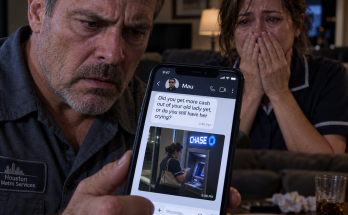
Austin leaned closer to his camera.
“What do you mean Dad knew?”
Martin rubbed his jaw.
“I mean I told him Calvin had been using employee credentials without authorization.”
“Mine?”
“Yours and others.”
“How did you know?”
“Because I was one of the investors.”
The answer surprised all of us.
Martin had not simply been a customer.
He had invested seventy-five thousand dollars with Brightline.
Calvin promised returns from short-term vehicle financing.
Martin received payments for several months.
Then they stopped.
“When things started falling apart,” Martin said, “I asked for records.”
“And?” Iris prompted.
“Some transactions used dealership paperwork. Austin’s login showed up repeatedly.”
Austin looked sick.
“I never invested anything.”
“I know that now.”
“Did you think I was part of it then?”
“At first.”
Austin’s jaw tightened.
Martin did not look away.
“I was angry and looking for someone to blame.”
That honesty mattered.
He continued.
“One of the vehicle identification numbers on my records matched a Tahoe I actually bought through Austin.”
“The Tahoe,” Austin said.
“Yes.”
“That was a legitimate sale.”
“It was. But Calvin reused information from it.”
Austin shook his head.
“So my real sale became fake paperwork.”
“Exactly.”
Martin began investigating.
He spoke to other dealership employees.
Two reported that Calvin had asked to use their credentials.
One admitted sharing a password.
Austin had too.
None realized how those credentials were being used.
“Why didn’t the dealership report this?”
“They tried to bury it.”
Martin said the company feared reputational damage and regulatory scrutiny.
Calvin was fired quietly.
Investors were told it was an internal accounting dispute.
Ernest learned only after Calvin approached him directly.
“That bastard scared Dad on purpose,” Austin said.
Martin nodded.
“He knew exactly what kind of father Ernest was.”
I closed my eyes.
That sentence hurt.
Calvin did not merely exploit a legal weakness.
He exploited love.
“He told your father you could be arrested,” Martin continued.
Austin whispered, “Dad believed him.”
“Yes.”
“Did you?”
“Not after I investigated.”
“When did you tell him?”
“Near the end.”
The final payment.
Seven thousand five hundred.
Iris asked, “Why did Ernest pay after learning Austin likely had no involvement?”
Martin took his time.
“Because by then Calvin had another lever.”
My stomach tightened.
“What?”
“The forged consent.”
My heart dropped.
“Mine.”
Martin nodded.
“Calvin told Ernest that if he refused final payment, he would record documents that made it look like both of you had participated in transferring property to conceal assets.”
I stared at the screen.
“So he threatened Ernest with the forged document.”
“Yes.”
“Blackmail.”
Martin did not argue.
Austin sat rigidly.
“Dad paid him to protect Mom.”
“And himself,” I said.
Austin looked toward me.
I continued.
“He was protecting himself from having to tell me what he had already done.”
The truth no longer felt disloyal.
It felt necessary.
Martin nodded slowly.
“That may be fair.”
Iris asked whether Martin witnessed the last payment.
“Yes.”
“Did Calvin acknowledge settlement?”
“Verbally.”
“In writing?”
Martin shook his head.
“Not directly.”
“What about Ernest’s handwritten notation?”
“I saw him write it.”
My pulse jumped.
“When?”
“Immediately after Calvin took the check.”
“Did Calvin object?”
“No.”
That changed everything.
Iris leaned forward.
“He saw Ernest write ‘paid in full’?”
“Yes.”
“And said nothing?”
“Yes.”
“Would you testify?”
Martin looked tired.
“I hoped never to hear Calvin Ross’s name again.”
No one spoke.
Then he nodded.
“But yes.”
I exhaled slowly.
Austin closed his eyes.
“Thank you.”
Martin looked at him.
“I should have stepped in sooner.”
“We all have something we should’ve done sooner,” I said.
The sentence came without planning.
Martin looked toward me.
“Yes,” he said. “I suppose we do.”
After the call, Iris sounded more optimistic.
“Calvin’s claim is weaker now.”
“Weaker or dead?”
“Weaker.”
“Lawyers must hate adjectives.”
“We survive on them.”
I laughed.
It felt good.
Then she turned serious.
“Martin’s testimony helps establish settlement and Calvin’s awareness.”
“So what happens?”
“I respond formally and reject the claim.”
“Then?”
“Calvin can walk away or sue.”
“And if he sues?”
“We defend.”
I hated the uncertainty.
But uncertainty no longer felt like a command to act.
That was new.
I could let a lawyer do legal work.
Austin could manage his finances.
Chloe could decide what she needed from her marriage.
Maya could be a child.
Perhaps adulthood was partly understanding which burden belonged to whom.
That evening, Austin called from the apartment.
Chloe was beside him.
They had created a budget.
He sent me a screenshot.
I laughed.
There really was a category called Austin nonsense.
“Chloe.”
“What?”
“You actually named it that?”
“Yes.”
Austin looked offended.
“It’s temporary.”
“No,” Chloe said. “The category is permanent. The amount may decrease.”
I laughed harder than I had since Ernest’s death.
Then they showed me the motorcycle listing.
Austin had priced it fairly.
Not desperately.
“I already got three messages,” he said.
“Good.”
“I’m keeping some money for emergency savings.”
I blinked.
“What?”
“Credit counselor said if I throw every dollar at debt and have no cash, I’ll use cards again when something breaks.”
I felt proud.
Not because he had made a perfect plan.
Because someone else had given him advice and he had listened without asking me to finance the solution.
“How much emergency savings?”
“Two thousand to start.”
“Reasonable.”
He grinned.
“That’s exactly what Chloe said.”
“Then listen to Chloe.”
“I am.”
Chloe gave me a look through the camera.
“We’re working on it.”
That phrase pleased me more than any dramatic declaration could have.
Working on it.
Not fixed.
Not saved.
Not transformed overnight.
Real life rarely changes that way.
Later, after they disconnected, I finally asked Iris to send me a scan of Ernest’s private letter to me.
Not the original.
I wanted the paper itself waiting at home.
But I was ready for the words.
The first line made me cry.
Dar, I know you’re angry.
I laughed through tears.
He knew me too well.
The letter was six pages.
Longer than Austin’s.
Ernest apologized without excuses.
For hiding Raul’s money.
For using property as collateral without telling me.
For failing to disclose the forgery.
For deciding that protecting me meant withholding choices that were mine to make.
He wrote:
I kept telling myself I was carrying the burden for you. Truth is, I was keeping you from telling me I was wrong.
That sentence was the center of it.
He had not been afraid of my pain.
He had been afraid of my judgment.
I understood because I had done similar things.
Not financially.
Emotionally.
How many times had I hidden exhaustion so no one could accuse me of giving too much?
How often had I agreed to something and then resented people for accepting?
Avoidance had been one of our marriage’s quiet languages.
We were good people.
We loved each other.
We were not always honest.
Those truths could coexist.
Near the end, Ernest wrote about the cruise.
He knew I had kept brochures.
He knew I checked itineraries online.
He knew I always closed the browser when someone entered the room.
I smiled through tears.
Nosy man.
Then his letter changed.
He wrote:
Do not make the trip a punishment for Austin.
That stopped me.
I reread it.
He continued.
If you spend the whole year thinking every sunset proves he lost and you won, you are still organizing your life around him.
I put the phone down.
That hurt.
Because some part of me had done exactly that.
The cruise began as freedom.
But there were moments when I imagined Austin discovering I could live without serving him.
Moments when the trip became demonstration.
Look at me.
Look what you made me miss.
Look how happy I am without you.
That was not freedom.
That was still dependence, only inverted.
I picked up the phone again.
Ernest wrote:
Go because you want to go.
Stay because you want to stay.
Come home because you want to come home.
No audience.
No lesson.
Just your life.
I cried for a long time after that.
Then I folded the scanned pages on my screen into memory as best I could and closed the file.
The following morning, I went snorkeling with Ruth.
Actually snorkeling this time.
Not thinking about Calvin.
Not checking my phone every ten minutes.
We saw a sea turtle.
Ruth nearly swallowed half the Caribbean trying to point at it.
Back on the boat, we laughed until our stomachs hurt.
For an hour, I forgot to be a widow.
Then guilt appeared.
Quietly.
Automatically.
I recognized it.
And let it pass.
That afternoon, Iris called.
“Calvin received our rejection.”
“And?”
“He responded.”
“Fast.”
“Very.”
“What does he want?”
“To negotiate.”
I sat down.
“How much?”
“He reduced the claim.”
“To?”
“Eighty thousand.”
I laughed.
“No.”
“Good.”
“You were going to tell me not to negotiate?”
“I was going to advise you not to pay anything based on what we currently know.”
“Then no.”
Iris paused.
“There is one complication.”
I groaned.
“What now?”
“Calvin attached another document.”
“What document?”
“A letter from Ernest.”
My chest tightened.
“What does it say?”
“Ernest asks Calvin not to involve Austin.”
“That sounds consistent.”
“Yes.”
“And?”
“He also writes, ‘I accept responsibility for what happened.’”
I stared at the wall.
Calvin would use that sentence.
Of course he would.
“Responsibility for what?”
“The letter doesn’t specify.”
“Could mean responsibility as Austin’s father.”
“Could.”
“Could mean financial responsibility.”
“Could.”
“Could mean moral responsibility.”
“Yes.”
I hated ambiguity.
Then Iris added, “There’s a date.”
“When?”
“The day after the final settlement check.”
I froze.
“After?”
“Yes.”
“If Ernest believed the matter was paid, why write that?”
“I don’t know.”
That question stayed with me through dinner.
Through the evening show.
Through midnight.
At one in the morning, I remembered something.
A box.
Not Elaine’s.
Ernest’s old tackle box.
After selling the boat, he kept it in the garage.
Years later, he stopped fishing entirely, but refused to throw it away.
Inside the lid, he used to tape receipts and fishing licenses.
What if he had hidden something there?
I called Austin.
He answered sleepily.
“Mom?”
“Go to the garage.”
“What?”
“The green tackle box.”
“Right now?”
“Yes.”
He groaned.
“You realize it’s one in the morning?”
“Welcome to responsibility.”
He laughed despite himself.
Five minutes later, I heard metal latches click.
“Found it.”
“Check under the lid.”
“Fishing line.”
“Behind it.”
Paper rustled.
Then silence.
“Austin?”
“There’s an envelope.”
My pulse quickened.
“Whose name?”
“Calvin Ross.”
“Open it.”
He did.
Inside was a carbon copy of Ernest’s letter.
But unlike Calvin’s copy, Ernest’s had a second page.
Austin read the first line aloud.
My acceptance of responsibility is moral, not financial, and does not extend beyond the settlement already paid in full yesterday.
I closed my eyes.
There it was.
Not ambiguity.
Context.
Austin kept reading.
Ernest wrote that he regretted failing to question Calvin earlier.
He regretted trusting threats.
He regretted placing his family’s property at risk.
But he expressly rejected any future liability.
The final paragraph ended with:
There will be no more money.
I laughed.
Austin laughed too.
Somewhere beyond my balcony, the ship cut through dark water.
“Take photographs,” I said.
“Already doing it.”
That also made me smile.
He was learning.
I forwarded the images to Iris.
At six thirty the next morning, she called.
“This changes everything.”
“Good everything?”
“Very good.”
“How good?”
“Good enough that Calvin’s attorney just asked for time to review.”
I smiled.
“Meaning?”
“Meaning Calvin may have hoped the second page was gone.”
My smile disappeared.
“Why would he have only the first?”
“Perhaps he removed the second.”
“That sounds like fraud.”
“It may be.”
“Can we prove it?”
“Not yet.”
Again.
Facts first.
But this time I was learning patience.
Then Iris said, “There’s another issue.”
I laughed tiredly.
“There is always another issue.”
“This one concerns Elaine.”
“What about her?”
“She just called.”
“And?”
“She says Calvin knows where the original second page is.”
“Where?”
Iris hesitated.
“With her.”
I stood.
“Why?”
“Because Ernest gave it to her for safekeeping.”
“Then why didn’t she mention that before?”
“That is the problem.”
“What did she say?”
Iris’s voice flattened.
“She says Calvin threatened her yesterday.”
Click here to continue reading: PART 15: Elaine’s Fear Finally Broke Her Loyalty to Calvin, and the Evidence She Preserved Turned Ernest’s Secret Shame Into Something Far More Dangerous
Nine Days After I Buried My Husband, My Son Asked a Question That Made Grief Feel Like the Smaller Problem
Part 14 of 25