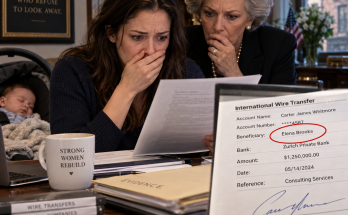
Michael Grant was thirty-two when he disappeared.
Financial analyst.
Dark hair.
Crooked smile.
Last seen leaving his downtown Chicago office eighteen months earlier.
His missing-person report listed him as married.
His spouse was Clara Bennett.
I stared at the photograph Collins showed me.
“I’ve never seen him.”
“I believe you.”
“My family attended that wedding.”
“Yes.”
I remembered the date.
June 12.
Mom had told me everyone was visiting Aunt Rebecca in Wisconsin because she was ill.
I had sent flowers.
I had spent that weekend working exhausting double shifts at a diner near O’Hare because I was trying to pay debts accumulated partly through the damage Olivia had done to my credit.
My family had been celebrating her wedding.
Under my name.
The prosecutor emerged with two detectives.
Detective Samuel Reed worked Missing Persons.
Detective Nina Alvarez introduced herself as Major Crimes.
That title settled heavily in my stomach.
They took Collins and me downstairs.
A black binder waited on the interview-room table.
Inside were photographs of Michael.
Photographs of Olivia.
Documents identifying Olivia as Clara Bennett Grant.
Reed asked whether I had ever met Michael.
No.
Spoken to him?
No.
Emailed him?
No.
Alvarez slid several messages across the table.
They had been sent to Michael’s mother after his disappearance.
They told her Michael needed space.
That he was traveling.
That his family should stop calling.
Each message was signed Clara.
“That wasn’t me.”
“We know,” Alvarez said.
Metadata connected several messages to locations associated with Olivia.
Michael’s family had suspected his wife.
But when investigators checked Clara Bennett, the records supported the woman they interviewed.
Driver’s license.
University history.
Banking information.
Lease.
Taxes.
Olivia had spent years constructing enough documentation to make herself more convincing as Clara Bennett than I was.
One discrepancy survived.
Fingerprints.
Michael’s employer had collected biometric data from employees and spouses during a security program.
The prints belonging to Michael’s wife did not match mine.
Nobody discovered the discrepancy until my arrest placed my fingerprints into another system.
The humiliation of being booked had finally created evidence proving another woman had been living under my identity.
“What happened to Michael?”
Reed explained.
Michael left work on February 4.
His vehicle exited the parking garage nine minutes later, but cameras did not show who was driving.
His phone remained active until shortly after seven.
Then nothing.
Four days later, police found his car at O’Hare.
No flight record showed Michael leaving Chicago.
Olivia told investigators he had been depressed.
She produced emails suggesting he intended to disappear.
Detectives now suspected those messages were fabricated.
Alvarez asked whether my family owned property outside Chicago.
I remembered my grandmother’s cabin near Lake Geneva.
Dad inherited it.
Ethan and Olivia used it most.
The detectives exchanged a look.
They showed me photographs taken from Michael’s recovered car.
Mud.
Leaves.
A pale limestone fragment caught in the trunk carpeting.
The material did not match the area around O’Hare.
It was consistent with geology near Lake Geneva.
“You think his car was at our cabin.”
“We believe it may have been.”
They were obtaining a warrant.
I wanted to go.
Everyone said no.
Reed’s expression softened.
“You don’t need to see what we may find.”
Nobody said body.
Nobody needed to.
Michael’s mother arrived before officers reached the cabin.
Her name was Susan.
She looked at me and went rigid.
“You.”
She accused me of telling her to stop calling her son.
Of changing the locks on his apartment.
Of standing in his kitchen and telling her Michael wanted nothing to do with his parents.
“I’ve never met you.”
She stared.
Then really looked.
Confusion entered her face.
“You look different.”
“Because the woman you met was Olivia.”
Reed explained.
Susan’s handbag slipped from her fingers.
I caught it.
She whispered that she did not even know the real name of the woman her son had married.
Then she said something that changed the investigation.
“Michael knew.”
Three days before he vanished, Michael had mailed Susan a letter.
She had given investigators a copy at the time, but its warnings had been dismissed as marital trouble.
The original was still in her handbag.
Michael wrote that his wife was not who she claimed.
He had discovered documents belonging to another Clara Bennett.
When confronted, Olivia told him I was her unstable sister and that the family had agreed to let her manage my identity because I could not handle my own affairs.
The lie was so grotesquely familiar I almost admired its efficiency.
Every crime became an act of charity if they made me defective enough.
But Michael had discovered more.
Accounts.
Transfers.
Financial activity involving clients from his firm.
He suspected the identity theft was part of something larger.
His final warning was simple.
If anything happened to him, investigators should check the property in Wisconsin.
Susan began crying.
“I told them.”
Reed looked shaken.
He had not handled the original investigation.
His phone rang.
The warrant had been signed.
Officers were heading to the cabin.
We waited.
Hours stretched into evening.
Olivia and Ethan were questioned separately.
My parents were interviewed.
Daniel’s family remained with prosecutors.
Susan sat beside me.
Eventually she asked what my life had been before Olivia became me.
I told her about architecture.
Northwestern.
The scholarship.
The years afterward.
Susan listened.
Then she told me Michael had loved the woman he knew as Clara.
He called his mother every Sunday after the wedding.
He described his wife as brilliant.
Driven.
The best thing that had happened to him.
Hearing that hurt unexpectedly.
Olivia had not merely stolen my records.
She had inserted my name into another person’s memories.
At 8:17, Reed returned.
Susan stood before he spoke.
One look at his face was enough.
Officers had found human remains beneath an old storage structure behind the cabin.
Identification would require forensic work.
Susan collapsed against me.
“My boy.”
I held her while she shook.
There was nothing useful to say.
I asked Reed what else they had found.
A suitcase containing documents.
Records tied to shell companies.
Bank transfers potentially involving millions of dollars.
Ethan’s name appeared on several accounts.
A laptop believed to belong to Michael had also been recovered.
Then Alvarez told us about the attic.
Boxes of personal records.
Birth certificates.
Tax documents.
License applications.
University records.
Not mine alone.
At least eleven identities.
The scale of it made me nauseous.
I remembered something Mom had said years earlier.
Olivia isn’t the first person in this family who needed a fresh start.
I had assumed she meant adoption.
Now I asked Alvarez to check my mother’s maiden name.
Margaret Elaine Parker.
Reed searched preliminary databases.
There was no Margaret Elaine Parker matching my mother’s supposed birth details.
Her Social Security number had been issued when she was twenty-seven.
That was approximately the age she had been when Olivia entered our home.
Alvarez asked when Olivia had been adopted.
“She wasn’t.”
They stared.
“At least, I don’t remember an adoption.”
I had been nine.
Olivia was seven.
Mom simply brought her home.
She said Olivia’s parents had died in a car accident and that Olivia was the daughter of an old friend.
Nobody ever told me Olivia’s previous surname.
The detectives left.
When they returned, another woman accompanied them.
Her jacket carried three letters.
FBI.
Special Agent Rachel Monroe placed a photograph on the table.
A younger version of my mother stared back at me.
Same eyes.
Same mouth.
Same small scar near her eyebrow.
But the name beneath the photograph was not Margaret Parker.
ELIZABETH ANNE MERCER.
Monroe explained that Margaret Bennett appeared to be an identity my mother had begun using twenty-nine years earlier.
Then she produced another photograph.
A young woman held a baby.
The baby had Olivia’s eyes.
The woman was Teresa Mercer.
Elizabeth’s younger sister.
Olivia was Teresa’s daughter.
My sister was actually my mother’s niece.
“Why did Mom say Olivia’s parents died?”
Monroe’s expression remained careful.
“Teresa Mercer didn’t die in a car accident.”
“What happened?”
“She disappeared twenty-one years ago.”
My skin went cold.
Olivia had entered our home nineteen years earlier.
Two years after Teresa vanished.
“Was Teresa ever found?”
“No.”
Collins asked whether Teresa’s disappearance connected to the records recovered from the cabin.
Monroe slid another document across the table.
A license application under Teresa Mercer’s name.
The photograph belonged to my mother.
Elizabeth.
Margaret.
Whatever her name was.
“She used her sister’s identity?”
“We believe your mother may have used several identities.”
I stared at Olivia’s childhood photograph.
“Did Olivia know?”
“We don’t know.”
“What about Ethan?”
“We don’t know.”
“Dad?”
“We’re still determining his involvement.”
For the first time, the pattern looked larger than Olivia.
She had learned to steal identities somewhere.
She had learned that documents could become more authoritative than people.
She had learned that a family could bury one person’s life beneath another person’s needs.
Maybe Mom had not merely enabled Olivia.
Maybe she had taught her.
Monroe placed one last file on the table.
It concerned Teresa Mercer’s disappearance.
Teresa had been investigating financial irregularities before she vanished.
Accounts had been opened using names belonging to other people.
One location appeared repeatedly in old records.
The Lake Geneva property.
My grandmother’s cabin.
Michael had found the same place years later.
And now investigators had discovered human remains there.
I looked toward the hallway where my mother was being questioned.
For most of my life, I thought Margaret Bennett’s worst act was choosing Olivia over me.
Now I understood favoritism might have been the least important explanation.
My mother had been running from another name since before I was born.
Her sister had vanished.
Her niece had become her daughter.
Stolen identities had been stored on family property.
And twenty-one years later, another person investigating suspicious accounts had disappeared there too.
I asked Agent Monroe the question nobody seemed eager to answer.
“Are the remains definitely Michael’s?”
“No.”
The word hit harder than yes would have.
“What do you mean?”
“The site may contain older evidence.”
Susan lifted her head.
Monroe continued carefully.
“Forensic teams found indications that the ground beneath the storage structure had been disturbed more than once.”
My mouth went dry.
“How many times?”
“We don’t know yet.”
I thought of Teresa.
Twenty-one years missing.
Michael.
Eighteen months missing.
Daniel dead in the street.
And my mother sitting less than a hundred feet away under a name that had never truly belonged to her.
The courthouse had begun the day preparing to send me to prison.
By nightfall, federal agents were asking whether our family cabin might contain evidence of crimes older than Olivia’s entire life with us.
Click here to continue reading: PART 4: The Search Beneath Our Family Cabin Uncovered an Older Secret, and My Mother Finally Asked to Speak to Me Alone
My Family Came to Court Expecting My Guilty Plea, but I Had Spent Four Years Preparing for That Morning
Part 3 of 24