Gabriel arrived the next morning carrying two coffees and no defense.
That was already an improvement.
He placed mine on the west-study desk exactly where I could reach it without having to thank him.
Cream.
No sugar.
Then he stood near the stairs leading down to Robert’s hidden archive and waited for me to decide whether he belonged below.
Elaine was already there.
So was the document specialist.
An investigator cataloged sealed boxes under the supervision of police because several files now overlapped with possible fraud, coercion, and financial-crime inquiries.
What had once been Robert’s private bunker had become evidence.
I wondered whether he would have appreciated the irony.
Probably.
Robert enjoyed being proved right more than was attractive in a husband.
“Come down,” I told Gabriel.
He did.
There were six boxes labeled with his name or initials.
Some contained ordinary correspondence.
Letters from Robert.
School records.
Copies of tuition payments.
Photographs.
Receipts from dinners that must have mattered to them because Robert had preserved them when he discarded thousands of more important pieces of paper.
The first surprise was how young Gabriel looked in those photographs.
Angry.
Thin.
Trying very hard not to look like someone waiting to be chosen.
I recognized the posture.
Not from him.
From my children.
From myself.
People who want love and do not trust it often stand the same way.
Gabriel saw me studying one photograph.
“I was twenty-two.”
“You looked furious.”
“I was.”
“With Robert?”
“With everybody.”
“That seems exhausting.”
“It was.”
I put the photograph down.
Robert’s letters to Gabriel were uneven.
Some warm.
Some stiff.
Some so formal that they read like communication between businessmen.
Then, slowly, they changed.
The later letters asked real questions.
How are you sleeping?
Are you eating properly?
Did the landlord finally fix the heat?
The mundane intimacy of fatherhood arriving decades late.
It hurt to read.
Not because Robert had cared for Gabriel.
Because he had been capable of caring openly and still hidden it from me.
Gabriel watched my face.
“You don’t have to read those.”
“Yes, I do.”
“You’re not required to know every part of him.”
“No. But I am choosing to.”
He nodded.
Choice.
The word had become almost sacred.
In the third box, we found Robert’s reports about Vale.
Not emotional accusations.
Timelines.
Payments.
Company registrations.
Copies of Michael’s early debt exposure.
Notes describing Daniel’s attempts to negotiate peace between his father and brother.
Memos about Sofia’s dependence on stronger personalities whenever conflict frightened her.
Robert had mapped us all.
That should have felt invasive.
It did.
But it also revealed his fear.
Not of one villain.
Of weakness interacting with opportunity.
Elaine found a report signed by Gabriel.
“This is yours.”
He looked over.
The date was nine years earlier.
The period when he worked briefly for Vale.
Gabriel’s face tightened.
“Yes.”
Elaine read silently.
Then handed it to me.
The report traced Michael’s hidden companies.
Shell entities.
Short-term loans.
Personal guarantees.
Money moved from one failing venture into another.
No outright theft was alleged at first.
Mostly desperation dressed as entrepreneurship.
Near the end, one entry changed the pattern.
Funds associated with the Mendoza estate had been used as collateral on a private credit arrangement.
Without proper authorization.
“Did you discover this?”
“Yes.”
“Did Robert know?”
“He was already dead.”
“Did Margaret?”
“No.”
“Did you tell anybody?”
Gabriel stared at the document.
“Vale.”
I already knew.
The answer still hurt.
“Only Vale.”
“Yes.”
Elaine asked, “Why didn’t you go to law enforcement?”
“I didn’t know whether the collateral document was enforceable or forged. Vale said he would investigate.”
“You believed him?”
“At first.”
I looked at Gabriel.
“You had Robert’s warning.”
“Yes.”
“You knew he distrusted Vale.”
“Yes.”
“Yet you gave Vale evidence that Michael had improperly used estate assets.”
“Yes.”
“Why?”
He did not answer immediately.
Then he said, “Because I wanted to stop being Robert’s instrument.”
The room went quiet.
“Explain.”
Gabriel rubbed one hand over his face.
“I was angry that Robert left me responsibility without legitimacy. If I went to Margaret, I became the secret son protecting the secret wife from the legitimate children. If I went to you, I exposed everything he told me to keep contained until the trigger. If I went to police, I risked exploding the estate without knowing the facts.”
“So you went to the man who paid you.”
“Yes.”
“That is a very convenient explanation.”
“I know.”
“What is the honest one?”
His eyes met mine.
“I wanted out.”
There it was.
“I wanted Vale to handle it. I wanted the money. I wanted my life to belong to me for once.”
I said nothing.
“So I gave him the report and told myself what happened next wasn’t my responsibility.”
“That sounds familiar.”
He flinched.
“What?”
“My children.”
His face tightened.
“They also kept saying someone else would handle things.”
Gabriel nodded.
“Yes.”
I put the report on the desk.
“That was your choice.”
“Yes.”
“You don’t get to bury it inside Robert’s failures.”
“No.”
“You don’t get to bury it inside Vale’s manipulation.”
“No.”
“You chose yourself.”
“Yes.”
The answer came without self-pity.
That mattered.
Then Elaine found another document.
Not from Gabriel.
From Robert.
Dated earlier.
It described a conversation with him about responsibility.
Robert had written:
Gabriel is not obliged to repair every failure created by my cowardice. If he walks away, that is his right.
I read the sentence twice.
Gabriel looked away.
“Did he tell you that?”
“Not in those words.”
“He wrote it.”
“I know.”
“Then he didn’t expect you to become his servant.”
“No.”
“But he did expect you not to help Vale.”
Gabriel looked at me.
“Yes.”
That was the distinction.
Freedom did not require betrayal.
A person could refuse responsibility without handing dangerous information to someone untrustworthy.
It was uncomfortable how often our family had confused those two things.
Elaine opened a smaller envelope tucked behind the report.
Inside was a copy of Gabriel’s contract with Vale.
Asset tracing.
Seventy-five thousand dollars.
Then a handwritten note from Gabriel to Robert.
Undated.
Never delivered.
I looked at him.
“You wrote this?”
He stared.
“I thought I destroyed it.”
“You didn’t.”
He took one step closer but did not reach.
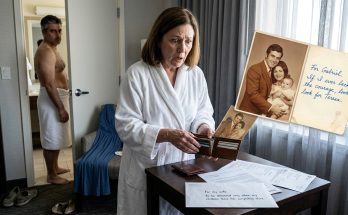
I read.
Dad,
I don’t know how to be your son without becoming responsible for everything you hid.
The letter was angry.
Painfully so.
Gabriel accused Robert of loving people through arrangements instead of honesty.
Money.
Trusts.
Contingencies.
Secret houses.
Secret sons.
Secret protections.
Then:
Teresa deserves the truth, and you made me promise to become another person who withholds it.
I stopped.
That sentence hurt.
Gabriel had known.
Years before the bar.
Years before my birthday.
He understood exactly what withholding did.
I continued.
I may keep your promise for now because I gave my word when you were dying. But I want you to know I hate it. I hate that you made your wife my responsibility and made me another secret in her life.
The letter ended:
If I ever meet her, I hope I have more courage than you did.
I lowered the page.
Gabriel’s face had gone still.
“You remembered writing this?”
“Yes.”
“And then you met me.”
“Yes.”
“In the bar.”
“Yes.”
“You recognized me.”
“Yes.”
“And you chose the same thing you condemned him for.”
His eyes closed.
“Yes.”
That was the sharpest truth between us.
Not that he lied.
That he had known what the lie meant.
He had lived it from the other side.
Then repeated it.
For the first time since the hotel room, my anger became clean.
Not confused with attraction.
Not tangled with Robert.
Not diluted by Michael or Vale.
Gabriel had wronged me.
Specifically.
Personally.
Knowing better.
I handed him the letter.
“Keep it.”
He shook his head.
“It belongs here.”
“No. It belongs to you.”
“Why?”
“Because you wrote the standard you failed.”
He accepted the paper.
Not gratefully.
Like a sentence.
We continued.
The archive showed other things too.
Years after taking Vale’s money, Gabriel had quietly blocked two attempts to obtain information about my trust.
One request came through a shell company.
Another through a private investigator tied to Michael.
Gabriel never told me because I never knew the threats existed.
He had protected me.
Silently.
Imperfectly.
Without earning redemption from it.
Another file documented his refusal of a direct bequest from Robert’s earlier plan.
Another showed he paid for independent legal review of certain trust structures before deciding not to intervene.
Elaine said, “You did more than you admitted.”
Gabriel gave a humorless smile.
“I admitted what I was ashamed of.”
“People often do the opposite,” she said.
I looked at him.
“Why didn’t you tell me these things?”
“Because good acts don’t cancel bad ones.”
That answer I respected.
By midday, the archive had established a more complicated Gabriel.
Not savior.
Not predator.
Not innocent.
Not villain.
A man who had failed.
Then tried to repair some of what he damaged.
Not always openly.
Not always enough.
Very much like everyone else.
That realization unsettled me.
Clean hatred would have been easier.
Elaine received a call shortly after one.
She stepped away.
When she returned, she carried a different expression.
“What?”
“Vale’s office has been searched pursuant to a warrant.”
My heartbeat quickened.
“Because of Kessler?”
“Partly. The investigation expanded after Unit 314.”
“Did they find the original files?”
“Some.”
“Anything useful?”
“Yes.”
She sat.
“A draft agreement between Vale and the development consortium.”
“What kind?”
“Success fee.”
My stomach tightened.
“If the Long Island property sold through Michael’s transaction, Vale would receive a percentage.”
“So he had money at stake.”
“A great deal.”
“How much?”
“Potentially seven figures.”
Gabriel swore quietly.
Elaine continued.
“They also found correspondence showing Vale knew the guardianship petition lacked medical support.”
I stared.
“Before filing?”
“Yes.”
“Then why proceed?”
“Because the emergency petition was meant to create temporary authority quickly enough to complete negotiations.”
I felt cold.
The plan had become clearer than ever.
Not care.
Not even permanent control.
Speed.
Get authority.
Place me somewhere secure.
Sell.
Restructure.
Then perhaps withdraw the guardianship and call the crisis resolved.
They had intended to borrow my legal incapacity like a tool.
Elaine looked at me.
“There is more.”
Of course.
“They recovered a message from Vale to Kessler sent the night Michael was attacked.”
Gabriel straightened.
“What does it say?”
“Locate the copy before M changes his mind.”
“That doesn’t order an assault,” I said.
“No.”
“Does it mention physical force?”
“No.”
“So we don’t know.”
“Correct.”
I appreciated that.
Facts.
Not appetite.
“What about Kessler?”
“His lawyer is negotiating.”
“For what?”
“Cooperation.”
Gabriel said, “He’ll trade Vale.”
“Maybe.”
Elaine gave him a look.
Right.
Maybe.
At three, Michael called me from the hospital.
He sounded stronger.
“Mom.”
“What?”
“Daniel says the police searched Vale’s office.”
“Yes.”
Silence.
Then: “Good.”
I could hear the fear beneath it.
“What are you worried about?”
“Things with my name.”
“Your name is already on many things.”
“I know.”
“Then stop trying to outrun paper.”
He laughed softly.
“Dad used to say something like that.”
“I’m trying to avoid becoming him.”
“Good luck.”
The humor vanished quickly.
“I need to tell you something.”
I sat.
“What?”
“The guardianship wasn’t originally my idea.”
My chest tightened.
“Vale?”
“Yes.”
“When?”
“Last year.”
Not fourteen years ago.
That earlier research had been Michael’s.
This specific petition was Vale’s.
“He said the development deal would fail if you had to negotiate directly.”
“Because I’d say no.”
“Yes.”
“So he suggested declaring me incapable.”
“He called it temporary protective authority.”
The language disgusted me.
“Did you agree immediately?”
“No.”
That surprised me.
“Why not?”
“Because it sounded insane.”
“What changed?”
“My debt.”
Of course.
“And Sofia’s house?”
“Later.”
“Daniel?”
“He found out after the draft existed.”
“Did he oppose it?”
“At first.”
“At first.”
“Yes.”
“What changed?”
Michael was quiet.
“Vale showed him documents saying the trust could collapse if the property wasn’t sold.”
“Were they real?”
“I don’t know.”
Probably altered.
Vale had fed each of them a different fear.
Michael: debt.
Daniel: family collapse.
Sofia: losing her home.
Gabriel: exclusion.
Margaret: professional ruin.
Me: incompetence.
He did not create every weakness.
He simply knew how to turn weakness into leverage.
“Why are you telling me?”
Michael’s voice cracked slightly.
“Because I keep thinking there has to be one moment where I became the person who did this.”
I closed my eyes.
“And?”
“I can’t find one.”
That was painfully honest.
“There usually isn’t.”
Silence.
“Mom.”
“Yes?”
“Are you going to make sure I go to prison?”
I stood and walked to the window.
There it was.
The question beneath everything.
Mother or witness.
Love or consequence.
Except those choices were false.
I said, “I am going to tell the truth.”
He breathed out.
“That sounds like yes.”
“No. It sounds like I am finished deciding consequences before facts.”
“You could help me.”
“I am helping you.”
“How?”
“By refusing to lie for you.”
He said nothing.
“You need your own lawyer.”
“I have one now.”
“Good.”
“And Mom?”
“Yes?”
“I know saying sorry doesn’t fix anything.”
“No.”
“But I am.”
My throat tightened.
“I heard you.”
That was all I could give.
When the call ended, Gabriel stood several feet away.
I had forgotten he was still in the room.
“You handled that well,” he said.
I looked at him.
“Do not grade me.”
“Sorry.”
We continued sorting until evening.
Then Elaine found something in the bottom of the final Gabriel box.
A sealed report.
Not addressed to Robert.
Addressed to me.
Written by Gabriel.
Dated seven years earlier.
I looked at him.
He went pale.
“What is this?”
“I don’t know.”
“You wrote it.”
“I wrote several things I never sent.”
I opened it.
The first page was titled:
If Teresa Ever Has to Know What I Did.
I looked up.
Gabriel closed his eyes.
The report documented everything.
Vale’s payment.
The asset tracing.
The information Gabriel handed over.
His later discovery that Vale used the report to pressure Michael.
His attempts to block future access.
His renunciation of Robert’s earlier bequest.
All of it.
At the end, he wrote:
If she learns this after I have met her, and I failed to tell her myself, then she should assume I have become exactly what I once accused Robert of being.
I stopped.
The date was seven years before we met.
He had predicted his own failure.
Not prophecy.
Character.
The danger we understand in ourselves and still repeat.
I folded the report.
“You knew.”
Gabriel’s voice was barely audible.
“Yes.”
“And still.”
“Yes.”
For a long moment, we said nothing.
Then I realized what I had to do.
Not legally.
Personally.
“Gabriel.”
He looked at me.
“I need you to leave the house.”
His face did not change.
“For how long?”
“I don’t know.”
He nodded.
No argument.
No plea.
He picked up his coat.
At the stairs, I said, “This is not punishment.”
He turned.
“What is it?”
“Space where I can decide what I think without you standing nearby looking sorry.”
Something almost like a smile crossed his face.
“Fair.”
“And Gabriel?”
“Yes?”
“I do believe some of what you did protected me.”
He waited.
“That does not mean I trust you.”
“I know.”
“Good.”
He left.
I remained in Robert’s hidden room with Elaine and the boxes.
The archive had done what truth often does.
It had not simplified anyone.
It had stripped away excuses.
The next decision would be mine.
Not Robert’s.
Not Gabriel’s.
Not my children’s.
Mine.
And for the first time, I understood that choosing distance could be an act of honesty rather than cruelty.
Click here to continue reading: PART 18: Sofia Asked Me to Save Her Marriage, Daniel Asked Me to Save His Children, and I Refused to Rescue Either From Consequences
I Kept Dinner Warm Until Midnight, Certain One of My Children Would Remember the Day I Had Never Forgotten for Them
Part 17 of 24