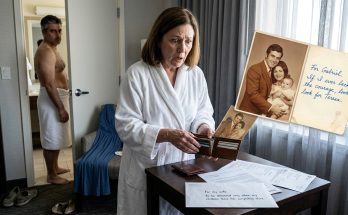
At seven minutes past six on the evening I turned sixty-five, I took the chicken and rice out of the oven for the second time and told myself not to be ridiculous.
The food was already cooked. Nothing would improve by reheating it again. Still, I peeled back the foil, stirred the rice with a wooden spoon, and tested the chicken with the edge of my fork as though three hungry children might appear on my porch at any moment. Steam fogged my glasses. Garlic, onion, and roasted pepper filled my little kitchen in Allentown, making the house smell like the Sundays we used to have when Robert was alive and the children still considered coming home ordinary.
My phone lay on the table beside my plate.
Its screen was black.
I dried my hands on a dish towel and touched the screen anyway.
No missed calls.
No messages.
There were three people in the world whose voices I wanted to hear that night. My eldest was in Boston. My daughter was in Charlotte. My youngest lived in New York City, close enough that I sometimes calculated the travel time without meaning to.
None of them had called.
I told myself six o'clock was early. People worked. People had meetings. Traffic happened. Children needed baths. Someone could be boarding an airplane. Someone could have ordered flowers that had been delayed. Perhaps the youngest was planning to surprise me.
Mothers can manufacture hope from almost nothing.
We learn early.
When children are babies, every unexplained cry becomes hunger, exhaustion, teething, gas—anything except the frightening possibility that we cannot fix what hurts them. When they are adults, we perform the same trick on ourselves. Silence becomes busyness. Distance becomes responsibility. Neglect becomes an unfortunate week.
I set four places at the kitchen table.
Then I stared at them.
That was when embarrassment arrived.
Not because anyone could see me. There was nobody there to see anything. But the sight of those extra plates made my hope look foolishly physical. Three empty chairs. Three folded napkins. Three water glasses catching the yellow light above the table.
I removed the settings one at a time.
At seven, I called my eldest.
The call went to voicemail after four rings.
“Hi, sweetheart. It's Mom.”
I stopped.
My own voice sounded too cheerful.
“I was just checking in. No emergency. Call when you have a minute.”
I nearly added, You know what today is.
Instead, I said, “Love you.”
At seven twenty-three, I called my daughter.
Voicemail.
This time I left no message.
At eight, I looked at the youngest child's name on my screen and did not press it.
He lived in New York. He had always been the one most likely to call late and behave as though lateness were charm.
I could already hear him.
Mom, you thought I forgot?
Perhaps I wanted to preserve that possibility.
I put one serving of dinner onto a plate and carried it to the table. The chicken was tender. The rice tasted exactly as it had for years.
I could barely swallow it.
Robert would have noticed.
That thought came so sharply that I lowered my fork.
My husband had been dead twelve years, but certain memories remained inconveniently alive. He had been terrible at buying presents and excellent at remembering dates. One year he had brought home a gardening shovel for my birthday because, in his words, I had complained about the old one.
I had stared at him.
“A shovel?”
“You said you needed one.”
“For my birthday?”
He had realized his mistake approximately three seconds too late.
The following afternoon, he returned with roses, chocolate, perfume, and a card so sentimental that I laughed until I cried.
After that, every birthday became a family joke.
Nobody buy Mom gardening equipment.
The children had repeated it for years.
I wondered whether any of them remembered the joke now.
At eight thirty, I opened the refrigerator.
On the middle shelf sat the single slice of cake I had bought that afternoon.
I had almost left the bakery without it.
The young woman behind the counter had asked what I was celebrating, and I had hesitated before admitting it was my birthday. Her whole face brightened.
“Happy birthday!”
A stranger had said it easily.
My children had not said it at all.
I put the cake on a small white plate. Then I opened the junk drawer and found the package of candles left over from some forgotten celebration.
There were blue ones, yellow ones, and a single red candle.
I chose the red.
I pushed it into the frosting.
For several minutes, I did not light it.
At nine, my phone finally rang.
I grabbed it so quickly that my knee struck the underside of the table.
Unknown number.
I answered anyway.
“Hello?”
A recorded voice offered to reduce my credit-card debt.
I hung up.
The silence afterward was worse.
I went to the living-room window. Rain had begun, faint enough that it looked like dust in the streetlight. Across the road, a family was unloading groceries from a minivan. A little boy jumped into a puddle. His father caught him by the hood and pulled him back. The mother laughed.
I stepped away before they could look toward my window.
At ten fifteen, I called my youngest.
He answered.
Relief hit me so hard I had to sit down.
“Mom?”
There was noise behind him. Voices. Glasses. Music.
“Hi.”
“What happened?”
Nothing in the question suggested he knew.
I pressed my thumb into the tablecloth.
“Nothing happened. I wanted to hear your voice.”
“Oh. Okay.”
A man said something near him. My son covered the phone and answered.
“Are you somewhere?” I asked.
“Yeah. I'm meeting some people.”
“For work?”
“Sort of.”
He sounded impatient now.
I looked at the candle standing untouched in my cake.
“I won't keep you.”
“Everything okay?”
There are moments when a person can ask for love plainly.
I had never been good at them.
I could have said, It's my birthday.
I could have made him remember.
But then the birthday would belong to my reminder, not his memory.
“Everything's fine,” I said.
“Okay. I'll call you later.”
“All right.”
“Bye, Mom.”
He disconnected.
He did not say he loved me.
He did not say happy birthday.
I remained at the table with the phone against my ear until the dead line became unbearable.
Then something inside me changed.
It was not dramatic. I did not throw the phone. I did not scream. I did not sweep the dishes onto the floor.
I simply looked around the kitchen and understood that I had spent the entire evening waiting for permission to exist.
I had prepared food nobody requested.
I had kept lights burning for people who were not coming.
I had protected my children from the discomfort of remembering they had forgotten me.
And I was tired.
I lit the red candle.
The flame stood straight and small.
“Happy birthday, Teresa,” I said.
My voice broke on my own name.
I closed my eyes.
I made no wish.
At sixty-five, wishes seemed less useful than decisions.
I blew out the candle.
Smoke curled toward the ceiling.
Then I stood, went upstairs, opened my closet, and pulled out a blue dress I had not worn since Robert's funeral reception.
I held it against myself in the mirror.
The woman looking back at me was older than the woman who had bought it. Her hair had gone mostly silver. Fine lines gathered around her mouth. Her shoulders had acquired the slight inward curve of someone accustomed to making herself smaller.
But the dress still fit.
I changed my shoes.
Put on lipstick.
Found my coat.
Then I placed my phone in my purse and walked out of the house before I could become sensible again.
The rain had strengthened.
I did not know exactly where I was going until I reached the station.
New York City.
The idea felt absurd.
That was partly why I bought the ticket.
The youngest was there, somewhere, having his mysterious meeting. I did not intend to find him. I did not even tell him I was coming.
I wanted lights.
Noise.
Strangers.
I wanted to spend the final hours of my birthday somewhere my loneliness would be one small thing among millions instead of the loudest object in an empty house.
On the train, I sat beside the window.
Pennsylvania dissolved into wet darkness.
I checked my phone twice.
Nothing.
Eventually I turned it facedown.
Across the aisle, two college-aged girls shared earbuds and tried not to laugh too loudly. An exhausted man slept with his forehead against the glass. A woman in a red coat typed furiously on a laptop.
Nobody knew me.
Nobody needed me.
The thought was frightening.
Then, unexpectedly, it became peaceful.
By the time I reached Manhattan, the rain had stopped.
The city shone.
Headlights streaked over wet pavement. Steam rose from a street grate. People moved with the determined speed of those who believed they were already late for something important.
I walked without a destination.
For once, nobody knew where Teresa Mendoza was supposed to be.
I passed restaurants crowded with couples and bars full of people younger than my children. I nearly turned around three times.
Then I found a quieter place on a side street.
Warm amber light showed through the windows.
Inside, the music was low enough for conversation.
I took a seat at the far end of the bar.
The bartender approached.
“What can I get you?”
I almost ordered tea.
Instead I said, “Whiskey.”
He waited.
I had no idea what came next.
“Whatever you would give someone who doesn't usually drink whiskey.”
His mouth twitched.
“That I can do.”
The first sip burned.
The second was easier.
I looked at myself in the mirror behind the bottles.
A sixty-five-year-old widow in a blue dress, drinking alone in Manhattan on her birthday because none of her children remembered.
It should have been humiliating.
Instead, I felt the first strange edge of freedom.
“That's a serious expression for a birthday drink.”
The voice came from two seats away.
I turned.
The man was perhaps a few years younger than I was, perhaps not. Dark hair threaded with gray. A face that seemed accustomed to listening before speaking. He wore a charcoal jacket over an open-collared shirt.
I narrowed my eyes.
“How do you know it's my birthday?”
He nodded toward the bartender.
The bartender had placed a tiny candle beside my drink.
I had not noticed.
I laughed.
It surprised me enough that I covered my mouth.
The stranger smiled.
“Happy birthday.”
Those two words nearly undid me.
I looked down at the whiskey.
“Thank you.”
“Big celebration?”
“Enormous.”
He glanced around the nearly empty bar.
“I can tell.”
I should have been offended.
Instead I laughed again.
He introduced himself as Gabriel.
I gave him only my first name.
“Teresa.”
Something changed in his face.
Barely anything.
A pause.
A tightening around the eyes.
Then it vanished.
“Teresa,” he repeated.
“Yes.”
“That's a beautiful name.”
“It has served me well enough.”
He smiled, but his gaze remained on me longer than the compliment required.
I should have noticed.
Perhaps some part of me did.
But loneliness makes attention feel innocent.
We talked.
At first about harmless things. The weather. New York. The ridiculous price of hotel rooms. The bartender's insistence that whiskey could taste like cherries if one possessed sufficient imagination.
Then Gabriel asked whether I lived in the city.
“Allentown.”
“Family there?”
I ran one finger around the rim of my glass.
“I have family in several places.”
He waited.
I said, “Tonight they appear to be everywhere except with me.”
His expression became still.
“Children?”
“Three.”
“Did they forget?”
I looked at him sharply.
He did not apologize.
“Yes.”
The word came out quieter than I intended.
“All three?”
“All three.”
Gabriel looked down at his drink.
For a moment, he seemed angry.
Not sympathetic.
Angry.
I noticed that.
“Do you know them?” I asked.
His head came up.
“No.”
Too quickly.
The answer left a small disturbance inside me.
Before I could examine it, he said, “I'm sorry. That was rude.”
“What was?”
“My face. I have a terrible habit of reacting before I decide whether I should.”
“At least that's honest.”
His smile carried something sad.
“I've been accused of worse.”
We talked for another hour.
I told him about Robert.
Not everything.
Just that I had been widowed twelve years. That marriage had occupied most of my adult life. That after Robert died, my children became busy in ways I had tried very hard to respect.
Gabriel asked what Robert had been like.
Again, the question felt unusually careful.
“He was complicated.”
“Aren't we all?”
“He could be stubborn. Secretive about money. Terrible at apologies until he realized an apology was required.”
Gabriel looked away.
“What?”
“Nothing.”
“You keep doing that.”
“Doing what?”
“Looking as though I've accidentally answered a question you didn't ask.”
His hand stopped around his glass.
For the first time, he appeared uncertain.
Then he said, “Maybe you're more observant than people give you credit for.”
I thought of my youngest saying everything was fine.
I thought of three silent phones.
“Maybe.”
Close to midnight, the bartender announced last call.
I should have gone home.
Gabriel offered to arrange a car to the station.
Instead, outside beneath the wet glow of the streetlights, I stood beside him and realized I did not want the night to end.
Not because I loved him.
Not because I had become foolish.
Because for several hours I had been visible.
Gabriel had listened when I spoke. He had noticed when I stopped. He had not checked his phone every thirty seconds or treated my memories like stories he had heard too many times.
“Teresa,” he said, “I should probably say good night.”
His voice had changed.
There was caution in it.
Almost warning.
I stepped closer.
“Do you want to?”
He closed his eyes briefly.
When he opened them, something troubled had entered his expression.
“No.”
Neither did I.
I knew exactly what I was doing when I went with him.
That mattered later.
I would not allow anyone—not Gabriel, not my children, not even my own shame—to rewrite me as a confused old woman who had been carried somewhere against her will.
I chose.
For one night, I chose something because I wanted it.
We went to his hotel.
And shortly after midnight, with my forgotten birthday officially over, I crossed a threshold I could not uncross.
Click here to continue reading: PART 2: Morning Light Turned One Reckless Night Into a Question When I Saw the Photograph Gabriel Had Tried to Keep Hidden
I Kept Dinner Warm Until Midnight, Certain One of My Children Would Remember the Day I Had Never Forgotten for Them
Part 1 of 24