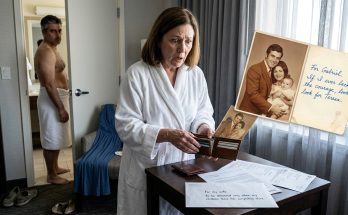
Gabriel did not move.
The signed page lay beneath my hand.
His name was unmistakable.
Gabriel Luis Mendoza.
The surname struck me differently now.
Mendoza.
Robert's name.
My children's name.
My name.
A family name that had apparently been carrying separate lives inside it.
"Answer me."
Gabriel stepped away from the wall.
"I signed part of it."
"Part?"
"Not the agreement you're holding."
"You expect me to believe someone attached your signature to the wrong document?"
"I expect you to look at the page numbers."
I did.
Page one.
Page two.
Page three.
Then page five.
I stopped.
There was no page four.
Elaine leaned forward.
"That is why I waited."
My youngest cursed.
My eldest turned on him.
"What did you do?"
"Nothing."
"Then where is page four?"
"I don't know."
Gabriel crossed the room but stopped before reaching the table.
"The document I signed was an acknowledgment of notice. Nothing more."
"Notice of what?" I asked.
"That Robert had died and that his estate attorneys were aware I existed."
"Why would my children send you that?"
"They didn't."
I looked at him.
"Then who did?"
"An attorney representing Robert's estate."
Elaine placed another set of papers beside the first.
"This is the original document Gabriel signed."
Same date.
Same signature.
Different text.
The signature page was almost identical.
My chest tightened.
"The page was reused."
Elaine nodded.
"It appears so."
My youngest stood again.
"This is insane. You're accusing us of forgery now?"
"I'm describing a document discrepancy," Elaine said.
"You know exactly what you're implying."
"I do."
My daughter looked at him.
"You told us he signed."
"He did sign."
"Not this."
"He agreed to stay away."
Gabriel's expression changed.
"No."
My youngest turned.
"You took the money."
"No."
"We transferred it."
"To an account I never controlled."
That silenced everyone.
Elaine opened another file.
"That is the second issue."
She laid out bank records.
I could understand enough without assistance.
A transfer had been made from an account connected to Robert's estate into an account opened in Gabriel's name.
The amount made my stomach tighten.
Two hundred thousand dollars.
"Whose account?" I asked.
"Nominally Gabriel's," Elaine said. "But it was opened using an address he never lived at, under authorization he denies giving."
My youngest laughed.
"Convenient."
Gabriel ignored him.
"I learned about that account three weeks ago."
"How?" I asked.
"A bank compliance review."
"Why now?"
"Because I was trying to verify whether Robert had left anything in my name."
That answer stung.
I heard myself ask, "Were you looking for money?"
"Yes."
At least he did not soften it.
"I wanted to know whether he had left me anything."
"Did he?"
"No."
A beat.
"Not directly."
"What does that mean?"
Gabriel looked at Elaine.
She said, "Robert created a small contingency trust whose purpose was not to provide Gabriel an inheritance. It was to fund legal costs if Gabriel ever needed to establish his identity in connection with the family."
I frowned.
"Why would he need that?"
"Robert anticipated conflict."
"With my children."
"Apparently."
My eldest looked furious.
"Dad was paranoid at the end."
I turned to him.
"Was he?"
"Yes."
"Then why did so many of the things he feared happen?"
He had no answer.
My daughter had not stopped staring at the bank records.
"Whose address is that?"
Elaine pointed.
"You recognize it?"
"Yes."
She looked at my youngest.
"That's your old office."
His face went still.
My eldest snatched the page.
"Is this true?"
My youngest said nothing.
"That's your old office address."
"So?"
"So why was an account in Gabriel's name opened there?"
"I don't know."
Gabriel spoke.
"Because someone needed proof I had accepted payment."
My youngest rounded on him.
"You don't know that."
"No. But whoever did it used my identity, moved money into the account, and then moved most of it out again."
"Where?"
Elaine answered.
"Through two intermediary accounts. We are still tracing the final destination."
I looked at my youngest.
"What did you know?"
"Nothing."
"Don't lie."
"I'm not."
"Then explain why every road keeps passing your door."
He shoved his chair back.
"This is exactly what I was afraid of. She meets this man, sleeps with him, and suddenly she's convinced her own children are criminals."
My body went cold.
My daughter looked at me.
My eldest looked at Gabriel.
The shame hit first.
Then something stronger replaced it.
I stood.
"Get out."
My youngest laughed harshly.
"Mom."
"Get out."
"You don't get to pretend this isn't relevant."
Gabriel moved.
I raised my hand.
"No."
He stopped.
I stepped toward my son.
"You filed documents accusing me of being vulnerable to strangers. You planned a facility for me. You tried to sell my property. You knew about your father's other son and concealed it. And now, because you are losing control of this conversation, you use something private to humiliate me."
His face shifted.
For one second, he looked like the little boy who had broken a window and hoped charm would save him.
Then he hardened again.
"I'm trying to wake you up."
"No. You're trying to make me ashamed."
He opened his mouth.
I did not let him speak.
"I am not."
Silence.
My own certainty surprised me.
"I made a reckless choice. I made it while hurt and lonely. I would not make it again. But it was my choice."
I pointed toward the door.
"You, however, made decisions about my freedom without asking me. Do not confuse those things."
My youngest picked up his coat.
"Fine."
My eldest stood.
"Don't leave."
"I'm not staying for this circus."
"If you walk out now, it looks terrible."
My youngest turned.
"That is what you're worried about?"
"Yes."
At least that was truthful.
He laughed once.
"Unbelievable."
Then he walked out.
The front door closed hard enough that the sound reached us through the house.
My daughter began to cry again.
This time I did not resent it.
She looked smaller somehow.
Not innocent.
Just tired.
"Mom, I didn't know about the account."
"Did you know about the agreement?"
"I knew what he told us."
"Your brother."
She nodded.
"He said Gabriel had contacted the estate."
Gabriel said, "I hadn't."
She looked at him.
"He said you wanted money."
"I did not contact any of you."
"He showed us emails."
"From me?"
"From an address with your name."
"I've never seen them."
Elaine made a note.
"Do you still have copies?"
My daughter nodded.
"Probably."
"Send them."
She looked at me.
"Mom, we thought someone was coming after Dad's estate."
"Someone was."
She shook her head.
"No. I mean Gabriel."
I looked toward him.
He said nothing.
My eldest sat again.
"Dad had hidden assets. Then we learned he had another son. What were we supposed to think?"
"Perhaps you could have told me."
"Mom, you were barely functioning after Dad died."
The words struck because they contained some truth.
For months after Robert died, mornings had seemed optional. I slept badly. Forgot meals. Left laundry damp in the washer until it smelled sour. I once drove halfway to the pharmacy and had to pull over because I could not remember why I had left the house.
Grief had made me disorganized.
Grief had not made me incompetent.
"You could have helped me."
"We did."
"No. You managed information."
My eldest looked away.
I continued.
"How many decisions did you make because you believed I couldn't handle the truth?"
He did not answer.
My daughter whispered, "A lot."
I looked at her.
"Thank you."
She began crying harder.
"I mean it."
That only made it worse.
Elaine gave her a tissue.
My daughter took it.
"I thought if we told you about Gabriel, it would destroy what you believed about Dad."
"It did hurt."
"I know."
"No. You don't."
I sat across from her.
"But I survived it."
She nodded.
"I should've told you."
"Yes."
"I'm sorry."
I believed that she regretted it.
I did not know yet whether regret was enough.
My eldest rubbed both hands over his face.
"The agreement was supposed to solve everything."
"Whose idea was it?"
He looked toward the door through which his brother had left.
"His."
"Did you sign it?"
"Yes."
"Did you read it?"
His silence answered.
"You're an attorney," I said.
"I was trying to keep the family together."
"By signing something you didn't read?"
"I read most of it."
"Did you know the signature page had been altered?"
"No."
"Did you know the money went into a false account?"
"No."
"Did you know your brother's office address was used?"
"No."
"Then either you're lying or you handed him control without checking."
He looked at me.
I saw the answer.
The second one.
My eldest had always believed intelligence could substitute for attention.
He trusted himself to recognize danger, which made him careless when danger came wearing a familiar face.
"Why did you file the guardianship petition?" I asked.
He leaned back.
"Because we thought you might discover the estate before the sale closed."
There it was.
Not concern.
Not memory.
Timing.
I felt my daughter stiffen.
She apparently had not expected him to say it so plainly.
"And if I discovered it?"
"We knew you'd resist."
"Because the price was low."
"Because you don't understand commercial property."
"This isn't commercial property."
"Not yet."
The word hung in the room.
I looked toward the windows.
"What did the buyer plan to do?"
He hesitated.
Elaine said nothing.
"Answer me."
"Redevelop part of the land."
"What part?"
"There are thirty-six acres behind the main house."
I had not known that.
"What kind of redevelopment?"
"Luxury residential."
My daughter looked confused.
"You said conservation lots."
My eldest turned.
"That was the original plan."
"So it changed?"
"Apparently."
"To what?"
He rubbed his forehead.
"Townhouses. Maybe more."
"How many?"
"I don't know."
Elaine said quietly, "One hundred and eighty units according to a preliminary zoning proposal."
All of us looked at her.
My eldest swore under his breath.
I felt something settle into place.
A low sale price.
A connected buyer.
Future development.
This was bigger than dividing proceeds from a house.
"How much would the property be worth if rezoned?"
Elaine said, "Potentially much more than its current residential valuation."
"How much more?"
"We don't know yet."
Gabriel spoke for the first time in several minutes.
"Robert did."
I turned.
"What?"
"He knew development pressure was coming."
"How?"
"He had been approached before he died."
Elaine looked at him sharply.
"You didn't tell me that."
"I found the letter yesterday."
"Where?"
"In my mother's papers."
I stared.
"Elena's?"
"Yes."
"What did Robert write?"
Gabriel reached into his jacket.
He removed an envelope.
Old.
Yellowed.
Another secret.
I almost laughed.
"How many dead people's envelopes are left in this family?"
His mouth tightened.
"At least this one."
He handed it to Elaine, not me.
That mattered.
She opened it carefully.
Inside was a copy of a letter Robert had written Elena decades ago, followed by a newer note added much later.
Elaine read silently.
Then looked at me.
"You need to see this."
I took it.
Robert wrote that the Long Island land was more important than anyone understood.
Not because of the house.
Because of what ran beneath part of the acreage.
I frowned.
"What's beneath it?"
Gabriel answered.
"Access rights."
"For what?"
"Aquifer infrastructure."
I looked at Elaine.
She nodded slowly.
"Water."
Robert's note explained that a regional authority had once explored easement rights across the land.
Developers had learned of the possibility.
If infrastructure plans returned, ownership of the property could affect access negotiations worth millions.
My eldest stared at the letter.
"That can't be current."
Elaine said, "It may not be."
"But if it is?"
"Then the property is potentially far more valuable than the sale proposal suggests."
My daughter looked sick.
"Did he know?"
She meant our youngest.
No one needed clarification.
My eldest stood.
"I don't know."
I did.
Not yet as fact.
But I knew enough to ask the right question.
"When your brother pushed the sale," I said, "did he ever explain why it had to happen quickly?"
My eldest stared toward the doorway.
"Yes."
"What did he say?"
"That market conditions were changing."
"Anything else?"
He swallowed.
"That if we waited, outsiders might discover what Dad had protected."
I held Robert's letter.
"What exactly did he say?"
My eldest looked at me.
"He said once the water people came back, we'd lose our chance."
The room became silent again.
Not the wounded silence of family.
The sharper silence of evidence.
My youngest had known.
Perhaps not everything.
But enough.
And for the first time, I understood that the guardianship petition might not have been the beginning of the plan.
It might have been the final step.
Click here to continue reading: PART 7: The Secret Beneath My Land Turned a Family Betrayal Into Something Larger, and My Daughter Finally Told Me Who Started It
On the Birthday My Children Forgot, I Finally Stopped Pretending Their Silence Was an Accident and Made One Reckless Choice
Part 6 of 24