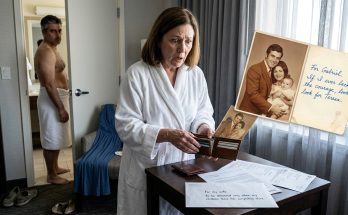
I did not open Robert's envelope immediately.
That surprised Gabriel.
It surprised me too.
For twelve years I had wanted one more conversation with my husband. I had imagined impossible versions of it while washing dishes, lying awake, riding buses, standing beside his grave. I would tell him what happened to the children. He would complain that I worried too much. I would ask whether death had cured him of leaving his socks beside the bed.
Now his handwriting was under my fingers, and I was afraid to discover what a dead man had saved for me.
"Tell me about the petition first," I said.
Gabriel nodded.
He opened the black folder and arranged the papers on the table without coming near me.
My children had filed the petition the previous morning.
My birthday.
The timing struck me with such precision that for several seconds I could hear nothing else.
While I had been seasoning chicken, they had been signing papers.
While I bought my own cake, they had been describing me to a court.
While I waited for their calls, they had been asking strangers for authority over my life.
"What did they say about me?"
Gabriel's eyes shifted.
"Tell me."
"They said you've become isolated since Robert died."
"That was twelve years ago."
"They said the isolation has worsened."
"Because they stopped visiting."
"I know."
"Read the rest."
He hesitated.
I almost shouted at him.
Instead, I said quietly, "I have spent enough of my life being protected from information other people decided I couldn't handle."
That landed.
Gabriel looked down at the petition.
"They describe episodes of confusion."
"What episodes?"
"They don't identify specific ones."
"Of course they don't."
"They claim you've made questionable financial decisions."
"I once bought the wrong brand of laundry detergent. Perhaps that's exhibit A."
His mouth almost moved.
I did not smile.
"What else?"
"They say you may be vulnerable to strangers."
The irony hung between us.
I looked deliberately at the unmade bed.
Gabriel's face reddened.
"That's unfortunate," I said.
"Teresa—"
"Continue."
"They requested emergency temporary guardianship while the court considers a permanent arrangement."
"Guardianship."
"Yes."
"Meaning?"
"Someone else could make major decisions for you."
"Who?"
"They proposed your eldest as primary guardian, with the other two sharing certain authority."
"Money?"
"Yes."
"Property?"
"Yes."
"My house?"
"Potentially."
"Medical decisions?"
"Yes."
I stared at him.
"Where I live?"
Gabriel was silent for half a second too long.
"Yes."
I walked to the window.
New York spread beneath me, indifferent and immense.
Yesterday I had felt abandoned.
Today abandonment seemed almost merciful compared with what my children had apparently intended.
"What does the Long Island property have to do with this?"
"Robert owned it before your marriage."
"Then it should have been part of his estate."
"He transferred it."
"To whom?"
"You."
I turned.
"When?"
"Eight years before his death."
"I never signed anything."
"You didn't need to accept the deed personally for the transfer to be recorded. Robert handled it through attorneys."
"Why?"
"I can only tell you what he told me."
"Which was?"
"That he wanted one thing nobody could take from you."
I almost laughed.
"They seem to be trying."
"That's why he put safeguards around it."
Gabriel showed me documents concerning a trust. There were accounts, property records, instructions, signatures.
The numbers made no sense to me.
Not because I could not understand money, despite what my children apparently believed.
Because the numbers did not fit the life Robert and I had lived.
We had argued about replacing a washing machine.
We had clipped coupons.
I had postponed dental work once because our daughter needed tuition money.
"Where did this come from?"
"Investments. Property Robert inherited. Business interests he sold quietly."
"He told me his father's estate barely covered debts."
"That wasn't true."
I closed my eyes.
Another lie.
Not an affair. Not yet.
A financial life running parallel to our marriage.
"Did my children know?"
"Parts of it."
"How long?"
"Long enough."
"How long, Gabriel?"
"At least several years."
I pressed both hands against the windowsill.
My children had watched me worry about money after Robert died.
They had watched me repair appliances instead of replacing them.
My eldest once told me he could not help with a four-hundred-dollar plumbing bill.
My daughter had suggested I sell the Allentown house because maintaining it alone was "too much."
My youngest had repeatedly offered to review my finances.
All that time, they knew?
"Why didn't Robert tell me?"
Gabriel looked at the envelope.
"I think that's in there."
I hated the envelope now.
I carried it to the table.
The seal opened with a dry tear.
Inside were several pages.
Robert's handwriting had deteriorated by the final page, suggesting he wrote it when he was already ill.
The first words were simple.
My Teresa.
My vision blurred.
I stopped.
Gabriel turned toward the window.
It was such a small courtesy that I resented being grateful for it.
I wiped my eyes and continued.
Robert apologized.
Not elegantly. Robert had never been elegant with feelings.
He wrote that if the letter had reached me, he had failed twice: once by hiding the truth while alive, and again by leaving behind circumstances in which our children had abandoned me badly enough to trigger his instructions.
I sat down.
He had feared their greed.
Not from childhood. Not always.
Near the end of his life, he had apparently discovered conversations about his assets. Questions from the children that had sounded less like concern than inventory.
He had changed documents.
Created protections.
Transferred control.
And hidden those decisions because he feared that if the children knew everything, they would pressure me after his death.
"He knew," I whispered.
Gabriel turned.
"He suspected."
"He knew enough."
"Yes."
I kept reading.
Then I reached the paragraph that changed the room.
Before I met you, there was another woman.
I stopped.
My fingers went numb.
Her name was Elena.
I looked at the photograph.
The woman holding the baby.
"No."
Gabriel lowered his eyes.
I read on.
Robert wrote that Elena had been part of his life when he was young. Their relationship had ended in circumstances he regretted for the rest of his life.
She had a son.
Gabriel.
I looked at the man standing beside the window.
"No."
He did not answer.
I returned to the page.
Robert had sent money.
He had maintained contact from a distance.
Years later, after Elena died, he had finally acknowledged the truth privately.
The baby was his.
Gabriel was his son.
The letter slipped from my fingers.
For several seconds, neither of us moved.
I looked at Gabriel's face.
Now that I knew, similarities emerged everywhere.
The eyebrows.
The shape of the jaw.
Even the irritating stillness Robert used when he knew there was no good answer available.
"You are Robert's son."
"Yes."
I stood so quickly the chair scraped backward.
The nausea arrived before thought.
I made it to the bathroom and gripped the sink.
Cold water ran over my wrists.
I stared at myself in the mirror.
Behind me, Gabriel remained outside the bathroom.
He did not enter.
Thank God.
I laughed once, an ugly sound.
"Of all the men in New York."
"I know."
"Don't say that."
"I'm sorry."
"You knew."
"Yes."
"Last night."
"Yes."
"You knew whose wife I had been."
"Yes."
I turned.
"You slept with your father's widow."
His face tightened.
"Yes."
I wanted to hurt him.
Perhaps that was why I opened the door and walked directly toward him.
My hand struck his cheek before I consciously decided to move it.
The sound snapped through the room.
Gabriel's head turned.
He did not touch his face.
He looked back at me.
"I deserved that."
"Don't make yourself noble."
"I'm not."
"You came looking for me."
"Yes."
"You knew exactly who I was."
"Yes."
"And you let me take you upstairs."
His voice became rough.
"Yes."
I slapped him again.
Less hard this time.
It did not help.
"You had every chance to tell me."
"I did."
"Then why didn't you?"
Gabriel finally raised his voice.
"Because you were sitting alone on your birthday talking about a candle nobody came to see!"
The room went still.
He closed his eyes.
When he spoke again, the anger had left.
"I came to New York because I had traced your youngest son to a meeting concerning the guardianship petition. I intended to speak to you afterward. With Elaine present. With documents. Properly."
"Yet you happened to be in that bar."
"I was staying in this hotel."
"Convenient."
"I saw you come in."
"And recognized me?"
"From photographs."
I felt exposed all over again.
"You watched me."
"For a few minutes."
"Why?"
"Because I couldn't believe it was you."
"Then you sat beside me."
"No. You sat beside me."
I remembered.
He was right.
The empty stool had been next to him.
That changed nothing important.
"You could have left."
"Yes."
"You could have told me."
"Yes."
"You could have remembered your father."
His face changed.
"I did."
"Apparently not enough."
"No."
For the first time, Gabriel looked close to tears.
"I have no defense for last night, Teresa."
That disarmed me more effectively than an excuse.
I returned to Robert's letter.
My hands shook as I picked it up.
Robert had asked Gabriel to protect me if the children ever attempted to isolate or control me.
The phrase made me furious.
"Protect."
Gabriel looked at me.
"He asked you to protect me."
"Yes."
"Men have spent my entire life protecting me by deciding what I should know."
"I understand."
"No. You don't."
"You're right."
I read the final section.
Robert had left the Long Island estate entirely to me.
A trust existed for my benefit.
Other accounts existed too.
The children knew enough to understand the potential value but not enough to access it legally.
Unless I became legally incapable.
Then guardianship could give them a path.
I lowered the pages.
"So this is why they need me incompetent."
"Yes."
"Not because they're worried."
"No."
"Not because I've forgotten things."
"No."
"Because they want control."
"That's what the evidence indicates."
I looked at my phone.
Another message appeared.
Mom, please don't sign anything until we talk.
My youngest.
I showed Gabriel.
His mouth tightened.
"They know."
"Know what?"
"That someone reached you."
"How?"
"We filed notice last night to preserve the property."
"You did what?"
"Elaine did. Before I met you."
I stared at him.
"Before?"
"Yes."
"Then why did you need me?"
"We needed your authorization for the next steps. But the emergency filing bought time."
Something occurred to me.
"If you are Robert's son, why aren't you trying to take the property?"
Gabriel opened the folder and handed me another document.
I read it.
He had formally disclaimed his potential interest in portions of Robert's estate.
The date was three days earlier.
Before the bar.
Before me.
"You signed this?"
"Yes."
"Why?"
"Because it isn't mine."
"Robert was your father."
"He was also the man who left my mother to raise me without publicly acknowledging me."
There was no bitterness in the words.
That made them heavier.
"He sent money."
"Money isn't a father."
I knew that much.
I looked again at the disclaimer.
"So you truly get nothing."
"I didn't come for anything."
"Except last night."
He closed his eyes.
"Except last night."
I walked to the bed and sat.
My birthday had ended less than twelve hours earlier.
Yet the woman who had waited beside that candle already seemed distant.
She had believed her worst problem was being forgotten.
She had been wrong.
I folded Robert's letter carefully.
"What happens now?"
Gabriel seemed surprised.
"You don't have to decide anything immediately."
"That's not what I asked."
"We meet Elaine."
"When?"
"Whenever you're ready."
"Today."
"Teresa—"
"Today."
He nodded.
I stood and finished dressing.
Gabriel reached for his jacket.
"Where are you going?"
"I thought—"
"You are staying."
He stopped.
I looked at him.
"I don't forgive you."
"I know."
"I don't trust you."
"I know."
"And if you ever hide something from me because you think you're protecting me, I will make yesterday's slap seem affectionate."
For the first time that morning, something like life returned to his expression.
"Understood."
I put Robert's letter into my purse.
Then I picked up the photograph.
Robert, Elena, Gabriel.
Three people from a life my husband had buried.
I placed it inside the black folder.
"My children think I'm confused?"
Gabriel said nothing.
"They think I'm alone?"
His eyes held mine.
I picked up my phone.
Three children had spent years teaching me that silence meant I should wait.
I finally understood that silence could mean something else.
"Call Elaine," I said.
Gabriel reached for his phone.
"What should I tell her?"
I looked at Robert's handwriting one last time.
"Tell her Teresa Mendoza is done waiting for other people to decide what happens to her."
Click here to continue reading: PART 4: The Lawyer Showed Me Where My Children Planned to Send Me, and I Chose the House Where They Expected to Win
On the Birthday My Children Forgot, I Finally Stopped Pretending Their Silence Was an Accident and Made One Reckless Choice
Part 3 of 24