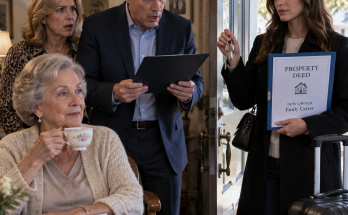
Mark picked up the property valuation and examined every photograph again. The more he looked, the less color remained in his face. Alicia sat with both arms folded, no longer pretending the morning was friendly. Thomas kept his legal pad open. I sat between them with my tea growing cold and wondered how many lies could fit around one kitchen table before somebody finally ran out of room.
“You told me she agreed,” Mark repeated.
Alicia’s jaw tightened.
“And she knew Bruce was here.”
“That isn’t the same thing.”
“You’re splitting hairs.”
Thomas said, “Consent is rarely a hair worth splitting.”
Alicia ignored him.
Mark turned to me. “Mom, I swear I believed you knew Bruce was evaluating the house.”
I wanted to ask whether he had also believed I knew he intended to sell it after sending me to Silver Meadows.
Instead I asked something narrower.
“Did you know they intended to list my house?”
He stopped.
The answer arrived in his silence.
Finally he nodded.
“Yes.”
I folded my hands beneath the table so he would not see them tremble.
“And did you know the listing was supposed to happen after I went to Silver Meadows?”
Another pause.
“Yes.”
There it was.
Maybe he did not know about every photograph.
Maybe he did not understand the document carrying my imitation signature.
But he had known the destination.
Thomas looked at him.
“What authority did you believe you had to sell your mother’s property?”
Mark pointed toward Alicia’s folder.
“She said the paperwork would handle it.”
“This paperwork?”
“I guess.”
Thomas’s eyes sharpened.
“You guess?”
“I didn’t read all of it.”
Alicia laughed bitterly.
“Interesting. Suddenly nobody reads anything.”
The sentence landed harder than she intended.
Thomas immediately asked, “What does that mean?”
“Nothing.”
He waited.
She reached for her purse.
“We’re done here.”
“Not yet,” I said.
Everyone turned toward me.
Something about the photographs bothered me. Not simply that they existed. Something inside one of them felt wrong.
I stood and walked to the small calendar hanging beside the refrigerator.
Bruce’s first visit had been September eighteenth.
His second had been October third.
I remembered because I had written ALICIA + BRUCE beside both dates after she called beforehand.
Then I looked again at the property photographs.
The living-room picture showed Raymond’s old chair beside a brass floor lamp with a cream shade.
My old lamp had stopped working in October.
Mark saw it too.
“That lamp.”
“What about it?”
“You bought it later.”
I stared at him.
He was right.
Eleanor had driven me to buy the replacement on October fourteenth.
Which meant the photographs could not have been taken during Bruce’s first visit.
Or his second.
Thomas understood before Alicia said anything.
“There was another visit.”
The back of my neck went cold.
I turned to the calendar again.
October seventeenth.
A note in my handwriting:
Alicia — blue casserole dish.
She had stopped by that afternoon claiming she needed the dish for a school fundraiser. She had stayed perhaps twenty minutes. For half of that time, I had been in the backyard talking to Eleanor through the fence about squirrels getting into her bird feeder.
I looked at Alicia.
“Was Bruce here October seventeenth?”
She said nothing.
Mark stared at her.
“Was he?”
Her lips compressed.
Finally she said, “I gave him the spare key.”
Mark shot to his feet.
“You what?”
Even Thomas looked startled.
“He needed measurements,” Alicia snapped.
“You gave a realtor Mom’s house key?”
“He was going to return it.”
“You told me he already had measurements.”
“He needed more.”
Their voices rose.
I remained seated.
For once, their argument was useful.
People trying to maintain the same lie speak carefully. People discovering they have been told different versions stop being careful altogether.
Mark paced toward the window.
“How many times was Bruce in this house?”
Alicia looked away.
“How many?”
“Three.”
My stomach dropped.
Thomas immediately turned to me.
“Dorothy, did you authorize any of those visits for the purpose of valuing or listing your property?”
“No.”
“Did you authorize Alicia to give anyone your key?”
“No.”
He wrote both answers down.
Then I thought of the laundry room.
“My spare key.”
Alicia looked toward the hallway.
“It was returned.”
“No.”
I stood.
“For forty years, Raymond and I kept one spare key on a hook inside the laundry-room cabinet.”
Mark stopped pacing.
I walked down the hallway.
Opened the cabinet.
The little brass hook was empty.
I stared at it longer than necessary.
It had always been there.
Through Mark’s teenage years.
Through tornado warnings.
Through Raymond’s illness.
Through the first winter after he died when I checked every lock twice before bed because living alone was still new.
Now the hook was bare.
When I returned to the kitchen, Thomas was already closing his legal pad.
“It’s gone,” I said.
Mark’s face changed.
Thomas stood.
“We change the locks today.”
Alicia rolled her eyes.
“This has become absurd.”
Thomas looked directly at her.
“No. The missing key is simply the first problem here that requires immediate physical action.”
He pulled another sheet from the folder.
Silver Meadows letterhead.
He read it once.
Then again.
His expression hardened.
“What?” I asked.
He placed it in front of me.
It was an intake summary.
My name.
My age.
My address.
Mark listed as emergency contact.
Then a section titled REASON FOR PLACEMENT.
I read the words beneath it twice.
Progressive memory impairment.
Increasing confusion.
Unable to manage finances safely without assistance.
For several seconds, I heard nothing except the clock above the sink.
Then I looked at my son.
Mark was staring at the page.
“I’ve never seen that.”
This time I believed him.
Not because I wanted to.
Because Alicia was staring at the floor.
Thomas pointed to the date.
“Silver Meadows received this almost two weeks ago.”
Two weeks.
Before they supposedly came to discuss my “options.”
Before anyone asked me whether I wanted to leave my house.
Before that morning’s performance of concern.
The decision had been prepared first.
My consent was supposed to come afterward.
I took off my glasses and placed them carefully beside my cup.
“Who told them my memory is failing?”
Nobody answered.
I looked at Alicia.
“Sweetheart?”
The word made her flinch now.
“Who diagnosed me?”
“It isn’t a diagnosis.”
“It sounds like one.”
“It’s just intake information.”
“Based on what?”
“Things we’ve noticed.”
“We?”
She looked at Mark.
He stared back at her in genuine confusion.
“I never told anybody Mom had progressive memory problems.”
Alicia snapped, “You’ve said she forgets things.”
“I said she forgot where she put her gardening gloves once.”
“You’ve worried about her living alone.”
“That doesn’t mean dementia.”
“I never used that word.”
Thomas spoke quietly.
“No. You chose language that can produce the same result without using it.”
Alicia’s face reddened.
Mark sat again.
“When did you send this?”
She did not answer.
“When?”
“About twelve days ago.”
He rubbed both hands across his face.
“Without telling me.”
“I was gathering information.”
“For what?”
“For us.”
“No. For this.”
He tapped the Silver Meadows page.
Then I remembered another part of the call.
Melissa already handled it.
Alicia’s cousin.
I had heard the name only twice before. Melissa Grant worked in admissions somewhere, though I had never known exactly where.
Now I did.
Thomas read the contact information near the bottom.
“Melissa Grant.”
Alicia’s eyes flicked toward him.
That was enough.
“You know her?” he asked.
“She’s my cousin.”
“At Silver Meadows?”
“Yes.”
“And she processed this?”
“She helped.”
Thomas wrote MELISSA beneath BRUCE.
My kitchen table was accumulating names like a map of people who had been discussing my life without me.
Mark stared at his wife.
“Why didn’t you tell me Melissa was involved?”
“It didn’t matter.”
“It matters now.”
Alicia reached for the Silver Meadows page.
Thomas covered it with his hand.
“No.”
“It belongs to me.”
“It concerns Dorothy.”
“I brought it.”
“And Dorothy is preserving it.”
He looked at me.
I understood.
“Yes. It stays.”
Alicia stood.
“This is unbelievable.”
“No,” I said. “What’s unbelievable is that my house has been photographed, my key is missing, my signature is on a paper I never signed, and a retirement facility has been told I’m losing my mind.”
My voice remained calm.
That seemed to frighten her more than anger would have.
Mark looked at the intake summary again.
Then he whispered, “Mom, I think I know where she got some of your medical information.”
Alicia turned sharply.
“Mark.”
He ignored her.
I looked at my son.
“What medical information?”
His face had changed.
Not guilt this time.
Recognition.
“Three weeks ago, Alicia asked me for your doctor’s name.”
The room went still.
I felt my fingers close around the edge of the table.
“What else did you give her?”
Mark swallowed.
“Your date of birth.”
Alicia grabbed her purse.
“And?”
“Insurance information.”
Thomas straightened.
“And?”
Mark looked at me.
“Your medication list.”
Every answer was worse than the one before it.
I asked the question slowly.
“Did I authorize you to give her any of that?”
His eyes dropped.
“No.”
Alicia slammed her palm against the table.
“We were trying to help you.”
Thomas turned toward her.
“Then why was helping Dorothy the one part of this plan Dorothy wasn’t allowed to know about?”
Nobody answered.
I looked again at the false description of my failing mind.
Then at the missing key.
Then at the photograph of my bedroom.
And for the first time, selling my house no longer seemed like the entire plan.
Someone was not simply preparing to move me.
Someone was preparing to create a version of me who could no longer object.
Click here to continue reading: PART 4: The Appointment I Never Made Showed Someone Was Building Evidence That I Could No Longer Control My Own Life
The Call My Daughter-in-Law Never Meant Me to Hear Changed What I Believed About My Own Family
Part 3 of 20