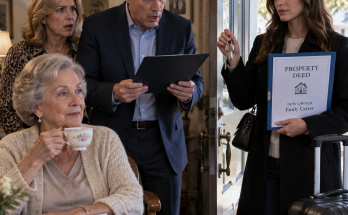
At 7:15 on Saturday morning, my telephone rang while I was standing barefoot in the kitchen, waiting for the coffeemaker to finish its slow, irritated dripping. The screen showed ALICIA. My daughter-in-law almost never called me that early. I answered with one hand while reaching for a mug with the other. “Good morning?” No one answered. Instead I heard the muffled thump of something against fabric, then the hollow vibration of a car engine.
I nearly hung up. Then Alicia spoke, not to me, but to someone sitting beside her. “You brought the folder, right?” Her voice was different from the one she used in my kitchen. No careful sweetness. No bright little “Mother D” at the beginning of every sentence. She sounded brisk, impatient, certain she was speaking privately. A man answered. My son Mark. “It’s in the back seat.”
I lowered the mug very slowly.
Mark and Alicia had been married eleven years. I had known every version of their disagreements—the tight politeness at Thanksgiving, the slammed cabinet doors when they thought I was outside, the silences that followed arguments about money. What I heard that morning was different. They were not arguing. They were rehearsing.
Alicia said, “We need her calm. If she gets suspicious, the whole thing becomes harder.” Mark sighed. “Mom always gets suspicious when paperwork comes out.” Alicia gave a short laugh. “Only because you explain too much. Let me talk.” The coffee machine clicked off behind me. I did not move. Suddenly every sound in my own kitchen felt dangerously loud.
Then Mark said something that made my fingers tighten around the telephone. “I still don’t like doing it before Christmas.” Alicia answered immediately. “We’ve been over this. If we wait, Bruce loses the window.” There was a pause, the sound of a turn signal, then Mark asked, “And Silver Meadows really has the room?” “Melissa already handled it.”
Silver Meadows. I knew the name. An assisted-living community twenty minutes away, the kind with trimmed hedges, cheerful brochures and monthly fees larger than the mortgage Raymond and I had once paid. Nobody had mentioned it to me. Not once.
I pulled the grocery notepad from beside the sugar bowl and wrote the time at the top: 7:19. Beneath it, I wrote exactly what I remembered. Silver Meadows. Melissa handled it. Bruce loses window. My hand shook once, then stopped. Raymond had spent forty-seven years teaching me one useful habit: when something matters, write it down before somebody convinces you that you remembered it wrong.
The conversation continued. Alicia said, “Once she’s settled, Bruce can move fast on the house.” My heart seemed to pause between beats. Mark answered too softly for me to catch every word, but I heard “sell” and “afterward.” Then Alicia said more clearly, “The place is sitting there wasting value. She doesn’t need all that space.”
My house.
The house where Raymond and I had raised Mark. The house whose kitchen floor still carried a faint burn mark from the Christmas Mark had dropped a roasting pan at fourteen. The house where I had slept alone for four years since Raymond died, not because I was helpless but because grief had eventually become quiet enough to share the rooms with me.
Mark said, “She’ll never agree if you put it like that.”
“She doesn’t have to understand every detail.”
I wrote that down too.
The engine noise shifted. They must have stopped at a light. For several seconds all I heard was road noise and Alicia tapping something against the dashboard. Then she said, “You can manage sad, can’t you?” Mark actually laughed. “What does that mean?” “It means don’t sit there looking guilty. You’re worried about your mother. Act like it.”
Silence followed.
Then my son said, “Yeah.”
I sat down.
It was not the house that hurt most in that moment. Not Silver Meadows. Not even the word sell. It was that single agreement. Yeah. My son, fifty-eight years old, practicing his expression because somebody expected me to make a decision they had prepared before I entered the room.
Alicia began talking about money. I caught pieces: the twins’ college costs, something about a lake trip, Bruce, and a boat I knew nothing about. Then came a sentence I wrote twice because I thought I must have misunderstood it. “If this falls apart, we lose everything.”
Mark asked, “How much did you say we need?”
Alicia lowered her voice. I could not hear the amount.
I pressed the phone harder against my ear.
She said, “It doesn’t matter if the paperwork works.”
Paperwork.
I stared at the notepad. For years I had assumed old age would announce itself through my knees, my eyes, perhaps my patience. I had never imagined it might first arrive as paperwork other people prepared while I was still perfectly capable of preparing my own breakfast.
At 7:31, Alicia said, “Remember—don’t bring up selling until I do. First we talk safety. Then options. Then the facility. After that the papers won’t seem so dramatic.”
Mark answered, “What if Thomas comes by?”
My breath caught.
Thomas Reed had been Raymond’s attorney for nearly thirty years and, eventually, mine. He had handled our wills, insurance questions, Raymond’s estate and the tedious matters families usually ignore until death makes them urgent. Thomas was also one of the few people Mark had never been able to charm when he wanted something quickly.
Alicia scoffed. “Why would Thomas be there?”
Mark said, “Mom talks to him.”
“About legal things. This isn’t a legal thing.”
I looked again at my notepad.
Apparently it was legal enough to require papers.
At 7:34, Alicia finally noticed the call. I heard her say, “Wait. My phone—” Then the connection vanished. Nineteen minutes after it began, my kitchen became completely quiet.
I stayed in the chair.
I did not call Mark back. I did not call Alicia. I did not send an angry message saying I knew what they were planning. Anger would have been satisfying for five minutes and expensive afterward. Instead I read my notes again and asked the question Raymond would have asked.
What do I know, and what do I only suspect?
I knew they were coming. I knew Silver Meadows was involved. I knew they expected paperwork. I knew a man named Bruce was connected to my house. I knew my son had agreed to help persuade me. I did not know what they wanted me to sign, what Bruce had done, why Alicia sounded desperate about money, or whether Mark understood the entire plan.
So at 7:42, I called Thomas.
He answered on the fourth ring, sounding like a man who had not yet forgiven the world for waking him. “Dorothy?”
“I need a favor.”
His voice changed immediately. “What happened?”
“I’d rather tell you in person.”
A pause.
“When?”
I looked at the clock.
“Before nine.”
“Is Mark involved?”
I did not answer quickly enough.
Thomas said, “I’ll be there.”
At 8:37, I baked banana bread.
That may sound ridiculous. It was not. I needed something ordinary happening in the room when Mark and Alicia arrived. Flour on the counter. Coffee in the pot. A dish towel hanging from the oven handle. If Alicia expected a confused widow frightened about her future, I wanted her to walk into the same kitchen where she had eaten Thanksgiving dinner for eleven years.
Thomas arrived at 8:54 and parked around the corner after I asked him not to block the drive. I told him only the essential parts of the call. He did not interrupt. When I finished, he glanced at the pages I had written and said, “Do not sign anything.”
“I wasn’t planning to.”
“Good.”
“What do you think they’re bringing?”
“I don’t know.”
That answer reassured me more than a confident guess would have.
At 9:08, my neighbor Eleanor knocked on the back door carrying an empty pie plate she had borrowed three weeks earlier. Eleanor had lived next door since Mark was in grade school and had the observational habits of a retired school secretary who believed privacy was mostly an inefficient filing system. She noticed Thomas’s coat on the chair, noticed my notes, and asked, “Trouble?”
“Possibly.”
She looked toward the driveway.
“Family?”
“Yes.”
Eleanor nodded once. “Worst kind.”
I almost laughed.
Before leaving, she asked if I wanted her nearby.
“Just keep an eye outside.”
She held up her phone. “I can do better than an eye.”
At 9:21, Mark’s car turned into my driveway.
I put my notes beneath a magazine.
Thomas moved into the living room, where the doorway left him out of sight from the front entrance. The banana bread cooled between us. My hands had stopped shaking entirely.
Mark came in first. He kissed my cheek.
Alicia followed carrying a leather folder.
Not a folder.
The folder.
The same one she had mentioned before sunrise.
“Mother D,” she said brightly. “You look wonderful.”
I smiled.
“So do you, sweetheart.”
Mark avoided my eyes.
Alicia placed the folder on my kitchen table and sat down as though she already belonged at the head of it. “We were in the neighborhood and thought we’d stop by.”
I glanced at Mark.
He looked toward the window.
They had driven nearly forty minutes.
“Lucky me,” I said.
Alicia opened the folder.
Before she could remove the first page, Thomas Reed stepped through the living-room doorway.
Mark went pale.
Alicia’s hand froze.
Thomas pulled out the chair beside me.
“Good morning,” he said pleasantly. “Dorothy mentioned there might be paperwork.”
And for the first time since 7:15 that morning, I watched Alicia realize she was not the only person who had prepared.
Click here to continue reading: PART 2: The Papers on My Kitchen Table Revealed a Plan That Had Begun Long Before Anyone Asked What I Wanted
The Call My Daughter-in-Law Never Meant Me to Hear Changed What I Believed About My Own Family
Part 1 of 20