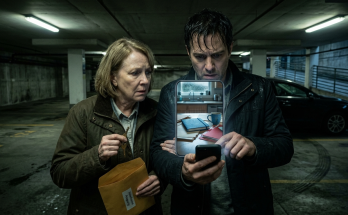
We reached Hartley Cold Storage shortly before four.
Denise had resisted bringing me.
Then Richard asked for me by name.
That changed her decision.
The facility sat behind a chain-link fence on industrial land near the railroad. Its windows had been boarded. Rust streaked the loading doors.
Emergency vehicles lined the road.
Agents moved through the property.
I got out before Robert could open my door.
“Where is he?”
“Ambulance.”
Richard sat inside with a blanket around his shoulders.
His blue jacket was torn.
A bandage covered his forehead.
When he saw me, he looked ashamed.
That was such a Richard expression that I nearly cried.
“You look terrible,” I said.
His mouth twitched.
“You always were sweet.”
I climbed into the ambulance.
Then I hit his shoulder.
Not hard.
Enough.
He winced.
“Ow.”
“That was for twenty years.”
“Fair.”
I hit him again.
“That was for lying about Florida.”
“Sue.”
A third time.
“That was for knowing Sam was alive.”
He caught my wrist.
“I deserve more.”
“Yes.”
Then I hugged him.
For several seconds, we were children again.
Brother and sister.
Before Delaney.
Before Sam disappeared.
Before secrets became the family language.
Richard shook against me.
“I’m sorry.”
I pulled back.
“You’re going to spend the rest of your life proving that sentence.”
“If I have one.”
“You do.”
I looked at his injury.
“What happened?”
“Calder’s men grabbed me outside Savannah.”
“Calder himself?”
“No.”
“Then who called me?”
“He was there later.”
“Here?”
Richard nodded.
“He left before agents arrived.”
“Where?”
“I don’t know.”
Denise entered the ambulance.
“Richard, we need you to explain the second person.”
He looked at me.
That strange expression returned.
“Sue.”
“What?”
“There’s something Dad never told us.”
I felt tired before he even finished.
“Of course there is.”
“He wasn’t working alone.”
“With Sam?”
“No.”
“With who?”
Richard looked outside.
A woman stood near one of the federal vehicles.
She was in her seventies.
Silver hair.
Straight posture.
She looked vaguely familiar.
Not enough to place.
Then she turned toward me fully.
I knew the eyes.
My mother’s eyes.
I stared.
“Who is she?”
Richard whispered, “Dad’s sister.”
“My father didn’t have a sister.”
“Yes, he did.”
“No.”
“He did.”
I climbed out of the ambulance.
The woman approached.
“Susan.”
Everyone in my life had apparently been practicing saying my name after decades of silence.
“Who are you?”
“Margaret Parker.”
My father’s last name.
“Our father was an only child.”
“That’s what he told you.”
“Why?”
She looked toward Richard.
“Because I was involved with Delaney.”
I almost laughed.
“Of course.”
Margaret flinched.
“I deserve that.”
“I don’t know you.”
“No.”
“Then don’t tell me what you deserve.”
She nodded.
“Fair.”
I looked at Richard.
“You knew about her?”
“Only recently.”
“How recently?”
“Six years.”
“The magical year when everyone in my family decided to rearrange their lives?”
Richard gave a weak smile.
“Pretty much.”
Margaret asked if we could speak somewhere private.
Denise arranged a small office inside the facility.
The room smelled of mold and cold concrete.
We sat around a metal table.
Margaret placed an old leather folder in front of her.
“Your father and I stopped speaking in 1978.”
“Why?”
“Money.”
Naturally.
“Our father inherited part of our grandfather’s machine shop. Frank wanted to keep it. I wanted to sell.”
“What does that have to do with Delaney?”
“I sold my share to Elias Calder’s father.”
I stared.
“Calder’s family knew ours?”
“Yes.”
“For generations?”
“Not intimately. Through business.”
Margaret folded her hands.
“Years later, Elias approached me about investments. Construction. Municipal work.”
“You worked for him.”
“At first.”
“Then?”
“I became his accountant.”
Denise leaned forward.
“For Calder Development?”
“For several companies.”
My chest tightened.
“You helped him steal.”
Margaret did not avoid the word.
“Yes.”
Richard looked down.
At least shame still existed in the Parker bloodline.
“Did Dad know?”
“Eventually.”
“How?”
“He found my signature on county invoices.”
The corruption loop tightened.
Dad discovered his sister.
Richard entered through his heating company.
Sam discovered both through project records.
Our family had not simply been harmed by Delaney.
We were woven through it.
Margaret opened the leather folder.
“Frank confronted me.”
“What did you do?”
“I told him to stay out.”
“Like everyone else.”
“Yes.”
“What happened before he died?”
Her face changed.
“Elias went to see him.”
“I heard the tape.”
“You found it?”
“Yes.”
She closed her eyes.
“I hoped he destroyed those.”
“Why?”
“Because Frank was angry enough to get himself killed.”
The room went silent.
“Was he murdered?”
Margaret looked at me.
“I don’t know.”
That answer felt more honest than reassurance.
“What do you know?”
“After the argument, Frank called me. He said Elias threatened Richard.”
“What threat?”
“That Richard would be prosecuted for the false contracts unless Frank surrendered the copies.”
“What did Dad say?”
“That he would go to the state police.”
“Did he?”
“No.”
“Why?”
“He died that night.”
My heart stopped.
I had always believed Dad died early the next morning.
At home.
My mother found him in the recliner.
“He died the same night?”
“Yes.”
“How do you know?”
Margaret looked at Denise.
“Because I was there.”
I stood.
“No.”
“Susan.”
“You were in our house?”
“After midnight.”
“My mother never said—”
“Your mother knew.”
I stared at her.
“What?”
“Elaine called me.”
My mother.
Another person inside the secret.
I sat because my knees could no longer be trusted.
“Tell me.”
“Your father came home furious. He complained of chest pain. Elaine wanted an ambulance.”
“And?”
“He refused.”
“Typical.”
“Yes.”
Margaret’s eyes filled.
“He asked for me.”
“Why?”
“He wanted the account information.”
“What account information?”
“Calder’s offshore transfers.”
“Did you give it?”
“Yes.”
“Why?”
“Because I was tired.”
Her voice cracked.
“Tired of lying. Tired of helping Elias. Tired of pretending nobody had been hurt.”
“What happened then?”
“Frank wrote down several numbers. Then his chest pain worsened.”
“Why didn’t you call an ambulance?”
“We did.”
I frowned.
“There was never an ambulance at the house.”
“Yes, there was.”
“No.”
“The report was buried.”
Denise leaned forward.
“By whom?”
Margaret whispered, “Leonard.”
Jared’s father.
The lawyer.
“He had contacts in emergency services and county records.”
“Why bury an ambulance call?”
“Because the paramedic noticed something.”
My throat tightened.
“What?”
“Frank had a puncture mark.”
I stared.
“Where?”
“His arm.”
No one spoke.
“From what?”
“We never proved it.”
“Then what did you think?”
Margaret looked directly at me.
“That Elias had visited him earlier.”
I stood again.
“You think Calder injected my father with something?”
“I think someone may have.”
“May have?”
“The autopsy was minimal. Leonard pushed the heart-history explanation.”
“My mother agreed?”
“She was terrified.”
“She let us bury him without telling us?”
“She had already lost him. She thought speaking would put you and Richard at risk.”
I walked away from the table.
That phrase again.
Protecting us.
Always through silence.
Always by deciding ignorance was safety.
Sam stood in the doorway.
He had heard enough.
I pointed at him.
“Don’t.”
He remained where he was.
Richard spoke behind me.
“Sue.”
“Did you know?”
“Not then.”
“When?”
“Six years ago.”
I turned.
“From Margaret?”
“Yes.”
“And you still said nothing.”
“Yes.”
“Why?”
“Because by then Mom was dead. Dad was dead. Sam was gone. I thought telling you would only destroy whatever peace you had.”
I laughed.
“Peace?”
Richard flinched.
“You all keep describing my ignorance as peace.”
He looked down.
I walked back to the table.
“Where are the offshore account numbers?”
Margaret opened the leather folder.
“Here.”
Denise took the pages.
“Why bring these now?”
“Because Calder found me.”
“When?”
“Two weeks ago.”
“What did he want?”
“The ledger.”
“You knew Richard had it.”
“Yes.”
“Did Calder?”
“He suspected.”
Richard continued.
“He took me because Margaret refused to tell him where I’d hidden it.”
I looked at her.
“He kidnapped your nephew.”
She nodded.
“And you stayed with him?”
“No.”
Denise explained.
Margaret had contacted investigators through an attorney but refused to disclose her identity until Richard was recovered.
“Why all the caution?”
Margaret gave a sad smile.
“I spent forty years learning from cautious criminals.”
My phone buzzed.
Paula.
I answered.
“Mom?”
“What?”
“Where are you?”
“Hartley.”
Silence.
Then: “Is Uncle Richard alive?”
“Yes.”
She began crying.
I looked at Richard.
He heard.
“Tell her I’m ugly but alive.”
I almost smiled.
“He says he’s ugly but alive.”
Richard mouthed, always was.
For one absurd second, family felt normal.
Then Paula said, “Mom, Jared’s lawyer called me.”
The room changed.
“Why?”
“He wants me to visit Jared.”
“No.”
“He says Jared has something important.”
Denise held out her hand for the phone.
I put it on speaker.
“What does Jared claim to have?” Denise asked.
Paula hesitated.
“A name.”
“What name?”
“He won’t tell anyone except me.”
I closed my eyes.
Of course.
Another secret.
Another piece of leverage.
Denise asked, “Why you?”
“Because he says it proves Dad lied.”
Sam entered fully.
“What?”
Paula heard him.
“Dad?”
“Yes.”
“Jared says you knew Calder never intended to hurt Mom twenty years ago.”
Sam’s face hardened.
“That’s not true.”
Paula continued.
“He says you didn’t disappear only because of threats.”
I looked at Sam.
His eyes moved away.
That was enough.
“Sam.”
“Susan.”
“What else?”
He rubbed his face.
“Not here.”
I stepped closer.
“There will never again be a place where you get to postpone truth.”
He looked at Richard.
Then Margaret.
Then me.
“I was already planning to leave.”
The sentence was quiet.
It hurt more than shouting.
“What?”
“Before Martin threatened us.”
“Why?”
He took a breath.
“I was having an affair.”
Everything in the room disappeared except his face.
Twenty years.
Threats.
Corruption.
A missing husband.
And beneath all of it, something painfully ordinary.
“You were leaving me.”
“I had considered it.”
“With who?”
Sam closed his eyes.
“Margaret.”
I turned.
My father’s sister looked down.
The woman I had learned existed ten minutes earlier had also been my husband’s lover.
For the first time since Social Security declared me dead, I found myself wishing one impossible thing.
That the computer had been right.
Because being dead sounded easier than discovering another version of my life.