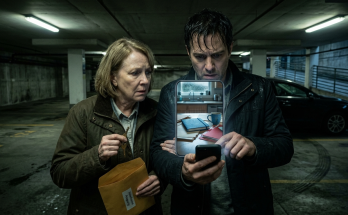
The laboratory results arrived forty-eight hours later.
Officer Grant asked me to come to the station.
I knew before he spoke.
The three tablets inside Dale’s prescription bottle contained the same drug Victor admitted obtaining for Charles.
They were visually similar to Dale’s normal medication.
Same general size.
Same pale color.
Different effect.
The medical examiner reviewing Dale’s records concluded that in someone with his cardiac condition, the substituted drug could produce severe rhythm instability, sudden blood-pressure changes and potentially fatal heart failure.
Eric sat beside me.
“So Charles killed him.”
Ruiz answered carefully.
“The evidence strongly supports the allegation that Charles intentionally substituted medication that contributed to your father’s death.”
Eric looked at her.
“Say it normally.”
Ruiz paused.
Then she did.
“Yes. We believe Charles killed your father.”
I had spent weeks moving toward that sentence.
When it arrived, I felt almost nothing.
Not because it did not matter.
Because some truths are too heavy to produce an immediate reaction.
I remembered Dale standing at the sink.
Dale asleep in his chair.
Dale complaining about hospital coffee.
Dale squeezing my hand.
None of those memories changed because a laboratory identified a chemical.
Yet everything around them did.
Ruiz explained that Melinda’s hidden bottle significantly strengthened the prosecution.
It connected the purchased substance to Dale’s actual prescription container.
Her testimony placed Charles inside the house.
Victor corroborated the substitution.
Thomas corroborated the plan and access.
Charles’s own recordings captured the act.
The medical evidence connected the substituted tablets to Dale’s fatal event.
The case no longer depended on one frightened accomplice.
It formed a chain.
Robert called it what Dale would have wanted.
Proof.
Charles’s attorney requested discussions with prosecutors two days later.
He was no longer pretending the evidence could simply be dismissed.
Ruiz would not discuss negotiations in detail.
But she told us Charles might seek an agreement avoiding a trial.
Eric reacted immediately.
“No.”
Ruiz looked at him.
“You don't control that decision.”
“He killed my father.”
“Yes.”
“He spent thirty-seven years hiding what he did to Raymond.”
“Yes.”
“He tried to steal Hawthorne.”
“Yes.”
“And now he gets to negotiate?”
“Everyone charged with a crime can negotiate.”
Eric stood.
“That isn't justice.”
Robert spoke before Ruiz could.
“Sometimes it is.”
Eric turned on him.
“Your father died because of Charles.”
“I know.”
“And you'd let him make a deal?”
“I'd rather have a guaranteed conviction with decades in prison than gamble everything on making him hear the word guilty in a courtroom.”
Eric stared at him.
Robert continued.
“I have spent my career watching families confuse maximum punishment with maximum certainty.”
The room became quiet.
“This isn't about mercy,” Robert said. “It's about what can be proved, what survives appeal and what finally ends.”
Eric sat again.
I looked at Ruiz.
“What would Dale say?”
She almost smiled.
“I never met your husband.”
“No.”
“But from the files I've read, I suspect he would ask what the evidence supports.”
That sounded painfully accurate.
Charles eventually agreed to plead guilty to Dale’s murder and multiple fraud-related offenses if prosecutors structured several other charges concurrently and resolved parts of the decades-old Raymond case without a separate trial.
Robert struggled with that portion.
“So Raymond becomes paperwork.”
“No,” Ruiz said.
“Then what becomes official?”
Charles would formally admit that he followed Raymond on the bridge road, intentionally drove aggressively beside him and caused the collision that sent Raymond’s vehicle through the barrier.
Because Charles had been a juvenile and because of the age of the case, the legal resolution was complicated.
But the factual admission would become part of the public record.
Robert looked toward Caroline.
She had joined us for the meeting.
“What do you want?”
She stared at the table.
“I want Raymond’s name cleared.”
It was.
The original accident finding was formally reopened.
The investigative record would state that Raymond’s death resulted from another driver’s actions while he was attempting to report financial crimes.
For Caroline, that mattered more than another sentence added to Charles’s imprisonment.
She looked at Robert.
“Your father wasn't reckless.”
“I know.”
“He didn't abandon us.”
“I know.”
“He was coming back.”
Robert’s eyes filled.
“I know.”
Perhaps those two words were what she had survived thirty-seven years to hear.
Thomas accepted a separate plea arrangement.
His cooperation exposed dozens of fraudulent transactions.
He would serve prison time.
Not as much as he might have without cooperation.
Far more than he wanted.
When Grant told him, Thomas reportedly nodded and asked whether Hawthorne would ever be developed.
I almost admired the consistency.
Even facing prison, he still thought about land.
Melinda’s case was harder for me.
Her attorney argued that she had been coerced by Charles and Thomas.
The evidence supported significant coercion.
It also showed voluntary fraud before the threats became severe.
She had stolen from me.
Used Eric’s identity.
Participated in attempts to obtain Hawthorne.
Failed to warn Dale.
Removed evidence after his collapse.
Then preserved that evidence rather than destroying it.
Every fact seemed to point in two directions.
Ruiz asked whether I wanted to submit a victim-impact statement.
I said yes.
Writing it took three days.
My first version was angry.
I deleted it.
The second tried too hard to sound forgiving.
I deleted that too.
The third was true.
I wrote that Melinda had entered our family and accepted our trust while carrying motives she concealed.
She had treated my finances as available because she believed her needs justified taking from me.
She had allowed fear and greed to make decisions that endangered Dale.
She had possessed the chance to warn us and chose silence.
But I also wrote that Charles had deliberately built traps around her, Eric and others.
Acknowledging coercion did not require pretending she had no agency.
Acknowledging her choices did not require pretending she had never been afraid.
I asked the court for accountability.
Not revenge.
Eric read the statement.
“You're kinder than I am.”
“No.”
“You don't hate her.”
“I did for a while.”
“And now?”
“I don't know if hate is useful.”
He considered that.
“I'm not there.”
“You don't have to be.”
His divorce moved forward.
Melinda did not contest it.
She wrote him a letter.
He left it unopened for two weeks.
Then one evening he read it alone.
He never showed me.
I never asked.
That was his boundary.
I was learning.
The money Melinda took from my account was traced.
Some had been spent.
Some recovered.
Her attorney arranged restitution using assets frozen from Northbridge.
Eventually every dollar taken directly from me was restored.
When Dawson showed me the balance, I expected satisfaction.
Instead I thought about the afternoon Melinda sat at my kitchen table and called me selfish.
The money had started everything for me.
Yet it had been one of the smallest numbers in the entire scheme.
The true cost was measured elsewhere.
Dale.
Raymond.
Thirty-seven years Caroline lost with her son.
Eric’s marriage.
Robert’s childhood without his parents.
Children who would eventually learn why their mother disappeared from their daily lives.
No bank statement could reconcile that account.
Hawthorne’s title case moved faster once Charles admitted Arthur’s fraud.
The six-hundred-thousand-dollar loan was formally established as fraudulent.
Arthur’s purported interest collapsed.
Raymond’s trust deed became enforceable.
Robert owned his father’s share.
I held Dale’s.
Fifty-fifty.
Dawson delivered the final determination in his office.
“Congratulations.”
Robert and I looked at each other.
Neither of us reacted.
Dawson smiled.
“That may be the least enthusiastic response I've ever received to acquiring property worth this much.”
“How much now?” I asked.
“Depends what you do.”
There were offers.
Thirty-six million.
Forty-one.
Then forty-five.
The transport authority confirmed preliminary interest in the corridor.
Developers began calling.
Robert turned off his phone.
I unplugged mine.
For one week, we made no decisions.
Then Caroline asked us to meet her at Hawthorne.
She stood near the old Mercer Brothers plaque.
Wind moved through the grass.
Robert helped her across uneven ground.
She looked toward the ruined foundation.
“Raymond loved this place.”
“So did Dale,” I said.
“They were going to build houses here.”
I had never known.
“One for each family,” Caroline continued. “Close enough that their children could walk between them.”
Robert smiled sadly.
“They didn't know whether I'd be a boy or girl.”
“No.”
“And Eric wasn't born yet.”
“No.”
“They planned all that anyway.”
“Yes.”
I looked across the field.
For decades, Hawthorne had been discussed as collateral, leverage, development rights and market value.
But before Arthur Voss turned it into an instrument of fraud, it had been two brothers imagining neighboring homes.
“What happened to that plan?” I asked.
Caroline looked toward the burned building.
“Money.”
One word.
Enough.
That evening, Robert and I made our first decision.
We would not sell Hawthorne to the highest bidder.
Not yet.
Instead, we hired independent planners to evaluate several possibilities.
Part development.
Part conservation.
A memorial area for Raymond and Dale.
Possibly affordable housing on one section.
Robert insisted we make no sentimental promises before understanding costs.
Dale would have liked that.
Weeks passed.
The criminal proceedings moved toward sentencing.
Charles remained in custody.
Thomas too.
Melinda awaited her hearing.
Life became less frantic.
Then Mr. Dawson called me one Tuesday morning.
“I found something.”
I laughed.
“Please stop saying that.”
“For once, it isn't bad.”
He asked me to come to his office.
On his desk lay an envelope.
Dale’s handwriting.
My name.
Again.
“Where was it?”
“In my old estate file.”
“You've had it this whole time?”
“Apparently.”
I stared at him.
“How?”
“Dale put it inside a sealed annual review packet. He wrote instructions on the interior flap.”
“What instructions?”
Dawson turned the packet toward me.
Give Margaret this only after Hawthorne ownership is settled.
My throat tightened.
Dale had anticipated the end.
Not every detail.
But enough.
I opened the envelope.
The letter was longer than the earlier one.
Dale began with an apology.
Not for dying.
For keeping Hawthorne from me.
He wrote that secrecy had begun as temporary protection and become a habit he no longer knew how to undo.
He admitted that was unfair.
I stopped reading.
For weeks, people had explained Dale’s secrecy as love.
Protection.
Necessity.
Dale himself did not.
He called part of it what it was.
A mistake.
I continued.
He wrote about Raymond.
About Caroline.
About Robert.
About Eric.
He said he feared telling me because once I knew, Charles might use me to reach the others.
But he also admitted another truth.
He had been ashamed.
Ashamed that his family’s history contained fraud, betrayal and Raymond’s death.
Ashamed that he had failed to prove it sooner.
Ashamed that he had allowed Hawthorne to become the organizing secret of our marriage.
Tears blurred the page.
Then Dale wrote about me.
He said I had spent forty-two years believing our marriage was ordinary.
In most important ways, he wrote, it was.
Morning coffee.
Bills.
Arguments about paint.
Eric’s childhood.
Vacations we could barely afford.
The garden he always planted too early.
Those things were not less real because he had hidden Hawthorne.
But the hiding was real too.
He asked me not to turn him into either a hero or a liar.
He had been both brave and afraid.
Both protective and controlling.
Both right and wrong.
Human.
I pressed the letter against the table.
Dawson looked away to give me privacy.
The final page concerned the land.
Dale did not tell me what to do with it.
He explicitly refused.
If Hawthorne became mine and Robert’s, the decision belonged to the living.
Then he wrote one request.
Not a legal instruction.
A request.
Do not keep Hawthorne because I died for it.
I read that sentence several times.
Dale continued.
If keeping the land made our lives smaller, sell it.
If selling it served only greed, keep it.
If some better use existed, find it.
But do not allow guilt toward Raymond, anger toward Charles or loyalty to Dale to make the decision.
The dead had already controlled Hawthorne long enough.
I cried then.
Not dramatically.
No collapse.
Just tears falling onto a letter written by the man I had spent months trying to reconstruct from clues.
His final lines were about the back window.
He apologized for making the hint so obscure.
He had become suspicious that Charles might be watching communications.
He hoped I would remember.
Then one final sentence.
Margaret, after this is finished, please live somewhere that does not require you to look for hidden compartments.
I laughed through tears.
That sounded like him.
Dawson smiled.
“What did he say?”
“That my husband was finally tired of secrets.”
I folded the letter.
That evening, I took it to Hawthorne.
Robert met me there.
Eric came too.
Caroline arrived shortly before sunset.
I read Dale’s letter aloud.
Nobody interrupted.
When I finished, Robert walked toward the old Mercer Brothers plaque.
“The dead have controlled Hawthorne long enough.”
“Yes.”
“That sounds like Dale.”
“It does.”
Eric looked across the land.
“What are you going to do?”
I corrected him.
“What are we going to do?”
Robert looked at me.
For the first time, the question did not feel like a burden.
It felt like permission.
We did not need to protect Hawthorne from Charles anymore.
We did not need to preserve every acre because Raymond had died.
We did not need to sell because developers offered numbers too large to imagine.
The criminal case would continue.
Sentencing still waited.
Melinda’s future remained unresolved.
Eric and his children still had difficult years ahead.
Robert and Caroline were only beginning to learn how to be mother and son.
And I was still learning who I was without Dale.
But the central secret of Hawthorne had finally reached its end.
The land belonged to the people Raymond and Dale had tried to protect.
What happened next would not be decided by Arthur Voss.
Not by Charles.
Not by Thomas.
Not by Melinda’s desperation.
Not even by Dale’s wishes.
For the first time in nearly four decades, Hawthorne’s future belonged entirely to the living.
And I intended to make sure we chose it in daylight.