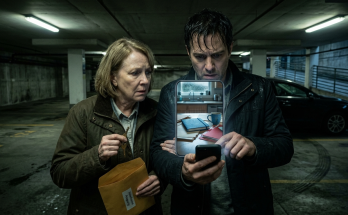
Paula hit the concrete hard.
For a second, I believed she had been shot.
I dropped beside her.
“Paula.”
She rolled onto her side, gasping.
“Mom.”
“Where are you hit?”
“I’m not.”
I ran my hands over her arms, shoulders, stomach.
No blood.
Behind us, agents shouted commands.
Martin lay facedown on the warehouse floor with two officers restraining him. His gun had skidded beneath a metal shelf.
The bullet had struck a support column.
Jared sat against the wall with both hands raised.
One of Martin’s men was bleeding from the forehead.
The other lay handcuffed near the loading door.
Paula grabbed my wrist.
“I’m okay.”
I looked at her face.
She was terrified.
But alive.
I pulled her against me.
For several seconds, everything else disappeared.
Not the forged documents.
Not the lies.
Not the three years of stolen money.
My daughter was alive.
Then I saw Sam coming down the catwalk stairs.
Something inside me tightened again.
He reached us.
“Paula.”
She looked at him.
“Dad.”
The word still sounded wrong after twenty years.
Sam dropped to his knees beside us.
Paula reached for him.
I moved back.
Not far.
Enough.
There were too many kinds of love in that warehouse and none of them were simple.
Denise approached.
“We need everyone separated.”
Paula looked frightened.
“I’m being arrested?”
“We need statements.”
“That isn’t what I asked.”
Denise held her gaze.
“Your involvement in the fraud is under investigation.”
Paula closed her eyes.
Sam stood.
“She cooperated.”
Denise looked at him.
“Today.”
“She was manipulated.”
“Mr. Miller.”
“She’s my daughter.”
“And she’s an adult.”
His face hardened.
I heard my own earlier words in Denise’s response.
No one would be allowed to make Paula a child simply because accountability hurt.
Paramedics checked us outside.
The shot left my ears ringing for nearly an hour.
I sat on the back step of an ambulance while an EMT wrapped a blood-pressure cuff around my arm.
“High,” he said.
“I’ve had a complicated morning.”
He smiled faintly.
“So I gathered.”
Across the lot, Martin Vale was placed into a federal vehicle.
He looked at me before entering.
There was no remorse in his face.
Only calculation.
Men like Martin, I realized, did not experience consequences as moral judgment.
They experienced them as tactical setbacks.
Jared was taken separately.
Paula was driven to the federal building for questioning.
Sam asked to ride with me.
“No.”
“Susan.”
“No.”
He looked tired.
Older.
Still not entitled to my comfort.
At the federal office, Denise placed me in a small interview room with a glass of water.
She returned an hour later.
“Paula is cooperating.”
“What does that mean for her?”
“It means cooperation will matter.”
“But she could still be charged.”
“Yes.”
I looked down.
Denise sat across from me.
“You don’t have to solve that today.”
“I’m her mother. Of course I do.”
“No. The law will decide what the law decides. You decide what relationship you want with her afterward.”
Afterward.
The word felt impossibly distant.
“What about Jared?”
“He asked for an attorney.”
“Of course.”
“But before the attorney arrived, he said something important.”
“What?”
“He said your death status was originally supposed to last only long enough to open accounts.”
I stared at her.
“That sentence is insane.”
“I agree.”
“How does someone become temporarily dead?”
“Fraudsters often assume systems can be corrected later.”
“Systems.”
I hated that word too.
“What changed?”
“Money.”
I laughed bitterly.
“It always comes back to money.”
“Jared discovered that maintaining the deceased status helped conceal transfers. Once the accounts were established, he kept it going.”
“Paula knew?”
“We’re determining that.”
I looked through the narrow window in the door.
“Can I see her?”
“Not yet.”
Instead, I saw Sam.
He stood at the far end of the hallway speaking with Robert.
There was something almost cruel about having my family returned to me all at once after years of absence and secrecy.
A husband.
A daughter I thought I knew.
A son-in-law I clearly never had.
By late afternoon, Denise returned with the preliminary contents of the flash drive.
“The records are extensive.”
“How extensive?”
“Enough to support charges beyond what happened to you.”
“Against Martin?”
“And potentially other people.”
“Anyone I know?”
“Not personally, based on what we’ve reviewed so far.”
I felt a strange relief.
I had begun to expect every name to belong to someone who had eaten at my table.
“What happens to my Social Security record?”
“We’re correcting it.”
“How long?”
“Hopefully days, not months.”
“Hopefully.”
She gave me a tired look.
“I know.”
“I’ve been dead for three years. I’m becoming impatient with hopeful.”
That earned the smallest smile.
“There’s something else.”
Of course there was.
“There’s always something else.”
“Your name wasn’t selected at random for the fraud.”
“I assumed that.”
“Jared targeted your record because Sam’s status created a way to disguise certain payments.”
“Explain.”
“Sam had been living under variations of his legal identity for years. Jared discovered that combining old spousal records, death reporting, and false beneficiary information created financial channels that looked legitimate long enough to move money.”
“In English.”
“He used our marriage.”
“Yes.”
That hurt differently.
Even after twenty years apart, the government still remembered Sam and me as connected.
Jared had turned that connection into a tool.
“What money was he moving?”
“Some came from benefits fraud. Some came from Sam’s payments. Some may have originated from accounts tied to Martin’s old network.”
I sat back.
“So Jared wasn’t only stealing from me.”
“No.”
“He was laundering money.”
“Potentially.”
“And Paula?”
Denise hesitated.
“She signed documents.”
“That isn’t what I asked.”
“She says Jared told her the accounts were for hiding money from Martin.”
I stared at her.
“Did she believe him?”
“I can’t answer that.”
But I could.
At least partly.
Paula had wanted to believe.
There was a difference between believing a lie and choosing not to examine one too closely.
My daughter had done the second.
Around six, Denise finally allowed Paula into the room.
She looked smaller than she had that morning.
No makeup.
Hair pulled back.
A bruise forming near her elbow from the fall.
She sat across from me.
Neither of us spoke.
Finally she said, “I’m sorry.”
I felt tired.
Too tired for easy words.
“Tell me what you did.”
Her eyes filled.
“I already told investigators.”
“I’m not an investigator.”
She looked down.
“I helped Jared request your replacement Social Security card.”
“I know.”
“I copied your driver’s license.”
“I know.”
“I signed your name.”
“I know.”
Her voice cracked.
“I submitted paperwork saying you had died.”
That was new.
I went still.
“You did it yourself?”
“Jared filled most of it out.”
“But you submitted it.”
“Yes.”
“Why?”
“He said we needed to create a temporary record so the accounts could be transferred without Martin finding Dad.”
The explanation was so foolish I almost became angry again.
Then I saw her face.
She knew how foolish it sounded.
“Did you know money would be taken?”
“At first, I thought it was Dad’s money.”
“At first.”
She nodded.
“When did you learn benefits were involved?”
“About six months later.”
“And you said nothing.”
“No.”
“Why?”
“Because Jared told me fixing it would expose everything. Dad. Martin. The accounts. Me.”
“So you chose yourself.”
Paula flinched.
“Yes.”
I had not expected agreement.
“Yes,” she repeated. “I chose myself.”
Tears rolled down her face.
“I kept telling myself I was protecting Dad. Then I told myself I was protecting you because if Martin found out Dad had returned, he might hurt you. Then I said I was protecting the kids.”
I looked at her.
“You don’t have children.”
She closed her eyes.
“I know.”
That frightened me.
“What do you mean?”
“I was pregnant.”
The room went quiet.
“When?”
“Three years ago.”
I had not known.
“I lost it.”
My anger shifted but did not disappear.
“Why didn’t you tell me?”
“Because everything was already falling apart.”
She wiped her face.
“Jared’s business was failing. Dad had come back. Martin’s name started appearing in the papers Jared found. Then I miscarried.”
Her shoulders shook.
“I couldn’t handle one more thing.”
I remembered that autumn.
Paula had looked tired.
She told me she had the flu for several days.
I had brought soup to her house.
She did not let me inside.
Another memory rewritten.
“I’m sorry you went through that alone.”
She looked at me.
“I wasn’t alone.”
“No.”
The word came out harder than I intended.
“You had Jared. You had Sam.”
She lowered her head.
“You had everyone except me.”
That was the wound beneath the fraud.
Money could be restored.
Records could be corrected.
But my daughter had built an entire hidden life around the father who abandoned us, and I had been standing outside it.
“Why didn’t you tell me Sam was alive?”
“Because he asked me not to.”
I almost laughed.
“And you obeyed?”
“He said Martin might still be watching.”
“For three years?”
“At first I believed him.”
“And later?”
She looked toward the door.
“Later I was afraid you’d hate me.”
“So you waited until I discovered I was legally dead.”
“I know.”
“No, Paula. Stop saying that. You don’t know what it feels like to walk into an office and have a stranger tell you your life has been erased while your daughter already knows why.”
She covered her face.
I let her cry.
I did not comfort her.
Not because I enjoyed her pain.
Because comfort given too early can become another way of avoiding truth.
After several minutes, she lowered her hands.
“There’s one more thing.”
My stomach tightened.
“What?”
“Jared didn’t come up with the death-record idea.”
“Who did?”
She looked toward the mirrored observation window.
“Dad.”
For a second, I thought I had misheard.
“Sam?”
“He mentioned years ago that Martin’s people sometimes created false death records for witnesses or employees they needed to disappear.”
I stood.
“You said Jared did this.”
“He did.”
“But Sam gave him the idea?”
“Not intentionally.”
“That phrase is becoming very popular in this family.”
“He told us about what Martin used to do. Jared realized the same process could be used on you.”
I moved toward the door.
“Where is Sam?”
“Mom.”
“Where is he?”
Paula stood.
“Please don’t think Dad wanted this.”
“I don’t care what he wanted.”
I opened the door.
Sam sat in the hallway.
He looked up.
One glance at my face told him what Paula had revealed.
“Susan.”
“You knew how to erase someone.”
His face changed.
“I knew how Martin had done it before.”
“You told Jared.”
“I told Paula what happened twenty years ago.”
“And Jared heard.”
“Yes.”
“You planted the idea.”
“No.”
“You brought the poison into my house and now you want me to admire you for helping clean it up.”
He stood.
“I never wanted any of this.”
“Neither did I.”
Robert appeared at the end of the hall.
Before either of us could speak again, he approached quickly.
“We found something in Leonard Thompson’s archived files.”
Denise came behind him.
She held a printed photograph.
“I think you both need to see this.”
She placed it on the table.
The image was old.
Twenty years old.
Sam recognized it immediately.
I saw his face lose color.
Three men stood outside Delaney Municipal Contracting.
Martin Vale.
Leonard Thompson.
And a third man.
Paula came closer.
“Who is that?”
Sam stared at the photograph.
Then he whispered a name I had not heard in years.
“Richard Parker.”
My brother.